Servant Evangelism -- a new way of life
I ran across a website that has great examples of servant evangelism. I would really like us to consider doing some of these to reach those in our community for Christ. Pray about this and see what the Holy Spirit says to your heart.
I have a story attached below that sums up what servant evangelism is all about. If you are interested in the website, you can get there by clicking here.
Greg
----------------------------------------------------------------
Acts of Kindness Show God's Love
By the Editors of Religion Today
Unexpected acts of kindness are surprising and delighting people and leading them to Christ.
...Christians are giving away soft drinks at intersections and mall parking lots, washing cars, cleaning toilets, shining shoes, grilling hot dogs in parks — all for free with no strings attached. Others are picking up trash, tutoring on college campuses, feeding parking meters, buying ice cream for customers at a sweet shop, and returning grocery carts, among other things.
...Steve Sjogren got involved in "servant evangelism" out of frustration, he told Religion Today. Sjogren, pastor of Vineyard Community Church in Cincinnati, found people in the Midwestern city to be quite conservative. "Cincinnati is where men wear both suspenders and belts," said Sjogren, (pronounced SHOW-grin). "They think that if it is fun it must be bad."
...Cincinnati residents, many of whom are Roman Catholic, also are "very skeptical and resistant to traditional evangelism," Sjogren said. In preparation for starting a church, he canvassed neighborhoods, talking with 1,500 people in two years, and got practically nowhere. "I hit a brick wall."
...He then learned from a survey that less than 10% of Christians have the spiritual gift of evangelism, but 90% have the gift of serving. "I wondered if Servant Evangelism would be possible. I believed that if people were served, they would be curious and probably ask questions. I figured that most people could answer questions about their faith."
...Sjogren’s small church started holding free car washes. Members constructed big banners making it clear that the wash and rinse was absolutely free and that the church would not accept donations. "Some people thought they must be on Candid Camera," Sjogren said. "We had everything from a mom in a rusted station wagon to a businessman in a DeLorean."
...The effort was a lot of fun, Sjogren said. What was most amazing was that "those who served actually broke out of their shell — they broke free from their own personal Christian ghetto. People were amazed that they could actually do something for Christ. There was an atmosphere of courage, relevancy, and excitement. They were thinking, ‘Even if I am a wheel washer, I am useful to the Body of Christ.’"
...Eventually, though not initially, many people who had been touched by the outreaches responded by coming to church, Sjogren said. Excitement and fun grew. Congregates knew "they could have a purpose and a place. People knew they had a value." The church tripled in size within a year, and now has 4,000 attending.
..."A very important thing to note is that we don’t do Servant Evangelism to grow our church," Sjogren said. "We do it because the Spirit of Christ is in us and compels us to acts of love and compassion. If you do Servant Evangelism for the purpose of growing your church, you violate His Spirit. You serve because the Spirit of Christ is in you." Often several churches join together in a Servant Evangelism outreach so that God, not an individual church, gets the glory and attention.
...Most people are surprised by free acts of kindness, Sjogren said. People who don’t go to church are "almost always impacted positively. They say things like, ‘I always thought this is what the church should be doing.’"
...Christians are more skeptical, he said. "Many times they ask, ‘Why are you doing this?’ When they are told we are sharing Christ’s love, they ask, ‘What are you really trying to do?’ "
...One girl who offered free cookies said it made her sad when people repeatedly turned her down and made her realize how God must feel when people reject His free gift of salvation.
...Sjogren spends about half his time serving and half "getting people excited that they can actually do this," he said. He has written the book Conspiracy of Kindness (Vine Books) and often is invited to talk about Servant Evangelism. He and others are planning a Kindness Explosion weekend in Nashville in September and one in Manchester, England in the spring. A group from the church will be doing acts of kindness in Gisborne, New Zealand, "the first spot in the world for the new millennium," on New Year’s Day. Secular and Christian events will be held there; and the site probably will receive a lot of coverage from the world media, he said.
..."We’re just trying to show people what God’s love is like, free and with no strings attached," said Mark Daniels, pastor of Friendship Church, a Lutheran congregation in Ohio that undertakes weekly Kindness Outreaches. "It’s sort of a mind-blower for people; and that’s the way God’s love of us is, free and always mind-blowing."
Sunday, May 23, 2004
Saturday, May 22, 2004
What Christians Believe?
What do Christians really believe? Do we really believe what we say we believe, or do our actions show otherwise? For instance, consider the orthodox Christian belief that Christianity is the only way to heaven (e.g. Jesus saying He is THE way, The truth, and THE life). According to Christian researcher George Barna, 26% of born-again believers believe that all religions are essentially the same and 50% believe that a life of good works will enable a person to get to heaven! More than one in three (35%) born-again Christians do not believe that Jesus physically rose from the dead. [Mr. Barna defines "born-again Christians" as those who report having made a personal commitment to Christ and expect to get to heaven because they accepted Jesus.]
According to an editorial by Gene Edward Veith in World Magazine, these beliefs are strong evidence of how American Christianity is conforming to the dominant secular culture. We can believe what we want provided we don't impose our views on others. If we do that, we run the risk of being labeled as an "intolerant menace to society."
Mr. Veith goes on to say, "Preachers sometimes exhort people to 'invite Jesus into your heart' without proclaiming who Jesus is and what He has done for sinners. This is evangelism that forgets to preach the gospel. The result will be 'nonevangelical born-agains.' New Christians, like babies, need to be fed, taught, and cared for; otherwise, they will die in their cribs. They need intensive nourishment from the Word of God."
The conformation of our church to the culture and the lack of adherence to biblical beliefs by a large percentage of those defined as "born-again Christians" is frightening. We must buck those trends in our own lives and in the lives of our churches. Disciple those new Christians around you and promote a lifestyle in agreement with Biblical beliefs.
What do Christians really believe? Do we really believe what we say we believe, or do our actions show otherwise? For instance, consider the orthodox Christian belief that Christianity is the only way to heaven (e.g. Jesus saying He is THE way, The truth, and THE life). According to Christian researcher George Barna, 26% of born-again believers believe that all religions are essentially the same and 50% believe that a life of good works will enable a person to get to heaven! More than one in three (35%) born-again Christians do not believe that Jesus physically rose from the dead. [Mr. Barna defines "born-again Christians" as those who report having made a personal commitment to Christ and expect to get to heaven because they accepted Jesus.]
According to an editorial by Gene Edward Veith in World Magazine, these beliefs are strong evidence of how American Christianity is conforming to the dominant secular culture. We can believe what we want provided we don't impose our views on others. If we do that, we run the risk of being labeled as an "intolerant menace to society."
Mr. Veith goes on to say, "Preachers sometimes exhort people to 'invite Jesus into your heart' without proclaiming who Jesus is and what He has done for sinners. This is evangelism that forgets to preach the gospel. The result will be 'nonevangelical born-agains.' New Christians, like babies, need to be fed, taught, and cared for; otherwise, they will die in their cribs. They need intensive nourishment from the Word of God."
The conformation of our church to the culture and the lack of adherence to biblical beliefs by a large percentage of those defined as "born-again Christians" is frightening. We must buck those trends in our own lives and in the lives of our churches. Disciple those new Christians around you and promote a lifestyle in agreement with Biblical beliefs.
Friday, May 21, 2004
Democratic Nomination Not a Sure Thing
For some time now I have been following the presidential political scene as it has played out over the primaries and beyond. I have been reading other bloggers and reading political news, and others have suggested (and I agree with them) that Sen. John Kerry may NOT be the democratic nominee for president, despite winning the required number of delegates for nomination.
According to reports and commentaries I have read, the current thinking in the Democratic party is that Sen Kerry will be unable to beat President Bush in a head-to-head election in November, especially with Ralph Nader in the mix drawing off some liberal voters. Some have suggested that the Democratic Convention would be an open convention, and that the Democratic nominee for President would be elected from the floor at that time. It might be Senator Kerry, or it might be another candidate who the party mainliners feel would be more competitive against Bush in November.
These rumors have now taken on more credibility with the CNN report from today, "Kerry considers postponing acceptance of nomination." Read the story. Read what other bloggers and commentators and political pundits are saying. And see what you think. Regardless, this year's presidential election is shaping up to be more exciting than the last.
For some time now I have been following the presidential political scene as it has played out over the primaries and beyond. I have been reading other bloggers and reading political news, and others have suggested (and I agree with them) that Sen. John Kerry may NOT be the democratic nominee for president, despite winning the required number of delegates for nomination.
According to reports and commentaries I have read, the current thinking in the Democratic party is that Sen Kerry will be unable to beat President Bush in a head-to-head election in November, especially with Ralph Nader in the mix drawing off some liberal voters. Some have suggested that the Democratic Convention would be an open convention, and that the Democratic nominee for President would be elected from the floor at that time. It might be Senator Kerry, or it might be another candidate who the party mainliners feel would be more competitive against Bush in November.
These rumors have now taken on more credibility with the CNN report from today, "Kerry considers postponing acceptance of nomination." Read the story. Read what other bloggers and commentators and political pundits are saying. And see what you think. Regardless, this year's presidential election is shaping up to be more exciting than the last.
God's Remedy for Sin
(From Experiencing God by Henry Blackaby and Claude King)
* Humble yourself. Do not try to justify yourself. Do not hold onto pride.
* Pray. God hears the prayer of repentance.
* Confess your sin to God. Agree with Him that it is wrong. Confess to all who have been directly affected by your sin and ask for their forgiveness (Matt. 5:23-24)
* Repent. Turn away from your sinful ways and return to God and His ways.
* Seek God's face. Seek to renew fellowship with God. Talk to Him. LIsten for His voice.
* If your sin has been an ongoing problem, confess the sin to one or more Christian friends and ask them to pray for you to be set free from sin's bondage (Jas 5:16).
* Grieve. Ask God to help you understand how He feels about your sin. His desire is that you feel grief. When your heart is broken over your sin, you will be less likely to ever repeat the offense (Ps. 51:17).
* Submit yourself to God. Resist the devil. Purify your heart (Jas. 4:7-10).
* Submit yourself to God. Resist the devil. Purify your heart (Jas 4:7-10).
* Claim the promises of forgiveness, cleansing, and healing (2 Chron 7:14; 1 John 1:9).
* Then live in the victory Jesus gives through His resurrection power.
(From Experiencing God by Henry Blackaby and Claude King)
* Humble yourself. Do not try to justify yourself. Do not hold onto pride.
* Pray. God hears the prayer of repentance.
* Confess your sin to God. Agree with Him that it is wrong. Confess to all who have been directly affected by your sin and ask for their forgiveness (Matt. 5:23-24)
* Repent. Turn away from your sinful ways and return to God and His ways.
* Seek God's face. Seek to renew fellowship with God. Talk to Him. LIsten for His voice.
* If your sin has been an ongoing problem, confess the sin to one or more Christian friends and ask them to pray for you to be set free from sin's bondage (Jas 5:16).
* Grieve. Ask God to help you understand how He feels about your sin. His desire is that you feel grief. When your heart is broken over your sin, you will be less likely to ever repeat the offense (Ps. 51:17).
* Submit yourself to God. Resist the devil. Purify your heart (Jas. 4:7-10).
* Submit yourself to God. Resist the devil. Purify your heart (Jas 4:7-10).
* Claim the promises of forgiveness, cleansing, and healing (2 Chron 7:14; 1 John 1:9).
* Then live in the victory Jesus gives through His resurrection power.
Tuesday, May 18, 2004
Pres. Bush and Same Sex Marriages
President Bush called again for a constitutional amendment to protect marriage in the United States today as same-sex marriages became legal in the state of Massachusett's.
As reported by CNN, President Bush offered the following written statement:
"The sacred institution of marriage should not be redefined by a few activist judges. All Americans have a right to be heard in this debate," the president said in a written statement.
"I called on the Congress to pass, and to send to the states for ratification, an amendment to our Constitution defining and protecting marriage as a union of a man and a woman as husband and wife. The need for that amendment is still urgent, and I repeat that call today."
President Bush called again for a constitutional amendment to protect marriage in the United States today as same-sex marriages became legal in the state of Massachusett's.
As reported by CNN, President Bush offered the following written statement:
"The sacred institution of marriage should not be redefined by a few activist judges. All Americans have a right to be heard in this debate," the president said in a written statement.
"I called on the Congress to pass, and to send to the states for ratification, an amendment to our Constitution defining and protecting marriage as a union of a man and a woman as husband and wife. The need for that amendment is still urgent, and I repeat that call today."
Britney Spears Revisited
After reflecting on my post on Britney Spears and the questions that I raised about how we can positively influence our children to choose right and not wrong, I have reaffirmed my Christian convictions in this area. When Jesus prayed in the Garden of Gethsemane on the night in which He was betrayed, He specifically said that He was not praying that we would be taken out of the world, but that we would be protected in the world. Christians, then, are to be IN the world, but not OF the world. In other words, we are to be islands of sanity and truth in a world gone mad, a light on a hill that leads others to safety.
How can we steer our children towards the truth and not the moral wrongs promoted by the culture and their prime billboard, Britney Spears? By instilling in our children a desire to know Jesus and to receive Him as Lord and Savior. By demonstrating to them through our life and our words that it is better to choose right than to live wrong.
The experience of a Christian is that of a new creation. When we are saved, the Holy Spirit begins His work to sanctify us from the inside out. It is this cleansing presence in us that protects us from the garbage of the world. The answer is not to isolate ourselves or our children from the things outside, but to worry about what is inside ourselves. Hence Jesus' statement in Mark 7:18-20, "'Don't you see that nothing that enters a man from the ouside can make him 'unclean?' For it doesn't go into his heart but into his stomach and then out of his body (in saying this Jesus delcared all foods clean)'. He went on, 'What comes out of a man is what makes him unclean.'" If we are clean on the inside, then we don't have to worry about the influences of this world.
After reflecting on my post on Britney Spears and the questions that I raised about how we can positively influence our children to choose right and not wrong, I have reaffirmed my Christian convictions in this area. When Jesus prayed in the Garden of Gethsemane on the night in which He was betrayed, He specifically said that He was not praying that we would be taken out of the world, but that we would be protected in the world. Christians, then, are to be IN the world, but not OF the world. In other words, we are to be islands of sanity and truth in a world gone mad, a light on a hill that leads others to safety.
How can we steer our children towards the truth and not the moral wrongs promoted by the culture and their prime billboard, Britney Spears? By instilling in our children a desire to know Jesus and to receive Him as Lord and Savior. By demonstrating to them through our life and our words that it is better to choose right than to live wrong.
The experience of a Christian is that of a new creation. When we are saved, the Holy Spirit begins His work to sanctify us from the inside out. It is this cleansing presence in us that protects us from the garbage of the world. The answer is not to isolate ourselves or our children from the things outside, but to worry about what is inside ourselves. Hence Jesus' statement in Mark 7:18-20, "'Don't you see that nothing that enters a man from the ouside can make him 'unclean?' For it doesn't go into his heart but into his stomach and then out of his body (in saying this Jesus delcared all foods clean)'. He went on, 'What comes out of a man is what makes him unclean.'" If we are clean on the inside, then we don't have to worry about the influences of this world.
Monday, May 17, 2004
Christian Singer Sounds Off About Britney Spears
CNN reports that Rebecca St. James, a grammy-award winning contemporary Christian singer, who preaches a message of abstinence from sex until marriage, says "she feels sorry for Britney Spears who herself once famously vowed to be a virgin until she wed."
Rebecca St. James gave a concert at Wild Adventures last year, and while I really enjoyed her music and the uplifting message that it gave, I was even more impressed with her bold stance for abstinence that she promoted from the stage. She works closely with the "True Love Waits" campaign, and promotes the abstinence message in her songs, her dialogue during concerts, books, and commercials. I think she is a wonderful role model for teens and young adults faced with this temptation.
The big question then, as I see it, is how to help turn our children onto good role models like Rebecca St. James and turn them away from cultural role models like Britney Spears. In spite of the revelation that Britney Spears lied about her virginity (revealed last June), her one-day marriage in Las Vegas to an old high school flame, and her revealing clothing, Britney is still tops on both the charts and in the hearts of young girls everywhere. Girls everywhere want to be like Britney, and they are dressing just like her. Just go to the mall on a weekend and you can see so for yourself.
But, whose fault is this? Is it the fault of the culture and the times we live in, or does the blame lay squarely on parents and the church for failing to promote more positive role models for our children? Perhaps it's time we took a stand and started actively pointing our children towards following the example of women like Rebecca St. James and others like her.
What can we do to make a difference? I don't know. I try all I can to point my daughter into other directions, but the world keeps dragging her back to it (reminds me of the weeds choking out the seed in Jesus' parable). One things for certain, though. If we don't try, we will never win.
CNN reports that Rebecca St. James, a grammy-award winning contemporary Christian singer, who preaches a message of abstinence from sex until marriage, says "she feels sorry for Britney Spears who herself once famously vowed to be a virgin until she wed."
Rebecca St. James gave a concert at Wild Adventures last year, and while I really enjoyed her music and the uplifting message that it gave, I was even more impressed with her bold stance for abstinence that she promoted from the stage. She works closely with the "True Love Waits" campaign, and promotes the abstinence message in her songs, her dialogue during concerts, books, and commercials. I think she is a wonderful role model for teens and young adults faced with this temptation.
The big question then, as I see it, is how to help turn our children onto good role models like Rebecca St. James and turn them away from cultural role models like Britney Spears. In spite of the revelation that Britney Spears lied about her virginity (revealed last June), her one-day marriage in Las Vegas to an old high school flame, and her revealing clothing, Britney is still tops on both the charts and in the hearts of young girls everywhere. Girls everywhere want to be like Britney, and they are dressing just like her. Just go to the mall on a weekend and you can see so for yourself.
But, whose fault is this? Is it the fault of the culture and the times we live in, or does the blame lay squarely on parents and the church for failing to promote more positive role models for our children? Perhaps it's time we took a stand and started actively pointing our children towards following the example of women like Rebecca St. James and others like her.
What can we do to make a difference? I don't know. I try all I can to point my daughter into other directions, but the world keeps dragging her back to it (reminds me of the weeds choking out the seed in Jesus' parable). One things for certain, though. If we don't try, we will never win.
United Methodist Church Worship Planning Calendars
I imagine most of you have seen the church worship planning calendars put out by the United Methodist Church. These calendars are great helps because they help you track the Christian seasons (advent, lent, etc.) and give worship helps for both the church and individual use. One great feature of these calendars is that they list the lectionary scriptures for each Sunday. While the lectionary is used by many churches and pastors to plan Sunday worship,it is also a valuable resource for those of you wishing to do at-home or small group Bible studies that will correspond to the Sunday School lessons.
You can access the 2004, 2005, and 2006 calendar by clicking on the respective year. This will open up the UMC General Board of Discipleship webpage for each year.
I imagine most of you have seen the church worship planning calendars put out by the United Methodist Church. These calendars are great helps because they help you track the Christian seasons (advent, lent, etc.) and give worship helps for both the church and individual use. One great feature of these calendars is that they list the lectionary scriptures for each Sunday. While the lectionary is used by many churches and pastors to plan Sunday worship,it is also a valuable resource for those of you wishing to do at-home or small group Bible studies that will correspond to the Sunday School lessons.
You can access the 2004, 2005, and 2006 calendar by clicking on the respective year. This will open up the UMC General Board of Discipleship webpage for each year.
THE DEVIL'S BEATITUDES
1. Blessed are those who are too tired, too busy, too distracted to spend an hour once a week with their fellow Christians --- they are my best workers.
2. Blessed are those Christians who wait to be asked and expect to be thanked --- I can use them.
3. Blessed are those who stop going to church --- they are my missionaries.
4. Blessed are the trouble makers --- they shall be called my children.
5. Blessed are the complainers --- I'm all ears to them.
6. Blessed are those who are bored with the minister's mannerisms and mistakes --- for they get nothing out of his sermons.
7. Blessed is the church member who expects to be invited to his own church --- for he is a part of the problem instead of the solution.
8. Blessed are those who gossip --- for they shall cause strife and divisions that please me.
9. Blessed are those who are easily offended --- for they will soon get angry and quit.
10. Blessed are those who do not give their offering to carry on God's work --- for they are my helpers.
11. Blessed is he who professes to love God but hates his brother and sister --- for he shall be with me forever.
12. Blessed are you who, when you read this think it is about other people and not yourself --- I've got you too!
1. Blessed are those who are too tired, too busy, too distracted to spend an hour once a week with their fellow Christians --- they are my best workers.
2. Blessed are those Christians who wait to be asked and expect to be thanked --- I can use them.
3. Blessed are those who stop going to church --- they are my missionaries.
4. Blessed are the trouble makers --- they shall be called my children.
5. Blessed are the complainers --- I'm all ears to them.
6. Blessed are those who are bored with the minister's mannerisms and mistakes --- for they get nothing out of his sermons.
7. Blessed is the church member who expects to be invited to his own church --- for he is a part of the problem instead of the solution.
8. Blessed are those who gossip --- for they shall cause strife and divisions that please me.
9. Blessed are those who are easily offended --- for they will soon get angry and quit.
10. Blessed are those who do not give their offering to carry on God's work --- for they are my helpers.
11. Blessed is he who professes to love God but hates his brother and sister --- for he shall be with me forever.
12. Blessed are you who, when you read this think it is about other people and not yourself --- I've got you too!
Saturday, May 15, 2004
Parable of the New Soap
Author: Jan Groenveld
http://www.barr-family.com/godsword/soap.htm
Once upon a time in a far-away land, a young man named Joshua announced the discovery of a marvelous new kind of soap.
People were skeptical at first, but they soon found that this new soap made everyone very happy because it got them so clean. Because it was so powerful, it got rid of dirt and stains that had been around for years.
Because Joshua's soap worked so well, men found that they had more time to spend with their wives and children. Marriages got better, people were happier, and everybody admired the young man who had given them the soap. Joshua refused to charge for the soap and gave it away to all who asked for it. This bothered some rich people, but the poor loved it. Not surprisingly, the manufacturers of rival kinds of soap soon became very angry because their business was being hurt badly.
Before long, Joshua had followers who were traveling around the country, giving away the new soap to all who asked for it. Of course, this new soap was an instant success because the people of Joshua's country had been trying for years to make themselves clean with their own homemade soap. Thousands became great fans of the new soap, and they formed small groups to spread its use. The other soap manufacturers became desperate and tried to get Joshua to charge for his soap, but he refused. He said, "I prefer to give it away, because no money would be adequate payment for a soap as perfect and complete as this one is."
When the soap manufacturers found that this strategy wouldn't work, they started a smear campaign against Joshua and his followers. They said that the soap made cleaning too easy - that you should have to work harder to get things clean. They also said that Joshua and his followers were immoral because they had been seen in the company of the dirtiest people in the world. Joshua smiled when he heard these charges, and said, "Although everybody needs soap, it is the dirty people who need the soap the most!" These slanders didn't work because the common people realized that Joshua truly loved them and that is why his soap was free.
Since their other tactics failed, the rival soap manufacturers plotted to kill the young man. They paid an informer to betray Joshua and then arrested him. They paid witnesses to perjure themselves in court, and finally they were able to have Joshua convicted of trumped up "crimes" and executed. The soap manufacturers were certain that this would take care of the problem, but to their dismay Joshua's followers continued to distribute the soap. Persecution of the followers didn't work either, for Joshua's followers kept spreading to new areas and kept giving away the soap.
After many years, the rival manufacturers decided to try the policy of "if you can't beat 'em then join 'em." So they analyzed Joshua's soap and came up with a very clever substitute, which looked the same, but, of course, it didn't work. They used the same name for their soap that Joshua had used and organized a promotion campaign to corner the market. Because of their organization and slick advertising, they made great progress and even got many of Joshua's followers to join them for a while.
Soon, however; these infiltrators started to charge for their counterfeit soap, and, because their distributors had replaced many of Joshua's followers, many people had to buy the soap now - and their substitute didn't really work! However; some people read Joshua's instructions and those of the early users of the soap and discovered how they could get it for free! Because of Joshua's written instructions, down through the centuries there were always groups who distributed Joshua's real soap for free.
After several centuries the leading soap manufacturers decided that they needed a publicity gag to stir up interest in their counterfeit version of the soap, so the started Soap Crusades to go back to Joshua's homeland and try to recover the original bucket in which he had first made the soap. Mighty armies were raised because Joshua's homeland was now in he hands of some people that didn't believe in Joshua's soap. These Soap Crusades resulted in wars and the deaths of thousands of people and much destruction and heartache. Many true followers of Joshua protested against these campaigns, but were killed for their efforts. Finally the Soap Crusades ceased, but they did stir up a lot of interest and sold a lot of the counterfeit soap.
Several centuries later, when soap sales were lagging again, the manufacturers decided to use force to make people buy their soap. They started an intricate system of spies to report on people who didn't use the "right" soap. They also used a group of zealous torturers who called themselves the 'Investigation' to torture people suspected of not using the manufacturers soap. Many people were killed by the Investigation for using Joshua's soap, and yet, Joshua's soap continued to be passed out to all who asked, for free!
After a few more hundred years, a whole new kind of attack on Joshua's soap began. This time the charge was made that Joshua's written instructions were not really reliable. This attack came from two directions.
The first group of attackers said that the instructions were missing some very important parts that the evil rival manufacturers had taken out in centuries past. Various of the attackers claimed that Joshua, himself, had come and appeared to them, giving them special authority to "restore" the lost instructions. Of course, the attackers all had different versions of the "restored" instructions and none of them were even close to being in agreement with each other. In many cases they weren't even in agreement with Joshua's instructions. Even so; they were able to deceive some of the users of Joshua's real soap.
The second group of these attackers used a more "intellectual" attack. They called themselves the "Elevated Critics" who said that the instructions didn't really mean what they said, and certainly they weren't the final authority on how to get clean. They told the people that Joshua was just another good man who had high ideals, but his wasn't the only soap around. So they took the "mythology" out of Joshua's instructions and left an empty shell, which couldn't clean anyone, in its place.
Well, about 2000 years have gone by now, and Joshua's true soap is still available free, and people are still getting clean and being happy. And there are those who try to peddle a similar but counterfeit kind of soap for profit or power. Now, there are some who say you, really, can't get clean, but a little soap is a good thing and everybody ought to have some, but don't go overboard! Others worship books about the original soap, and still others have Joshua's true soap, and have found that only through his power can they become clean.
In our parable, Joshua's soap is the Gospel of Jesus Christ. The Gospel (which means "GOOD NEWS") could not be stamped out by the "rival manufacturers" or anyone else, because it was a MESSAGE, not an earthly system of priesthoods, rites and organizations. The message of God's provision for the gift of eternal life for sinful men has endured even to our day and people are still getting "clean" by submission of their lives to Jesus Christ - ALONE. In spite of many attempts to destroy the Gospel message by eradication of the believers, or perversion of the message itself, the GOOD NEWS of what Jesus Christ did for YOU on His cross remains as viable today as it was on the Resurrection Morning.
* Truth is not always popular, but it is always right.
"For I testify unto every man that heareth the words of the prophecy of this book, If any man shall add unto these things, God shall add unto him the plagues that are written in this book:" - Revelation 22:18
Author: Jan Groenveld
http://www.barr-family.com/godsword/soap.htm
Once upon a time in a far-away land, a young man named Joshua announced the discovery of a marvelous new kind of soap.
People were skeptical at first, but they soon found that this new soap made everyone very happy because it got them so clean. Because it was so powerful, it got rid of dirt and stains that had been around for years.
Because Joshua's soap worked so well, men found that they had more time to spend with their wives and children. Marriages got better, people were happier, and everybody admired the young man who had given them the soap. Joshua refused to charge for the soap and gave it away to all who asked for it. This bothered some rich people, but the poor loved it. Not surprisingly, the manufacturers of rival kinds of soap soon became very angry because their business was being hurt badly.
Before long, Joshua had followers who were traveling around the country, giving away the new soap to all who asked for it. Of course, this new soap was an instant success because the people of Joshua's country had been trying for years to make themselves clean with their own homemade soap. Thousands became great fans of the new soap, and they formed small groups to spread its use. The other soap manufacturers became desperate and tried to get Joshua to charge for his soap, but he refused. He said, "I prefer to give it away, because no money would be adequate payment for a soap as perfect and complete as this one is."
When the soap manufacturers found that this strategy wouldn't work, they started a smear campaign against Joshua and his followers. They said that the soap made cleaning too easy - that you should have to work harder to get things clean. They also said that Joshua and his followers were immoral because they had been seen in the company of the dirtiest people in the world. Joshua smiled when he heard these charges, and said, "Although everybody needs soap, it is the dirty people who need the soap the most!" These slanders didn't work because the common people realized that Joshua truly loved them and that is why his soap was free.
Since their other tactics failed, the rival soap manufacturers plotted to kill the young man. They paid an informer to betray Joshua and then arrested him. They paid witnesses to perjure themselves in court, and finally they were able to have Joshua convicted of trumped up "crimes" and executed. The soap manufacturers were certain that this would take care of the problem, but to their dismay Joshua's followers continued to distribute the soap. Persecution of the followers didn't work either, for Joshua's followers kept spreading to new areas and kept giving away the soap.
After many years, the rival manufacturers decided to try the policy of "if you can't beat 'em then join 'em." So they analyzed Joshua's soap and came up with a very clever substitute, which looked the same, but, of course, it didn't work. They used the same name for their soap that Joshua had used and organized a promotion campaign to corner the market. Because of their organization and slick advertising, they made great progress and even got many of Joshua's followers to join them for a while.
Soon, however; these infiltrators started to charge for their counterfeit soap, and, because their distributors had replaced many of Joshua's followers, many people had to buy the soap now - and their substitute didn't really work! However; some people read Joshua's instructions and those of the early users of the soap and discovered how they could get it for free! Because of Joshua's written instructions, down through the centuries there were always groups who distributed Joshua's real soap for free.
After several centuries the leading soap manufacturers decided that they needed a publicity gag to stir up interest in their counterfeit version of the soap, so the started Soap Crusades to go back to Joshua's homeland and try to recover the original bucket in which he had first made the soap. Mighty armies were raised because Joshua's homeland was now in he hands of some people that didn't believe in Joshua's soap. These Soap Crusades resulted in wars and the deaths of thousands of people and much destruction and heartache. Many true followers of Joshua protested against these campaigns, but were killed for their efforts. Finally the Soap Crusades ceased, but they did stir up a lot of interest and sold a lot of the counterfeit soap.
Several centuries later, when soap sales were lagging again, the manufacturers decided to use force to make people buy their soap. They started an intricate system of spies to report on people who didn't use the "right" soap. They also used a group of zealous torturers who called themselves the 'Investigation' to torture people suspected of not using the manufacturers soap. Many people were killed by the Investigation for using Joshua's soap, and yet, Joshua's soap continued to be passed out to all who asked, for free!
After a few more hundred years, a whole new kind of attack on Joshua's soap began. This time the charge was made that Joshua's written instructions were not really reliable. This attack came from two directions.
The first group of attackers said that the instructions were missing some very important parts that the evil rival manufacturers had taken out in centuries past. Various of the attackers claimed that Joshua, himself, had come and appeared to them, giving them special authority to "restore" the lost instructions. Of course, the attackers all had different versions of the "restored" instructions and none of them were even close to being in agreement with each other. In many cases they weren't even in agreement with Joshua's instructions. Even so; they were able to deceive some of the users of Joshua's real soap.
The second group of these attackers used a more "intellectual" attack. They called themselves the "Elevated Critics" who said that the instructions didn't really mean what they said, and certainly they weren't the final authority on how to get clean. They told the people that Joshua was just another good man who had high ideals, but his wasn't the only soap around. So they took the "mythology" out of Joshua's instructions and left an empty shell, which couldn't clean anyone, in its place.
Well, about 2000 years have gone by now, and Joshua's true soap is still available free, and people are still getting clean and being happy. And there are those who try to peddle a similar but counterfeit kind of soap for profit or power. Now, there are some who say you, really, can't get clean, but a little soap is a good thing and everybody ought to have some, but don't go overboard! Others worship books about the original soap, and still others have Joshua's true soap, and have found that only through his power can they become clean.
In our parable, Joshua's soap is the Gospel of Jesus Christ. The Gospel (which means "GOOD NEWS") could not be stamped out by the "rival manufacturers" or anyone else, because it was a MESSAGE, not an earthly system of priesthoods, rites and organizations. The message of God's provision for the gift of eternal life for sinful men has endured even to our day and people are still getting "clean" by submission of their lives to Jesus Christ - ALONE. In spite of many attempts to destroy the Gospel message by eradication of the believers, or perversion of the message itself, the GOOD NEWS of what Jesus Christ did for YOU on His cross remains as viable today as it was on the Resurrection Morning.
* Truth is not always popular, but it is always right.
"For I testify unto every man that heareth the words of the prophecy of this book, If any man shall add unto these things, God shall add unto him the plagues that are written in this book:" - Revelation 22:18
Friday, May 14, 2004
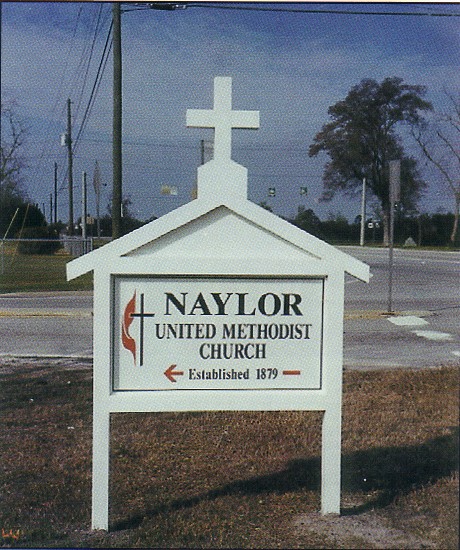
Church Sign for Naylor United Methodist Church

As I learn more about blogs and about this program, I will be able to start posting new items. Just yesterday I learned how to add a link to a post. Today I am attempting to learn how to add pictures to my posts.
For the record, the church sign at Naylor UMC was built by Mr. Robert Tomlinson, a faithful member of our congregation and a skilled woodworker.


******************************************************************
No Excuse Sunday
To make it possible for everyone to attend church next Sunday, we are going to have a special "No Excuse Sunday." Cots will be placed in the foyer for those who say, "Sunday is my only day to sleep in." There will be a special section with lounge chairs for those who feel that our pews are too hard. Eyedrops will be available for those with tired eyes from watching TV late Saturday night. We will have steel helmets for those who say, "The roof would cave in if I ever came to church." Blankets will be furnished for those who think the church is too cold and fans for those who say it is too hot. Scorecards will be available for those who wish to list the hypocrites present. Relatives and friends will be in attendance for those who can't go to church and cook dinner, too. We will distribute "Stamp Out Stewardship" buttons for those who feel that the church is always asking for money.
One section will be devoted to trees and grass for those who like to seek God in nature. Doctors and nurses will be in attendance for those who plan to be sick this Sunday. A big-screen TV will be set up in the fellowship hall for race fans who can't miss the opening flag of the Nascar Race. The Sanctuary will be decorated with Christmas poinsettas and Easter lilies for those who have never seen the church without them. We will provide hearing aids to those who can't hear the preacher and cotton for those who can.
Author Unknown (Printed in Chicken Soup for the Christian Soul)
No Excuse Sunday
To make it possible for everyone to attend church next Sunday, we are going to have a special "No Excuse Sunday." Cots will be placed in the foyer for those who say, "Sunday is my only day to sleep in." There will be a special section with lounge chairs for those who feel that our pews are too hard. Eyedrops will be available for those with tired eyes from watching TV late Saturday night. We will have steel helmets for those who say, "The roof would cave in if I ever came to church." Blankets will be furnished for those who think the church is too cold and fans for those who say it is too hot. Scorecards will be available for those who wish to list the hypocrites present. Relatives and friends will be in attendance for those who can't go to church and cook dinner, too. We will distribute "Stamp Out Stewardship" buttons for those who feel that the church is always asking for money.
One section will be devoted to trees and grass for those who like to seek God in nature. Doctors and nurses will be in attendance for those who plan to be sick this Sunday. A big-screen TV will be set up in the fellowship hall for race fans who can't miss the opening flag of the Nascar Race. The Sanctuary will be decorated with Christmas poinsettas and Easter lilies for those who have never seen the church without them. We will provide hearing aids to those who can't hear the preacher and cotton for those who can.
Author Unknown (Printed in Chicken Soup for the Christian Soul)
Thursday, May 13, 2004
Link to Rev. Dr. Bill Hinson's Talk
Try Clicking HERE to get to his address as mentioned in the earlier post.
Try Clicking HERE to get to his address as mentioned in the earlier post.
***********************************************************************
Splitting the Methodist Church
O.K. Time for me to weigh in on the big news from General Conference, which recently ended in Pittsburgh, PA. I have gotten some additional information from delegates to the event, and now know the true story in regards to the proposed split of the Methodist Church that was bandied about in the news media over the past week.
First, this was NOT an official call for a split and was not the result of a resolution offered on the floor. The mention of a split occurred at the annual breakfast of the Good News organization. Rev. Bill Hinson, the President of the Confessing Movement, suggested the possibility of a split in the future during his address at this breakfast. His comments were then reported on the media as an offical call for a split.
According to the information that I have been able to find, this comment by Rev. Hinson was based on the fact that liberals in the church are gaining more and more ground in pushing forth their homosexual agenda, primarily in two areas -- ordination of gay ministers and same-sex marriages. Rev. Hinson maintains, and I agree, that these views are not compatible with orthodox Christian doctrines or with the underlying doctrines of the United Methodist Church as outlined in our Book of Discipline. So, even though the delegates to General Conference soundly defeated attempts to push through homosexual resolutions this year, the threat is not going to go away.
Here is a direct quote from Rev. Hinson's address to the Good News breakfast attendees:
"We cannot fight both church and culture. Our culture alone confronts us with more challenges than we can humanly speaking confront and challenge. That struggle, combined with the continuous struggle in the church, is more than we can bear. And our people, who have been faithful and patient, should not have to continue to endure our endless conflict. I believe the time has come when we must begin to explore an amicable and just separation that will free us both from our cycle of pain and conflict. Such a just separation will protect the property rights of churches and the pension rights of clergy. It will also free us to reclaim our high calling and to fulfill our mission in the world. Therefore, let us like Paul and Barnabas, agree to go our separate ways."
Thoughts to think on. Jesus said that the world would know we were His through our love and our unity. However, unity cannot be based on false doctrine or incompatible teachings.
If you would like to read the entire address by Rev. Hinson, click on this link:
Splitting the Methodist Church
O.K. Time for me to weigh in on the big news from General Conference, which recently ended in Pittsburgh, PA. I have gotten some additional information from delegates to the event, and now know the true story in regards to the proposed split of the Methodist Church that was bandied about in the news media over the past week.
First, this was NOT an official call for a split and was not the result of a resolution offered on the floor. The mention of a split occurred at the annual breakfast of the Good News organization. Rev. Bill Hinson, the President of the Confessing Movement, suggested the possibility of a split in the future during his address at this breakfast. His comments were then reported on the media as an offical call for a split.
According to the information that I have been able to find, this comment by Rev. Hinson was based on the fact that liberals in the church are gaining more and more ground in pushing forth their homosexual agenda, primarily in two areas -- ordination of gay ministers and same-sex marriages. Rev. Hinson maintains, and I agree, that these views are not compatible with orthodox Christian doctrines or with the underlying doctrines of the United Methodist Church as outlined in our Book of Discipline. So, even though the delegates to General Conference soundly defeated attempts to push through homosexual resolutions this year, the threat is not going to go away.
Here is a direct quote from Rev. Hinson's address to the Good News breakfast attendees:
"We cannot fight both church and culture. Our culture alone confronts us with more challenges than we can humanly speaking confront and challenge. That struggle, combined with the continuous struggle in the church, is more than we can bear. And our people, who have been faithful and patient, should not have to continue to endure our endless conflict. I believe the time has come when we must begin to explore an amicable and just separation that will free us both from our cycle of pain and conflict. Such a just separation will protect the property rights of churches and the pension rights of clergy. It will also free us to reclaim our high calling and to fulfill our mission in the world. Therefore, let us like Paul and Barnabas, agree to go our separate ways."
Thoughts to think on. Jesus said that the world would know we were His through our love and our unity. However, unity cannot be based on false doctrine or incompatible teachings.
If you would like to read the entire address by Rev. Hinson, click on this link:
Monday, May 10, 2004
*****************************************************************
Methodist Church Affirms Its Unity
[From South Georgia Conference -- The Link]
On Friday, May 7, the General Conference overwhelmingly (95%)
approved a resolution expressing our intention to remain in Christian fellowship with one another even through difficult and painful decisions.
The full text of the resolution is below:
As United Methodists we remain in covenant with one another, even in the midst of disagreement, and reaffirm our commitment to work together for our common mission of making disciples of Jesus Christ throughout the world.
This action was in response to inaccurate and misleading news stories reporting a planned split within the United Methodist Church. While there were some informal and unofficial conversations earlier this week, neither the idea of separation nor a plan for separation had been presented on the floor of General Conference or considered in a legislative committee. We
remind you that only The General Conference can speak for the United Methodist Church.
For a detailed article, to download the Unity Resolution or to read the verbatim transcript of Unity Resolution, visit
http://www.sgaumc.com/General%20Conference/Day%2010article%205.htm. (Copy and paste into your browser)
Methodist Church Affirms Its Unity
[From South Georgia Conference -- The Link]
On Friday, May 7, the General Conference overwhelmingly (95%)
approved a resolution expressing our intention to remain in Christian fellowship with one another even through difficult and painful decisions.
The full text of the resolution is below:
As United Methodists we remain in covenant with one another, even in the midst of disagreement, and reaffirm our commitment to work together for our common mission of making disciples of Jesus Christ throughout the world.
This action was in response to inaccurate and misleading news stories reporting a planned split within the United Methodist Church. While there were some informal and unofficial conversations earlier this week, neither the idea of separation nor a plan for separation had been presented on the floor of General Conference or considered in a legislative committee. We
remind you that only The General Conference can speak for the United Methodist Church.
For a detailed article, to download the Unity Resolution or to read the verbatim transcript of Unity Resolution, visit
http://www.sgaumc.com/General%20Conference/Day%2010article%205.htm. (Copy and paste into your browser)
***********************************************************************
UNITY CONCERT!
The local contemporary singing group Unity will be in concert at Messiah Lutheran Church, 500 Baytree Avenue, Valdosta, on 22 May at 7:00 pm. This group performed at Naylor UMC this year and are a dynamic trio who have been gifted by God to bring forth His message through song. They have just released their first CD, and have been getting airplay on Benny Daniel's radio show. Everyone who has heard them expects great things from them.
Please keep this date in mind and share with all who might be interested.
UNITY CONCERT!
The local contemporary singing group Unity will be in concert at Messiah Lutheran Church, 500 Baytree Avenue, Valdosta, on 22 May at 7:00 pm. This group performed at Naylor UMC this year and are a dynamic trio who have been gifted by God to bring forth His message through song. They have just released their first CD, and have been getting airplay on Benny Daniel's radio show. Everyone who has heard them expects great things from them.
Please keep this date in mind and share with all who might be interested.
Sunday, May 09, 2004
**************************************************************
PROTESTANT PASTORS REVEAL BIBLE PREFERENCES
[From Pastors Weekly Briefing, Focus on the Family]
A survey of Protestant ministers finds the New International
Version translation of the Bible is the most popular among pastors
(31%). The poll, conducted by Ellison Research, found that other
personal favorites included the King James Version (23%), New Revised
Standard Version (14%), New King James Version (13%) and New American
Standard Version (10%).
According to the research, ministers tend to select their favorite
versions based on perceived accuracy (40%), readability (16%),
language style (14%) and solid reputation (13%).
Pastors of small churches, those over 60 years of age and those in
the South lean toward the King James Version. The New International
Version is strongest in the Midwest and West, while the New Revised
Standard Version scored best in the Northeast.
When asked which Bible versions they would be least likely to
recommend to their congregations, they listed the Living Bible (26%),
Today's New International Version (18%), The Message (15%) and the
King James Version (15%).
NOTE: I would concur with this list wholeheartedly. I prefer the NIV because I think it is accurate and is the easiest to read and understand. I also do not recommend paraphrases to the congregation such as the Living Bible or The Message for Bible study or Sunday morning worship. These paraphrases are good when used in concert with a good translation (such as the NIV), but offer too much bias and writer-interpretation to gain an accurate understanding of passages.
PROTESTANT PASTORS REVEAL BIBLE PREFERENCES
[From Pastors Weekly Briefing, Focus on the Family]
A survey of Protestant ministers finds the New International
Version translation of the Bible is the most popular among pastors
(31%). The poll, conducted by Ellison Research, found that other
personal favorites included the King James Version (23%), New Revised
Standard Version (14%), New King James Version (13%) and New American
Standard Version (10%).
According to the research, ministers tend to select their favorite
versions based on perceived accuracy (40%), readability (16%),
language style (14%) and solid reputation (13%).
Pastors of small churches, those over 60 years of age and those in
the South lean toward the King James Version. The New International
Version is strongest in the Midwest and West, while the New Revised
Standard Version scored best in the Northeast.
When asked which Bible versions they would be least likely to
recommend to their congregations, they listed the Living Bible (26%),
Today's New International Version (18%), The Message (15%) and the
King James Version (15%).
NOTE: I would concur with this list wholeheartedly. I prefer the NIV because I think it is accurate and is the easiest to read and understand. I also do not recommend paraphrases to the congregation such as the Living Bible or The Message for Bible study or Sunday morning worship. These paraphrases are good when used in concert with a good translation (such as the NIV), but offer too much bias and writer-interpretation to gain an accurate understanding of passages.
Sunday, May 02, 2004
****************************************************************
On Vacation!
Just a note to let anyone reading this know that we will be in Washington, D.C. for the following week. We will be back next Sunday, and will start reposting to the blog then.
If you have been visiting to keep up with the proceedings at General Conference, try contacting the MethoBlog at: http://www.methoblog.blogspot.com/
See you on May 10th!
On Vacation!
Just a note to let anyone reading this know that we will be in Washington, D.C. for the following week. We will be back next Sunday, and will start reposting to the blog then.
If you have been visiting to keep up with the proceedings at General Conference, try contacting the MethoBlog at: http://www.methoblog.blogspot.com/
See you on May 10th!
Thursday, April 29, 2004
******************************************************************************
Methodists Urge Civility Ahead of Debate on GaysTue Apr 27, 7:46 PM ET Add U.S. National - Reuters to My Yahoo!
By Greg Frost
PITTSBURGH (Reuters) - The United Methodist Church pleaded on Tuesday for civility and respect as its members prepared to debate church policy on homosexuality, an issue that threatens to tear apart the third-largest U.S. Christian denomination.
Just as the Episcopal Church struggles to stay together after the consecration of its first openly gay bishop, the United Methodist Church -- whose 8.3 million U.S. members include President Bush (news - web sites) and his wife, Laura -- faces a possible schism over a decision to allow the Rev. Karen Dammann to remain a minister despite a church ban on gay clergy.
Dammann, a lesbian from Washington state, had been accused of violating a church law declaring homosexuality incompatible with Christian teachings, but a clergy jury last month cleared her of the charges.
Some 1,000 Methodist delegates are meeting in Pittsburgh church's general conference, a rule-making session held once every four years. Among the tasks they will likely take up is whether to replace the so-called "incompatibility clause" in church law with more inclusive language.
But resistance to such change may be stiff from delegates representing conservative to moderate regions who are expected to dominate the meeting.
The Confessing Movement, a conservative group in the United Methodist Church that has 600,000 supporters, has called the Dammann verdict "schismatic" and said the Pacific Northwest Conference -- the part of the church that acquitted Dammann -- had broken off and gone its own way.
LEADERS LAMENT TENSION, CONFLICT
This will not be the first time the Methodists have tried to reconcile homosexuality with a general doctrine of inclusiveness. In fact, homosexuality has been a controversial issue at each of the church's quadrennial conferences since 1972.
Noting that the church has so far failed to resolve its differences on human sexuality, Bishop Kenneth Carder of Mississippi urged delegates to proceed with civility and open-mindedness.
"Even the central activity of the church, worship, has become in many congregations a source of tension and conflict between 'contemporary' and 'traditional' expressions," Carder said in an opening address delivered on behalf of church leaders.
"We often label and malign those with whom we differ, rather than humbly and sensibly listening and engaging one another in meaningful disagreement in common pursuit of transcendent truth."
Earlier, as delegates filed in to the convention center in downtown Pittsburgh, more liberal members of the church stood by with glass bowls of water and asked conference participants not to forget their baptism.
Among those bearing water was the Rev. Bonnie Beckonchrist, lead pastor of the First United Methodist Church in Arlington Heights, Illinois, and a member of a group seeking greater inclusiveness.
"We baptize people in the Methodist church long before we know their sexual orientation," she said. "We want to remind people that in our baptism we are named and claimed by Christ, and you can't erase a watermark."
This year's conference will run through May 7 but because of the fluid nature of the conference, it is not known when delegates will take up the question of homosexuality.
Methodists Urge Civility Ahead of Debate on GaysTue Apr 27, 7:46 PM ET Add U.S. National - Reuters to My Yahoo!
By Greg Frost
PITTSBURGH (Reuters) - The United Methodist Church pleaded on Tuesday for civility and respect as its members prepared to debate church policy on homosexuality, an issue that threatens to tear apart the third-largest U.S. Christian denomination.
Just as the Episcopal Church struggles to stay together after the consecration of its first openly gay bishop, the United Methodist Church -- whose 8.3 million U.S. members include President Bush (news - web sites) and his wife, Laura -- faces a possible schism over a decision to allow the Rev. Karen Dammann to remain a minister despite a church ban on gay clergy.
Dammann, a lesbian from Washington state, had been accused of violating a church law declaring homosexuality incompatible with Christian teachings, but a clergy jury last month cleared her of the charges.
Some 1,000 Methodist delegates are meeting in Pittsburgh church's general conference, a rule-making session held once every four years. Among the tasks they will likely take up is whether to replace the so-called "incompatibility clause" in church law with more inclusive language.
But resistance to such change may be stiff from delegates representing conservative to moderate regions who are expected to dominate the meeting.
The Confessing Movement, a conservative group in the United Methodist Church that has 600,000 supporters, has called the Dammann verdict "schismatic" and said the Pacific Northwest Conference -- the part of the church that acquitted Dammann -- had broken off and gone its own way.
LEADERS LAMENT TENSION, CONFLICT
This will not be the first time the Methodists have tried to reconcile homosexuality with a general doctrine of inclusiveness. In fact, homosexuality has been a controversial issue at each of the church's quadrennial conferences since 1972.
Noting that the church has so far failed to resolve its differences on human sexuality, Bishop Kenneth Carder of Mississippi urged delegates to proceed with civility and open-mindedness.
"Even the central activity of the church, worship, has become in many congregations a source of tension and conflict between 'contemporary' and 'traditional' expressions," Carder said in an opening address delivered on behalf of church leaders.
"We often label and malign those with whom we differ, rather than humbly and sensibly listening and engaging one another in meaningful disagreement in common pursuit of transcendent truth."
Earlier, as delegates filed in to the convention center in downtown Pittsburgh, more liberal members of the church stood by with glass bowls of water and asked conference participants not to forget their baptism.
Among those bearing water was the Rev. Bonnie Beckonchrist, lead pastor of the First United Methodist Church in Arlington Heights, Illinois, and a member of a group seeking greater inclusiveness.
"We baptize people in the Methodist church long before we know their sexual orientation," she said. "We want to remind people that in our baptism we are named and claimed by Christ, and you can't erase a watermark."
This year's conference will run through May 7 but because of the fluid nature of the conference, it is not known when delegates will take up the question of homosexuality.
Tuesday, April 27, 2004
Methodists' meeting to address hot issues
*****************************************************************************
Divide in Bush's church on war, gay marriages reflects nation's discord
April 27, 2004
BY DAVID CRUMM
FREE PRESS RELIGION WRITER, Detroit Free Press http://www.freep.com/news/religion/meth27_20040427.htm
In the midst of a controversial war and a hotly contested election year, the global leaders of President George W. Bush's church will gather today in Pittsburgh for their first legislative conference in four years.
Delegates to the United Methodist General Conference say they are determined to send a strong message about terrorism and the war in Iraq to their church's most famous member before they adjourn May 7.The White House still is negotiating with church leaders on whether the president or first lady Laura Bush will make an appearance.
The question that has journalists and political analysts closely watching the conference is: How will this cross section of Americans work out issues that are bedeviling the whole world right now?
Interviews with many United Methodists in Michigan on the eve of the conference reveal a denomination as deeply divided as the voting public on issues from homosexuality to Iraq.
"The Methodists are fascinating to watch because they have the whole diversity of American opinion -- left, right and center," said political scientist John Green, one of the nation's leading experts on religion and politics. Green, who teaches at the University of Akron in Ohio, plans to go to Pittsburgh to watch delegates work out these hot-button issues.
This is a church that embraces U.S. Sens. Hillary Rodham Clinton, D-N.Y., and Elizabeth Dole, R-N.C., as well as Vice President Dick Cheney. Four years ago, then-first lady Clinton addressed the last General Conference. A postelection study in 2000 of voting patterns among United Methodist clergy showed them evenly split between Bush and Al Gore, Green said.
"If you take Methodists as a group, they're very close to the middle of American politics, while at the same time reflecting the country's diversity: North to South, rural and urban, black and white, rich and poor," Green said.
Michigan's 20-member United Methodist delegation to the Pittsburgh conference ranges from Lew Tibbits, a camp director in Sebewaing on Saginaw Bay, to the Rev. Charles Boayue, the Liberian-American pastor of Second Grace United Methodist Church in Detroit.
Both say they are passionately committed to forging a prophetic statement on war and terrorism.
Tibbits took a break last week from organizing an upcoming fishing derby at his Bay Shore Camp to talk about the agonizing moral dilemmas Americans are facing.
"I feel very strongly that we've got to do something, but as I look at our choices, well, it feels like our pond has gotten pretty muddy," he said. "It's so cloudy now that it's hard to see."
A self-described conservative who has strongly backed Bush, Tibbits said: "This is very emotional for me. I've got good Christian friends who've told me, 'We shouldn't be over there in Iraq.' And other good Christians are telling me, 'We need to be there. Hats off to our president.' "
In Detroit, Boayue (pronounced boy-AY-you) said: "I hope the president does come to Pittsburgh. This is such a crucial time for the world that it would be a great opportunity for the president to meet with leaders of his church.
"Of course, because I was born in Liberia, I must look at these conflicts from a global perspective," he said. Boayue came to the United States in 1983 as a student and was ordained a United Methodist minister in 1993. He became a U.S. citizen in 1998.
He didn't support attacking Iraq, but Boayue doesn't think the United States can pull out now. "It would be immoral for us to have destroyed Iraq's institutions, then to abandon these people."
Thinking of relatives in Liberia and friends in many poor countries around the world, Boayue said, "The issue that is more important, now, is the way we are creating a new world with a devastating rift between the wealthy and the poor. If we fear terrorism, we must realize that this rift is the recipe for terror."
In Pittsburgh, American delegates will hear a broad array of international viewpoints. The seats in the conference, 500 for clergy and 500 for lay delegates, will include 188 men and women from Africa, Asia and Europe.
Delegates from Asia and Africa are expected to play a major role in defending their church's existing bans on gay clergy and on blessing gay unions.
"In the United States, people seem to be divided on these issues, but I can tell you that those coming from Asia and Africa will be 99 percent opposed to changing these positions," Boayue said.
About 8.3 million United Methodists live in the United States, including 200,000 in Michigan, and 1.9 million live overseas.
When compared with other churches, United Methodist numbers may seem low. The largest religious group in the United States, the Catholic Church, reports 64 million members, but that is a rough estimate of baptized Catholic children and adults, including families who have been inactive for years. Methodists count only teens and adults who have taken membership vows and remain active as gauged by attendance or donations.
Since 2000, Bush has visited many churches but remains active in his home congregation, Tarrytown United Methodist Church in Austin, Texas. His 2003 tax return reports donations to Tarrytown, St. John's Episcopal Church in Washington, D.C., and a chapel at Camp David.
When it comes to church membership, Bush has a huge advantage over his chief opponent in November, Green said. Unlike U.S. Sen. John Kerry, D-Mass., who has been dogged by complaints that a practicing Catholic is forbidden to publicly support abortion rights, Bush's church practices a nearly wide-open policy on taking communion.
Bush has been free to disagree with his church's teachings and, at the moment, is at odds with United Methodist positions that call for sharply limiting handguns, keeping abortion legal and opposing the death penalty. All those positions are up for review in Pittsburgh, however.
Established in 1784 just after the American Revolution, Methodism's founders borrowed from the democratic institutions that were springing up around them. The church's hallmark is its system that entrusts its church law to the review of delegates every four years.
Bush could learn some valuable lessons in Pittsburgh, Green said. "This is a church that's been successful over many years in embodying the divisions in American society and struggling to find a middle ground on which to move ahead."
Contact DAVID CRUMM at 313-223-4526 or crumm@freepress.com.
*****************************************************************************
Divide in Bush's church on war, gay marriages reflects nation's discord
April 27, 2004
BY DAVID CRUMM
FREE PRESS RELIGION WRITER, Detroit Free Press http://www.freep.com/news/religion/meth27_20040427.htm
In the midst of a controversial war and a hotly contested election year, the global leaders of President George W. Bush's church will gather today in Pittsburgh for their first legislative conference in four years.
Delegates to the United Methodist General Conference say they are determined to send a strong message about terrorism and the war in Iraq to their church's most famous member before they adjourn May 7.The White House still is negotiating with church leaders on whether the president or first lady Laura Bush will make an appearance.
The question that has journalists and political analysts closely watching the conference is: How will this cross section of Americans work out issues that are bedeviling the whole world right now?
Interviews with many United Methodists in Michigan on the eve of the conference reveal a denomination as deeply divided as the voting public on issues from homosexuality to Iraq.
"The Methodists are fascinating to watch because they have the whole diversity of American opinion -- left, right and center," said political scientist John Green, one of the nation's leading experts on religion and politics. Green, who teaches at the University of Akron in Ohio, plans to go to Pittsburgh to watch delegates work out these hot-button issues.
This is a church that embraces U.S. Sens. Hillary Rodham Clinton, D-N.Y., and Elizabeth Dole, R-N.C., as well as Vice President Dick Cheney. Four years ago, then-first lady Clinton addressed the last General Conference. A postelection study in 2000 of voting patterns among United Methodist clergy showed them evenly split between Bush and Al Gore, Green said.
"If you take Methodists as a group, they're very close to the middle of American politics, while at the same time reflecting the country's diversity: North to South, rural and urban, black and white, rich and poor," Green said.
Michigan's 20-member United Methodist delegation to the Pittsburgh conference ranges from Lew Tibbits, a camp director in Sebewaing on Saginaw Bay, to the Rev. Charles Boayue, the Liberian-American pastor of Second Grace United Methodist Church in Detroit.
Both say they are passionately committed to forging a prophetic statement on war and terrorism.
Tibbits took a break last week from organizing an upcoming fishing derby at his Bay Shore Camp to talk about the agonizing moral dilemmas Americans are facing.
"I feel very strongly that we've got to do something, but as I look at our choices, well, it feels like our pond has gotten pretty muddy," he said. "It's so cloudy now that it's hard to see."
A self-described conservative who has strongly backed Bush, Tibbits said: "This is very emotional for me. I've got good Christian friends who've told me, 'We shouldn't be over there in Iraq.' And other good Christians are telling me, 'We need to be there. Hats off to our president.' "
In Detroit, Boayue (pronounced boy-AY-you) said: "I hope the president does come to Pittsburgh. This is such a crucial time for the world that it would be a great opportunity for the president to meet with leaders of his church.
"Of course, because I was born in Liberia, I must look at these conflicts from a global perspective," he said. Boayue came to the United States in 1983 as a student and was ordained a United Methodist minister in 1993. He became a U.S. citizen in 1998.
He didn't support attacking Iraq, but Boayue doesn't think the United States can pull out now. "It would be immoral for us to have destroyed Iraq's institutions, then to abandon these people."
Thinking of relatives in Liberia and friends in many poor countries around the world, Boayue said, "The issue that is more important, now, is the way we are creating a new world with a devastating rift between the wealthy and the poor. If we fear terrorism, we must realize that this rift is the recipe for terror."
In Pittsburgh, American delegates will hear a broad array of international viewpoints. The seats in the conference, 500 for clergy and 500 for lay delegates, will include 188 men and women from Africa, Asia and Europe.
Delegates from Asia and Africa are expected to play a major role in defending their church's existing bans on gay clergy and on blessing gay unions.
"In the United States, people seem to be divided on these issues, but I can tell you that those coming from Asia and Africa will be 99 percent opposed to changing these positions," Boayue said.
About 8.3 million United Methodists live in the United States, including 200,000 in Michigan, and 1.9 million live overseas.
When compared with other churches, United Methodist numbers may seem low. The largest religious group in the United States, the Catholic Church, reports 64 million members, but that is a rough estimate of baptized Catholic children and adults, including families who have been inactive for years. Methodists count only teens and adults who have taken membership vows and remain active as gauged by attendance or donations.
Since 2000, Bush has visited many churches but remains active in his home congregation, Tarrytown United Methodist Church in Austin, Texas. His 2003 tax return reports donations to Tarrytown, St. John's Episcopal Church in Washington, D.C., and a chapel at Camp David.
When it comes to church membership, Bush has a huge advantage over his chief opponent in November, Green said. Unlike U.S. Sen. John Kerry, D-Mass., who has been dogged by complaints that a practicing Catholic is forbidden to publicly support abortion rights, Bush's church practices a nearly wide-open policy on taking communion.
Bush has been free to disagree with his church's teachings and, at the moment, is at odds with United Methodist positions that call for sharply limiting handguns, keeping abortion legal and opposing the death penalty. All those positions are up for review in Pittsburgh, however.
Established in 1784 just after the American Revolution, Methodism's founders borrowed from the democratic institutions that were springing up around them. The church's hallmark is its system that entrusts its church law to the review of delegates every four years.
Bush could learn some valuable lessons in Pittsburgh, Green said. "This is a church that's been successful over many years in embodying the divisions in American society and struggling to find a middle ground on which to move ahead."
Contact DAVID CRUMM at 313-223-4526 or crumm@freepress.com.
****************************************************************************
Methodists to Focus on Lesbian Minister
Mon Apr 26, 3:24 PM ET Add U.S. National - AP to My Yahoo!
By RACHEL ZOLL, AP Religion Writer
After three decades of disagreement over what the Bible says about homosexuality, the church trial of a lesbian minister has sharpened the debate for the United Methodist Church as it prepares for a national meeting that occurs once every four years.
The church's General Conference, which starts Tuesday in Pittsburgh and lasts until May 7, will take up the question of gays' role in the church amid bitter feelings over the case of the Rev. Karen Dammann.
Last month, a jury acquitted Dammann — who had disclosed she was in a committed relationship with a woman — of practices the denomination has declared are incompatible with Christianity. The church bars ordination of sexually active gays and lesbians.
Traditionalists have called the ruling a "schismatic act" that flouted Methodist law. Their anger is expected to infuse the assembly.
"There's an enormous sense of upheaval across the church," said the Rev. James Heidinger, publisher of Good News, a magazine and organization for evangelical Methodists.
Adding to the tension is the nationwide debate over gay marriage in courtrooms and state capitols, and the growing rifts over homosexuality in other mainline Protestant churches.
Among the most dramatic examples is the Episcopal Church, which last year consecrated its first openly gay bishop. The result has been a conservative rebellion and frayed relations with its sister churches in the global Anglican Communion.
No one believes that the 8.3 million-member Methodist Church is about to break apart. Delegates have rejected proposals more accepting of sexually active gays by about 60 percent to 40 percent over the years, said the Rev. James Wood, a Methodist sociologist who researches General Conferences. That voting trend is expected to continue among this year's 1,000 delegates.
"Are people so energized that they are simply ready to rend the denomination?" said William Lawrence, dean of the Methodist's Perkins School of Theology in Dallas. "Frankly, I don't think so."
However, individual traditionalists could protest by withholding donations and leaving their local congregations if denominational leaders fail to enforce church law in areas where gays openly serve.
Traditionalists have proposed censuring the Pacific Northwest Annual Conference — the regional Methodist body which oversaw Dammann's case — and asking the Judicial Council, the denomination's highest court, to review the trial. They also hope to add language to Methodist law that would make it easier to oust sexually active gay clergy.
Groups who support ordaining gays have countered with a proposal to drop language from the Methodist Social Principles calling homosexuality "incompatible with Christian teaching," and replace it with a statement that "faithful Christians" disagree on the issue.
The liberal advocates acknowledge it's unlikely they will win a majority vote. Chances for the conservative proposals remain unclear; there is little precedent for their efforts seeking redress for the Dammann ruling.
"The folks that disagree with the verdict are just so very angry and hurt that they're coming into General Conference out of that position of just being furious," said the Rev. Kathryn Johnson of the Methodist Federation for Social Action, a liberal organization. "I think it will make it harder to be able to step back and look at the situation with a little less passion."
Delegates from the Seattle-based Pacific Northwest Annual Conference, to which Dammann belongs, attempted to ease the tension in a letter this month to the full assembly.
They said their understanding of sexual orientation had been "transformed" through ministries to gays and their families, leading them to re-examine Scripture on homosexuality. But they also declared, "We are not a one-issue conference," and restated their commitment to evangelizing and charitable service.
"The verdict of the recent trial court does not have the power to break the covenant of our great church unless we, the leaders and members of the church, give it that power," they said.
This week, delegates in Pittsburgh will form committees to review legislation, then send the measures to the full conference for a vote the following week.
Methodists to Focus on Lesbian Minister
Mon Apr 26, 3:24 PM ET Add U.S. National - AP to My Yahoo!
By RACHEL ZOLL, AP Religion Writer
After three decades of disagreement over what the Bible says about homosexuality, the church trial of a lesbian minister has sharpened the debate for the United Methodist Church as it prepares for a national meeting that occurs once every four years.
The church's General Conference, which starts Tuesday in Pittsburgh and lasts until May 7, will take up the question of gays' role in the church amid bitter feelings over the case of the Rev. Karen Dammann.
Last month, a jury acquitted Dammann — who had disclosed she was in a committed relationship with a woman — of practices the denomination has declared are incompatible with Christianity. The church bars ordination of sexually active gays and lesbians.
Traditionalists have called the ruling a "schismatic act" that flouted Methodist law. Their anger is expected to infuse the assembly.
"There's an enormous sense of upheaval across the church," said the Rev. James Heidinger, publisher of Good News, a magazine and organization for evangelical Methodists.
Adding to the tension is the nationwide debate over gay marriage in courtrooms and state capitols, and the growing rifts over homosexuality in other mainline Protestant churches.
Among the most dramatic examples is the Episcopal Church, which last year consecrated its first openly gay bishop. The result has been a conservative rebellion and frayed relations with its sister churches in the global Anglican Communion.
No one believes that the 8.3 million-member Methodist Church is about to break apart. Delegates have rejected proposals more accepting of sexually active gays by about 60 percent to 40 percent over the years, said the Rev. James Wood, a Methodist sociologist who researches General Conferences. That voting trend is expected to continue among this year's 1,000 delegates.
"Are people so energized that they are simply ready to rend the denomination?" said William Lawrence, dean of the Methodist's Perkins School of Theology in Dallas. "Frankly, I don't think so."
However, individual traditionalists could protest by withholding donations and leaving their local congregations if denominational leaders fail to enforce church law in areas where gays openly serve.
Traditionalists have proposed censuring the Pacific Northwest Annual Conference — the regional Methodist body which oversaw Dammann's case — and asking the Judicial Council, the denomination's highest court, to review the trial. They also hope to add language to Methodist law that would make it easier to oust sexually active gay clergy.
Groups who support ordaining gays have countered with a proposal to drop language from the Methodist Social Principles calling homosexuality "incompatible with Christian teaching," and replace it with a statement that "faithful Christians" disagree on the issue.
The liberal advocates acknowledge it's unlikely they will win a majority vote. Chances for the conservative proposals remain unclear; there is little precedent for their efforts seeking redress for the Dammann ruling.
"The folks that disagree with the verdict are just so very angry and hurt that they're coming into General Conference out of that position of just being furious," said the Rev. Kathryn Johnson of the Methodist Federation for Social Action, a liberal organization. "I think it will make it harder to be able to step back and look at the situation with a little less passion."
Delegates from the Seattle-based Pacific Northwest Annual Conference, to which Dammann belongs, attempted to ease the tension in a letter this month to the full assembly.
They said their understanding of sexual orientation had been "transformed" through ministries to gays and their families, leading them to re-examine Scripture on homosexuality. But they also declared, "We are not a one-issue conference," and restated their commitment to evangelizing and charitable service.
"The verdict of the recent trial court does not have the power to break the covenant of our great church unless we, the leaders and members of the church, give it that power," they said.
This week, delegates in Pittsburgh will form committees to review legislation, then send the measures to the full conference for a vote the following week.
Monday, April 26, 2004
*******************************************************************************
"Visitors Welcome -- Members Expected"
The above quote was from a church sign that I saw this weekend enroute from Savannah to Valdosta. I thought the statement made was very strong. I have been concerned for several years concerning the commitment of people to our churches.
Currently in the United States, we live in a climate of change and movement. In earlier generations, life was a lot more static. People generally lived and worked in the same town, or at least the same general area, where they were born and raised. Their lives were more sedentary and were characterized by loyalty and steadfastness. They generally attended the same church in which they were raised. During this time, workers typically had only one or two jobs during a 35-year work career.
Now, however, people's lives in the U.S. are more dynamic, which has led to a loss of stability in our lives. The average worker will now have 7-8 jobs during a 35-year work career, meaning that they change jobs every 4-5 years during their work career. Also, people rarely stay in the same town or same area where they were raised. It is much more common for people to relocate to other areas just as they relocate to other jobs. This dynamic shift has also been applied to church membership. Previously, people joined churches and remained members for a lifetime. But now, people are changing churches at even higher rates than they change jobs. Some people may be members of over 10 churches during their lifetime.
This is not all bad. People should definitely make their decision on where to attend church based on where they feel called by God versus joining a church simply because their parents and grandparents were members there. However, this tendency to jump churches does lead to a lack of commitment among members. Why get involved since we will probably be leaving in a few years anyway?
Regardless of the length of time that you are the member of a church, membership carries with it responsibilities. When a person joins a church, they are making a covenant with that local body of believers and with God to support that church with their time, their tithe, and their talents. God has put them there to help the body of Christ be complete in that area. Members should be expected to live up to their God-given responsibilities and to participate in the life of the church. True fellowship in a church setting cannot happen if members refuse to participate in the life of the church or the members there. Nothing is more frustrating to a body of believers than to know that God has placed a person in that body to help serve in a certain area, and then not being able to depend on that person to be there. Hence the message -- "Visitors welcome, Members expected."
Perhaps we all need to examine our covenantal relationship with our churches. Maybe we've been neglecting our responsibilities as members of Christ's holy church. Maybe we've gotten into that mindset that if we're not there, someone else will take care of it. Perhaps we need to renew our covenantal relationships, not just with God, but with the church.
"Visitors Welcome -- Members Expected"
The above quote was from a church sign that I saw this weekend enroute from Savannah to Valdosta. I thought the statement made was very strong. I have been concerned for several years concerning the commitment of people to our churches.
Currently in the United States, we live in a climate of change and movement. In earlier generations, life was a lot more static. People generally lived and worked in the same town, or at least the same general area, where they were born and raised. Their lives were more sedentary and were characterized by loyalty and steadfastness. They generally attended the same church in which they were raised. During this time, workers typically had only one or two jobs during a 35-year work career.
Now, however, people's lives in the U.S. are more dynamic, which has led to a loss of stability in our lives. The average worker will now have 7-8 jobs during a 35-year work career, meaning that they change jobs every 4-5 years during their work career. Also, people rarely stay in the same town or same area where they were raised. It is much more common for people to relocate to other areas just as they relocate to other jobs. This dynamic shift has also been applied to church membership. Previously, people joined churches and remained members for a lifetime. But now, people are changing churches at even higher rates than they change jobs. Some people may be members of over 10 churches during their lifetime.
This is not all bad. People should definitely make their decision on where to attend church based on where they feel called by God versus joining a church simply because their parents and grandparents were members there. However, this tendency to jump churches does lead to a lack of commitment among members. Why get involved since we will probably be leaving in a few years anyway?
Regardless of the length of time that you are the member of a church, membership carries with it responsibilities. When a person joins a church, they are making a covenant with that local body of believers and with God to support that church with their time, their tithe, and their talents. God has put them there to help the body of Christ be complete in that area. Members should be expected to live up to their God-given responsibilities and to participate in the life of the church. True fellowship in a church setting cannot happen if members refuse to participate in the life of the church or the members there. Nothing is more frustrating to a body of believers than to know that God has placed a person in that body to help serve in a certain area, and then not being able to depend on that person to be there. Hence the message -- "Visitors welcome, Members expected."
Perhaps we all need to examine our covenantal relationship with our churches. Maybe we've been neglecting our responsibilities as members of Christ's holy church. Maybe we've gotten into that mindset that if we're not there, someone else will take care of it. Perhaps we need to renew our covenantal relationships, not just with God, but with the church.
Wednesday, April 21, 2004
****************************************************************
YOU MIGHT BE A UNITED METHODIST IF......
you don't take Rolaids when your heart is strangely warmed
you know that a circuit rider is not an electrical device
"The Upper Room" is as essential to your bathroom as the toilet paper
you've ever owned a pair of cross and flame boxer shorts
you sit while singing "Stand Up, Stand Up for Jesus"
you've ever sung a gender-inclusive hymn
tithing is encouraged but widely ignored
half the people sitting in your pew lip-sync the words to the hymns
the word apportionment sends a chill down your spine
you realize pluralism isn't a communicable disease
names like Aldersgate, Asbury and Epworth are familiar
you consider the monthly potluck a sacrament
the only church camp song you know by heart is "Kum ba yah"
you've ever attended an Annual Conference and actually enjoyed it
you have an unexplained yearning to visit Wesley's chapel in London
your church is named for a geographical location rather than for a saint
you've never heard a sermon on Hell and don't feel you're missing out
you realize that VBS isn't a sexually transmitted disease
your pastor moves every four or five years and you like it that way
your pastor responses to you with, "I hear you saying..."
there's at least one person in every church meeting who says, "But we've never done it that way before"
your congregation's Christmas pageant include both boy and girl wise men
you accept the fact that the hymn, "O For a thousand tongues to sing" has almost as many stanzas as tongues
you know that the Wesleyan Quadrilateral isn't a trick football play involving four lateral passes
you realize that the Book of Discipline is not a guide to getting you child to behave
you understand that an "appointment" has nothing to do with keeping a lunch date
you know "UMW" stands for United Methodist Women rather than the United Mine Workers
you know the difference between a "diagonal" minister and a "Diaconal" minister
"Good morning" has the status of a liturgical greeting in the worship service
you feel a twinge of guilt when you sing "Onward Christian Soldiers" with gusto
you say "trespasses" instead of "debts" in the Lord's Prayer and have no idea why
your annual conference spends most of its time debating resolutions that nobody reads
you'd rather be branded with a hot iron than serve on the Nominating Committee (or PPR, Trustees, Finance, etc)
you've ever sipped Welch's grape juice out of a plastic shot glass during Communion
the members of the Friendship class are always fighting among themselves
you realize that sprinkling, pouring and immersing are not ways of seasoning food
you're asked to donate money to a "special offering" every other Sunday
you pour over the Conference Journal with the same intensity you would read a John Grisham novel
you have to fight through a cadre of "designated greeters" to get into the sanctuary
when the worship service lasts for more than one hour the beeping of watch alarms drowns out the final hymn.
YOU MIGHT BE A UNITED METHODIST IF......
you don't take Rolaids when your heart is strangely warmed
you know that a circuit rider is not an electrical device
"The Upper Room" is as essential to your bathroom as the toilet paper
you've ever owned a pair of cross and flame boxer shorts
you sit while singing "Stand Up, Stand Up for Jesus"
you've ever sung a gender-inclusive hymn
tithing is encouraged but widely ignored
half the people sitting in your pew lip-sync the words to the hymns
the word apportionment sends a chill down your spine
you realize pluralism isn't a communicable disease
names like Aldersgate, Asbury and Epworth are familiar
you consider the monthly potluck a sacrament
the only church camp song you know by heart is "Kum ba yah"
you've ever attended an Annual Conference and actually enjoyed it
you have an unexplained yearning to visit Wesley's chapel in London
your church is named for a geographical location rather than for a saint
you've never heard a sermon on Hell and don't feel you're missing out
you realize that VBS isn't a sexually transmitted disease
your pastor moves every four or five years and you like it that way
your pastor responses to you with, "I hear you saying..."
there's at least one person in every church meeting who says, "But we've never done it that way before"
your congregation's Christmas pageant include both boy and girl wise men
you accept the fact that the hymn, "O For a thousand tongues to sing" has almost as many stanzas as tongues
you know that the Wesleyan Quadrilateral isn't a trick football play involving four lateral passes
you realize that the Book of Discipline is not a guide to getting you child to behave
you understand that an "appointment" has nothing to do with keeping a lunch date
you know "UMW" stands for United Methodist Women rather than the United Mine Workers
you know the difference between a "diagonal" minister and a "Diaconal" minister
"Good morning" has the status of a liturgical greeting in the worship service
you feel a twinge of guilt when you sing "Onward Christian Soldiers" with gusto
you say "trespasses" instead of "debts" in the Lord's Prayer and have no idea why
your annual conference spends most of its time debating resolutions that nobody reads
you'd rather be branded with a hot iron than serve on the Nominating Committee (or PPR, Trustees, Finance, etc)
you've ever sipped Welch's grape juice out of a plastic shot glass during Communion
the members of the Friendship class are always fighting among themselves
you realize that sprinkling, pouring and immersing are not ways of seasoning food
you're asked to donate money to a "special offering" every other Sunday
you pour over the Conference Journal with the same intensity you would read a John Grisham novel
you have to fight through a cadre of "designated greeters" to get into the sanctuary
when the worship service lasts for more than one hour the beeping of watch alarms drowns out the final hymn.
*******************************************************************************
Future of the Church?
There is a saying that demography determines destiny. In other words, if you were to look at the demographic breakdown of a country, it would give you an idea of the fate of that country over the next 5, 10, and even 20 years. For example, if you look at some of the African nations that have been ravaged by the AIDS epidemic, the current demographic breakdown is disheartening. The average life expectancy has been dropped to the low 30's, and entire generations are now missing from their population. The fate of these nations does not look good, because they have not only lost the wisdom and leadership of their seniors, but they have lost the next generation of leaders.
So, to get to the point of this post, what does the future look like for the United Methodist Church? Demographics of church members show that our denomination is heavily biased towards older Christians, those over 50 years of age. We have very members in their teens, 20's, and 30's. As a biologist, if I was to look at a population structured like this, I would be led to the conclusion that this was a declining population, with very little recruitment into the population. And, this is exactly what is going on in our church.
We have very few professions of faith annually, and we are seeing a steady to somewhat declining membership overall. These declines may not be the result of people leaving the church for other denominations, but may actually be the result of death. Bottom-line -- we are not bringing new people into the church, and we are really failing at bringing younger people into the church.
So, what can we do about it? The message does not need to change. The solid rock of the gospel of Christ is unchanging and has been affecting lives for thousands of years. But perhaps our way of delivering the message needs to change. As the culture around us has changed, so has the way people interact with each other. If we are to introduce people to Christ, we are going to need to interact with them on their level -- not changing the message, but getting it to them in a way they can understand and relate to. So far, our denomination, and most other mainline denominations, have failed in this regard.
Part of the reason is the diversity of theological understandings in the church, with liberals holding sway over the denomination in some parts of the country and orthodox conservatives holding sway over other parts. If someone were to look at the church, then, they would not be able to clearly say what we believe and what we stand for. Cases like the Damaan trial in the Pacific Northwest only serve to confuse the issue.
We need to make a concerted effort to solidify what we believe and what we are standing for and draw a line in the sand. Then, we need to make every effort we can to reach out to the world around us, young and old, to give them the life-changing gospel of Christ. To paraphrase the Apostle Paul, we need to become all things to all people so that we might save some through our efforts. If we don't start bringing the younger generations into our churches, we are doomed to a slow, lingering death.
Future of the Church?
There is a saying that demography determines destiny. In other words, if you were to look at the demographic breakdown of a country, it would give you an idea of the fate of that country over the next 5, 10, and even 20 years. For example, if you look at some of the African nations that have been ravaged by the AIDS epidemic, the current demographic breakdown is disheartening. The average life expectancy has been dropped to the low 30's, and entire generations are now missing from their population. The fate of these nations does not look good, because they have not only lost the wisdom and leadership of their seniors, but they have lost the next generation of leaders.
So, to get to the point of this post, what does the future look like for the United Methodist Church? Demographics of church members show that our denomination is heavily biased towards older Christians, those over 50 years of age. We have very members in their teens, 20's, and 30's. As a biologist, if I was to look at a population structured like this, I would be led to the conclusion that this was a declining population, with very little recruitment into the population. And, this is exactly what is going on in our church.
We have very few professions of faith annually, and we are seeing a steady to somewhat declining membership overall. These declines may not be the result of people leaving the church for other denominations, but may actually be the result of death. Bottom-line -- we are not bringing new people into the church, and we are really failing at bringing younger people into the church.
So, what can we do about it? The message does not need to change. The solid rock of the gospel of Christ is unchanging and has been affecting lives for thousands of years. But perhaps our way of delivering the message needs to change. As the culture around us has changed, so has the way people interact with each other. If we are to introduce people to Christ, we are going to need to interact with them on their level -- not changing the message, but getting it to them in a way they can understand and relate to. So far, our denomination, and most other mainline denominations, have failed in this regard.
Part of the reason is the diversity of theological understandings in the church, with liberals holding sway over the denomination in some parts of the country and orthodox conservatives holding sway over other parts. If someone were to look at the church, then, they would not be able to clearly say what we believe and what we stand for. Cases like the Damaan trial in the Pacific Northwest only serve to confuse the issue.
We need to make a concerted effort to solidify what we believe and what we are standing for and draw a line in the sand. Then, we need to make every effort we can to reach out to the world around us, young and old, to give them the life-changing gospel of Christ. To paraphrase the Apostle Paul, we need to become all things to all people so that we might save some through our efforts. If we don't start bringing the younger generations into our churches, we are doomed to a slow, lingering death.
Monday, April 19, 2004
***************************************************************
Downfall of a People
In the text that I am currently working through for my class on Hebrew Bible I(Understanding the Old Testament by Anderson and Darr), the authors make a profound statement on page 167:
"History teaches that the downfall of a pepole often begins not with external military pressure, but with internal moral and spiritual degradation."
While they made this statement in the context of the struggle of the ancient Israelites to maintain their faith in a surrounding pagan culture, this statement speaks volumes for the current state of the United States.
I firmly believe that the United States success, from its earliest days until now, is a direct result of the establishment of the nation on Christian principles. I have no doubt that God has blessed us and protected us as a nation for that sole fact alone. No where else has true democracy been able to flourish apart from a strong Christian moral ethic.
We were a Christian nation, founded and supported by Scriptural principles. But, since about 1960, we have seen our country straying from its traditional Christian moorings and drifting about in a cultural morasse. Since 1960, we have seen prayers in schools banned, legalized abortion, the initiation of the gay rights movement, sycretism, and an epistemiological shift in the definition of the term "tolerance." In other words, we have been experiencing wholesale internal moral and spiritual degeneration. If you don't believe me, take a look at your news today and note the increases in crime and violence and disrespect that is running rampant in our society.
How long can God allow this to continue in our country? How long before we are judged and found wanting? How long before we see our country follow the path that Rome followed? Rome was never defeated by an outside entity, but was destroyed by inside moral degradation and licentiousness.
But, the good news of the Bible is that we have a God who has the power to redeem each and every circumstance. All is not lost! A study of the nation of Israel shows that even though the people drifted from God and were judged and punished as a nation, God restored the kingdom following the nation's repentance and wholesale return to Him. What would happen if we were to heed the words of II Chronicles 7:14 and humble ourselves and pray and seek God's face as a nation? His Word is clear -- He would hear us and heal our land and forgive our sin. The current trend towards moral and spiritual decline would be reversed, and we would once again be a nation under God.
Downfall of a People
In the text that I am currently working through for my class on Hebrew Bible I(Understanding the Old Testament by Anderson and Darr), the authors make a profound statement on page 167:
"History teaches that the downfall of a pepole often begins not with external military pressure, but with internal moral and spiritual degradation."
While they made this statement in the context of the struggle of the ancient Israelites to maintain their faith in a surrounding pagan culture, this statement speaks volumes for the current state of the United States.
I firmly believe that the United States success, from its earliest days until now, is a direct result of the establishment of the nation on Christian principles. I have no doubt that God has blessed us and protected us as a nation for that sole fact alone. No where else has true democracy been able to flourish apart from a strong Christian moral ethic.
We were a Christian nation, founded and supported by Scriptural principles. But, since about 1960, we have seen our country straying from its traditional Christian moorings and drifting about in a cultural morasse. Since 1960, we have seen prayers in schools banned, legalized abortion, the initiation of the gay rights movement, sycretism, and an epistemiological shift in the definition of the term "tolerance." In other words, we have been experiencing wholesale internal moral and spiritual degeneration. If you don't believe me, take a look at your news today and note the increases in crime and violence and disrespect that is running rampant in our society.
How long can God allow this to continue in our country? How long before we are judged and found wanting? How long before we see our country follow the path that Rome followed? Rome was never defeated by an outside entity, but was destroyed by inside moral degradation and licentiousness.
But, the good news of the Bible is that we have a God who has the power to redeem each and every circumstance. All is not lost! A study of the nation of Israel shows that even though the people drifted from God and were judged and punished as a nation, God restored the kingdom following the nation's repentance and wholesale return to Him. What would happen if we were to heed the words of II Chronicles 7:14 and humble ourselves and pray and seek God's face as a nation? His Word is clear -- He would hear us and heal our land and forgive our sin. The current trend towards moral and spiritual decline would be reversed, and we would once again be a nation under God.
Saturday, April 17, 2004
*************************************************************
Language Lessons
"To be successful in marriage you have to learn how to communicate with and without words" (Dr. Gary Chapman).
I occasionally am called upon to counsel engaged couples or those with marital problems. Of all the resources that I have ever used, the best resource by far is "The Five Love Languages" by Dr. Gary Chapman. Even though I had been to numerous Promise Keepers events and pledged to serve and love my wife with my whole heart, this book alone changed our relationship for the better. I used to just recommend it for new couples, and now I purchase a copy and give it to each couple I counsel -- it is that good. Anyway, someone e-mailed me the following article by Dr. Chapman, with their thoughts attached. It is a great synopsis of the book, and I hope you will read it and APPLY it to your lives.
-------------------------------------------------------------------------------
Dr. Gary Chapman is one of our favorite authors when it comes
to providing a practical, Biblical approach to marriage communication. If
you've never read his classic, The Five Love Languages, published by
Moody Press, we feel this is a Must Read for every couple. So, when we received this article by Dr. Chapman this week from the Marriage Partnership
magazine web site, we thought this synopsis of the importance of
understanding each others Love Language, would be a valuable resource for us. Following is Dr. Chapman's article:
"I'm desperate," Mark told me when he entered my office. "My wife told me
she doesn't love me, and she wants me out of her life. I don't understand.
I've been a good husband. I love Suzanne: I tell her how beautiful and
special she is. How can she throw away 17 years of marriage?"
"Has Suzanne ever complained to you?" I asked. "She says we don't spend
enough time together and that we don't talk. But my business is demanding,
and when I get home I need down time."
I knew their problem: Suzanne's love language (the way she
best understands and receives love) was Quality Time, and Mark hadn't spoken that language.
His compliments weren't enough; Suzanne needed his time and attention.
Feeling loved is our deepest emotional need. When that need goes unmet,
it weakens our love for our spouse. Then the negative behavior patterns
we once overlooked begin to annoy us. That's why Suzanne could say, "I
don't love you."
After 30 years of marriage counseling, I'm convinced there are five main
languages of love. Each person uses all the languages, but really thrives
on one. The better you speak your spouse's love language, the stronger
your emotional love life will be. For those unfamiliar with love languages,
here's a brief course:
Words of Affirmation: Proverbs 18:21 says, "The tongue has the power of
life and death." This language uses words to honor and appreciate your
spouse. "You look nice in that outfit." "Thanks for taking out the trash.
I really appreciate all the hard work you do."
Gifts: A gift says, She was thinking about me. Look what she got for me.
Gifts don't need to be expensive. Haven't we always said, "It's the
thought that counts"? With gifts, it isn't what you give, but how often
you give that communicates love.
Acts of Service: The Bible tells us to love not only in word but in action
(1 John 3:18). Acts of service include: washing the car, walking the dog,
changing the baby, or whatever needs doing.
Quality Time: This means giving your spouse undivided attention. Maybe
it's a picnic, a weekend away, or just muting the TV. The important
thing is the two of you are focused on each other.
Physical Touch: We've long known the emotional power of physical touch.
Holding hands; embracing; a back rub; even putting your hand on your
mate's leg while you drive.
So how do you discover your spouse's love language? Answer the following:
"How does my spouse most often express love to me?" If they give you
words of affirmation that may be their love language. They're giving you what they wish to receive.
"What does my spouse complain about most often?" Our complaints reveal
our deepest desires. Suzanne complained, "We don't have time for each
other. We don't talk." Quality Time was her love language.
"What does my spouse request most often?" If your spouse routinely asks,
"Would you help me make the bed?" "Would you give the children a bath
tonight?" then Acts of Service may be his or her primary love language.
You need 3 things to be a successful in expressing your love to your spouse.
1. Information. What is your spouse's love language?
2. Will. Love is an active choice.
3. Frequency. Use your spouse's primary language to express love regularly.
It took Suzanne 9 months to work through the hurt, neglect, and lack of
empathy she felt from Mark. But eventually their marriage was reborn.
"If anyone told me I could have loving feelings for him again, I would have
never believed it," Suzanne told me. "But I do. He's speaking my language,"
she said, smiling. Learn to speak your spouse's love language and you too
can live with a smiling mate!
Dr Gary Chapman, a marriage and relationship expert and best-selling author of numerous books, including The Five Love Languages (Moody) and Covenant Marriage (Broadman & Holman), lives in North Carolina. For
further articles and resources on marriage, visit the Marriage Partnership web
site at www.MarriagePartnership.com.
When Cindy and I first employed Dr. Chapman's principles of the Five Love
Languages in our marriage it revolutionized our understanding of each other.
By the way, Cindy's primary Love Language is Acts of Service and mine is
Words of Affirmation. Now we know when we want to truly express love for
the other one how we can do it in a way that will really speak to them.
This is a great tool. We strongly suggest you learn them and use them.
We pray this will be a wonderful week in your marriage. Our love is with
you as we work together to make our marriages strong, healthy, loving,
and Christ honoring.
In Christ,
Steve & Cindy Wright (Tucson, Arizona, USA)
As always, we appreciate the opportunity to share these marriage messages
each week. If you find value in them, we hope you might share them with
other couples you know. Anyone can subscribe to this free weekly email
service simply by sending their name(s) and the word "subscribe" in the
subject line. Send it to subscribe@marriagemissions.com.
Language Lessons
"To be successful in marriage you have to learn how to communicate with and without words" (Dr. Gary Chapman).
I occasionally am called upon to counsel engaged couples or those with marital problems. Of all the resources that I have ever used, the best resource by far is "The Five Love Languages" by Dr. Gary Chapman. Even though I had been to numerous Promise Keepers events and pledged to serve and love my wife with my whole heart, this book alone changed our relationship for the better. I used to just recommend it for new couples, and now I purchase a copy and give it to each couple I counsel -- it is that good. Anyway, someone e-mailed me the following article by Dr. Chapman, with their thoughts attached. It is a great synopsis of the book, and I hope you will read it and APPLY it to your lives.
-------------------------------------------------------------------------------
Dr. Gary Chapman is one of our favorite authors when it comes
to providing a practical, Biblical approach to marriage communication. If
you've never read his classic, The Five Love Languages, published by
Moody Press, we feel this is a Must Read for every couple. So, when we received this article by Dr. Chapman this week from the Marriage Partnership
magazine web site, we thought this synopsis of the importance of
understanding each others Love Language, would be a valuable resource for us. Following is Dr. Chapman's article:
"I'm desperate," Mark told me when he entered my office. "My wife told me
she doesn't love me, and she wants me out of her life. I don't understand.
I've been a good husband. I love Suzanne: I tell her how beautiful and
special she is. How can she throw away 17 years of marriage?"
"Has Suzanne ever complained to you?" I asked. "She says we don't spend
enough time together and that we don't talk. But my business is demanding,
and when I get home I need down time."
I knew their problem: Suzanne's love language (the way she
best understands and receives love) was Quality Time, and Mark hadn't spoken that language.
His compliments weren't enough; Suzanne needed his time and attention.
Feeling loved is our deepest emotional need. When that need goes unmet,
it weakens our love for our spouse. Then the negative behavior patterns
we once overlooked begin to annoy us. That's why Suzanne could say, "I
don't love you."
After 30 years of marriage counseling, I'm convinced there are five main
languages of love. Each person uses all the languages, but really thrives
on one. The better you speak your spouse's love language, the stronger
your emotional love life will be. For those unfamiliar with love languages,
here's a brief course:
Words of Affirmation: Proverbs 18:21 says, "The tongue has the power of
life and death." This language uses words to honor and appreciate your
spouse. "You look nice in that outfit." "Thanks for taking out the trash.
I really appreciate all the hard work you do."
Gifts: A gift says, She was thinking about me. Look what she got for me.
Gifts don't need to be expensive. Haven't we always said, "It's the
thought that counts"? With gifts, it isn't what you give, but how often
you give that communicates love.
Acts of Service: The Bible tells us to love not only in word but in action
(1 John 3:18). Acts of service include: washing the car, walking the dog,
changing the baby, or whatever needs doing.
Quality Time: This means giving your spouse undivided attention. Maybe
it's a picnic, a weekend away, or just muting the TV. The important
thing is the two of you are focused on each other.
Physical Touch: We've long known the emotional power of physical touch.
Holding hands; embracing; a back rub; even putting your hand on your
mate's leg while you drive.
So how do you discover your spouse's love language? Answer the following:
"How does my spouse most often express love to me?" If they give you
words of affirmation that may be their love language. They're giving you what they wish to receive.
"What does my spouse complain about most often?" Our complaints reveal
our deepest desires. Suzanne complained, "We don't have time for each
other. We don't talk." Quality Time was her love language.
"What does my spouse request most often?" If your spouse routinely asks,
"Would you help me make the bed?" "Would you give the children a bath
tonight?" then Acts of Service may be his or her primary love language.
You need 3 things to be a successful in expressing your love to your spouse.
1. Information. What is your spouse's love language?
2. Will. Love is an active choice.
3. Frequency. Use your spouse's primary language to express love regularly.
It took Suzanne 9 months to work through the hurt, neglect, and lack of
empathy she felt from Mark. But eventually their marriage was reborn.
"If anyone told me I could have loving feelings for him again, I would have
never believed it," Suzanne told me. "But I do. He's speaking my language,"
she said, smiling. Learn to speak your spouse's love language and you too
can live with a smiling mate!
Dr Gary Chapman, a marriage and relationship expert and best-selling author of numerous books, including The Five Love Languages (Moody) and Covenant Marriage (Broadman & Holman), lives in North Carolina. For
further articles and resources on marriage, visit the Marriage Partnership web
site at www.MarriagePartnership.com.
When Cindy and I first employed Dr. Chapman's principles of the Five Love
Languages in our marriage it revolutionized our understanding of each other.
By the way, Cindy's primary Love Language is Acts of Service and mine is
Words of Affirmation. Now we know when we want to truly express love for
the other one how we can do it in a way that will really speak to them.
This is a great tool. We strongly suggest you learn them and use them.
We pray this will be a wonderful week in your marriage. Our love is with
you as we work together to make our marriages strong, healthy, loving,
and Christ honoring.
In Christ,
Steve & Cindy Wright (Tucson, Arizona, USA)
As always, we appreciate the opportunity to share these marriage messages
each week. If you find value in them, we hope you might share them with
other couples you know. Anyone can subscribe to this free weekly email
service simply by sending their name(s) and the word "subscribe" in the
subject line. Send it to subscribe@marriagemissions.com.
Friday, April 16, 2004
****************************************************************
Fulfilled
Luke 22:16, "For I tell you, I will not eat it again until it finds fulfillment in the kingdom of God."
As I was reading the Bible over this past week, I ran across the above verse in Luke's account of the last supper. As Jesus passed out the bread and the wine to His disciples, He gave them this verse. I think the implications of this verse to our faith are immense.
For months, the question, "Who killed Jesus?" has been reveberating throughout our country in response to Mel Gibson's film, "The Passion of Christ." This verse gives us the answer. Jesus' body and blood were being offered up voluntarily by Him to fulfill the will of the Father. He knew without a doubt what was about to happen to Him, and He accepted it freely and without reservation. That is why He prayed in the Garden of Gethsemene, "Not my will, but your will be done." And what was God's will? That Jesus would give us His body and His blood as an atoning sacrifice for the sins of the world. That is also shy Jesus could cry from the cross, "It is finished." He was saying, in effect, "It is fulfilled. It is completed. God's will has been done, the sacrifice has been made, and salvation has been offered."
The next time you take Holy Communion or the Lord's Supper (or whatever you call it), think about what is meant by the symbolism of the bread and the wine. This is not just a way to remember Jesus as the text suggests, but a way to identify with His atoning sacrifice and to agree with Him that God's will has been fulfilled.
Fulfilled
Luke 22:16, "For I tell you, I will not eat it again until it finds fulfillment in the kingdom of God."
As I was reading the Bible over this past week, I ran across the above verse in Luke's account of the last supper. As Jesus passed out the bread and the wine to His disciples, He gave them this verse. I think the implications of this verse to our faith are immense.
For months, the question, "Who killed Jesus?" has been reveberating throughout our country in response to Mel Gibson's film, "The Passion of Christ." This verse gives us the answer. Jesus' body and blood were being offered up voluntarily by Him to fulfill the will of the Father. He knew without a doubt what was about to happen to Him, and He accepted it freely and without reservation. That is why He prayed in the Garden of Gethsemene, "Not my will, but your will be done." And what was God's will? That Jesus would give us His body and His blood as an atoning sacrifice for the sins of the world. That is also shy Jesus could cry from the cross, "It is finished." He was saying, in effect, "It is fulfilled. It is completed. God's will has been done, the sacrifice has been made, and salvation has been offered."
The next time you take Holy Communion or the Lord's Supper (or whatever you call it), think about what is meant by the symbolism of the bread and the wine. This is not just a way to remember Jesus as the text suggests, but a way to identify with His atoning sacrifice and to agree with Him that God's will has been fulfilled.
Tuesday, April 13, 2004
**************************************************************
The South Georgia Delegation to the 2004 General and Jurisdictional
Conferences are dismayed and deeply concerned about the clear violation of
the Book of Discipline which occurred in the Karen Dammann case in the
Pacific Northwest Conference. We believe that when the order of the church
is violated, the connection itself splinters or disintegrates. Being in
covenant with each other, we commit ourselves at the 2004 General
Conference to seek and support ways to enforce the Book of Discipline as
the church's rule and law. We thank you for supporting us with your
prayers as we seek to follow God's will for the church.
The delegation met and agreed upon this statement on April 12, 2004.
The South Georgia Delegation to the 2004 General and Jurisdictional
Conferences are dismayed and deeply concerned about the clear violation of
the Book of Discipline which occurred in the Karen Dammann case in the
Pacific Northwest Conference. We believe that when the order of the church
is violated, the connection itself splinters or disintegrates. Being in
covenant with each other, we commit ourselves at the 2004 General
Conference to seek and support ways to enforce the Book of Discipline as
the church's rule and law. We thank you for supporting us with your
prayers as we seek to follow God's will for the church.
The delegation met and agreed upon this statement on April 12, 2004.
****************************************************************
What'cha Going To Believe?
Well, I guess it's about time for me to get on my annual soapbox about the liberal theologies that are pervading our seminaries, pulpits, and churches. For those of you who know me, you know that I am a conservative -- socially, politically, and theologically. I guess if you were to try to put a label on me I would be one of those right-wing fundamentalist wackos who are constantly derided by the liberal politicians. What is a right-wing fundamentalist wacko? As I define it, it is a person who believes in a literal interpretation of the Bible, who believes that the Bible is the Word of God, who believes that Jesus was a man who was also fully God, that Jesus performed miracles and that His coming was foretold in the Old Testament by the Prophets. A person who believes that Jesus died on the cross for the atonement for our sins and who rose from the dead on the third day to prove He had conquered sin and death. A person who believes in the mercy and grace of God and who believes that the Holy Spirit has the power to redeem any circumstance. A person who believes that God is still working in the lives of men and who still has His hand in the nations.
That said, let me define for you what I call liberal theology. I am basing this understanding on the texts that are required reading at one of our nation's top Methodist seminaries and based on the theology I see espoused in cases such as the Karen Damman trial in the Pacific Northwest. A liberal is a person who believes in God, or at least a concept of God, but who thinks the power of goodness lies ultimately in the heart of man. A liberal is a person who denies the supernatural, and tries to come up with a natural explanation for every supernatural occurrence in the Bible, both Old Testament and New Testament. Some liberals go so far as to deny the divinity of Christ, the virgin birth, and the resurrection. Liberals tend to view the Bible as a living document, but their definition is different from mine. Living, for them, means evolving and changing to reflect the current culture.
So, getting back to the title of this post, "what are you going to believe?" Who fills your pulpit? At this time of the year, we are seeing the appointments being set for the churches in the south Georgia Conference. Has anyone in the church ever sat down with a new pastor and asked them what their theology is? Has anyone even questioned whether their new leader was going to teach the Bible in a conservative, literal fashion or whether they were going to preach based on a more liberal understanding? What are you going to believe?
I believe that all teaching and preaching in churches should line up with the testimony of the Holy Bible. As the apostle Paul puts it, if anyone, whether it is a person or angels, preach or teach anything different from the gospel message put forth in scripture, then they are not to be believed or followed. Test all things by the Word of God. If you do that, you will see where liberal theologies begin to fail, and you will find yourself standing on the rock of the Word. Don't believe every word that you hear or every teaching that you hear just because the person saying it claims to be a man or woman of God.
What'cha Going To Believe?
Well, I guess it's about time for me to get on my annual soapbox about the liberal theologies that are pervading our seminaries, pulpits, and churches. For those of you who know me, you know that I am a conservative -- socially, politically, and theologically. I guess if you were to try to put a label on me I would be one of those right-wing fundamentalist wackos who are constantly derided by the liberal politicians. What is a right-wing fundamentalist wacko? As I define it, it is a person who believes in a literal interpretation of the Bible, who believes that the Bible is the Word of God, who believes that Jesus was a man who was also fully God, that Jesus performed miracles and that His coming was foretold in the Old Testament by the Prophets. A person who believes that Jesus died on the cross for the atonement for our sins and who rose from the dead on the third day to prove He had conquered sin and death. A person who believes in the mercy and grace of God and who believes that the Holy Spirit has the power to redeem any circumstance. A person who believes that God is still working in the lives of men and who still has His hand in the nations.
That said, let me define for you what I call liberal theology. I am basing this understanding on the texts that are required reading at one of our nation's top Methodist seminaries and based on the theology I see espoused in cases such as the Karen Damman trial in the Pacific Northwest. A liberal is a person who believes in God, or at least a concept of God, but who thinks the power of goodness lies ultimately in the heart of man. A liberal is a person who denies the supernatural, and tries to come up with a natural explanation for every supernatural occurrence in the Bible, both Old Testament and New Testament. Some liberals go so far as to deny the divinity of Christ, the virgin birth, and the resurrection. Liberals tend to view the Bible as a living document, but their definition is different from mine. Living, for them, means evolving and changing to reflect the current culture.
So, getting back to the title of this post, "what are you going to believe?" Who fills your pulpit? At this time of the year, we are seeing the appointments being set for the churches in the south Georgia Conference. Has anyone in the church ever sat down with a new pastor and asked them what their theology is? Has anyone even questioned whether their new leader was going to teach the Bible in a conservative, literal fashion or whether they were going to preach based on a more liberal understanding? What are you going to believe?
I believe that all teaching and preaching in churches should line up with the testimony of the Holy Bible. As the apostle Paul puts it, if anyone, whether it is a person or angels, preach or teach anything different from the gospel message put forth in scripture, then they are not to be believed or followed. Test all things by the Word of God. If you do that, you will see where liberal theologies begin to fail, and you will find yourself standing on the rock of the Word. Don't believe every word that you hear or every teaching that you hear just because the person saying it claims to be a man or woman of God.
Monday, April 12, 2004
**************************************************************
Welfare and Poverty -- Whose Concern?
While I believe wholeheartedly in compassionate conservatism, I have always had a problem with the Government's interference in matters of the church. I have maintained, in sermons and in conversation with others, that the Government has usurped a mission of the church in regards to taking care of the poor and the elderly and the unemployed. As I have read the Bible and as I have considered the words of Jesus and the apostles, I have come to the conclusion that it is the responsibility of the church to take care of these people. Why do we currently have such massive government programs such as welfare and unemployment assistance? Simply because the church has failed to live up to its biblical responsibility and its obligation.
In a recent article on the World Magazine online website, Doug Banders had the same thoughts in an article on what role religion should take in a government:
"Consider poverty. God's concern for the poor, the vulnerable, and the weak is persistent, pervasive, and powerful. Notably, however, the Bible does not vest this responsibility in the state. While Scripture does not bar a public role, the alleviation of poverty is consistently presented as an obligation of individuals, families, and congregations, not government, and a duty to God, not a right of the recipient.
Moreover, the biblical model of limited assistance to those unable to work imposed responsibilities upon the recipients, and avoided the social destructiveness of the modern welfare state. Although Scripture does not formally proscribe a public role or broader approach, it implies that believers should fulfill their individual and corporate responsibilities before turning to government, and that any state programs should not violate other biblical norms, such as family formation."
Maybe we are starting to see the turning of the tide on this issue. In the Methodist Church, our own Book of Discipline states that we support Government efforts in taking care of the poor and needy. That is patently wrong and unbiblical. It's time the church stood up and took care of the people as God commanded! What would happen if all the Christians and all the churches in America made a concerted effort to take care of the poor and the needy? I, for one, would like to know. Here are a few ramifications that I can see off the bat:
1. Less government debt
2. Lower taxes
3. Revitalized churches and congregations (give someone a purpose and see what they will do!)
4. Christianity in action leading to saved souls (the old cliche is true, "people don't care what you have to say, until they know how much you care" -- if the people see the church putting faith into action, they will come to know God through us!)
What do you think? How can we start?
Welfare and Poverty -- Whose Concern?
While I believe wholeheartedly in compassionate conservatism, I have always had a problem with the Government's interference in matters of the church. I have maintained, in sermons and in conversation with others, that the Government has usurped a mission of the church in regards to taking care of the poor and the elderly and the unemployed. As I have read the Bible and as I have considered the words of Jesus and the apostles, I have come to the conclusion that it is the responsibility of the church to take care of these people. Why do we currently have such massive government programs such as welfare and unemployment assistance? Simply because the church has failed to live up to its biblical responsibility and its obligation.
In a recent article on the World Magazine online website, Doug Banders had the same thoughts in an article on what role religion should take in a government:
"Consider poverty. God's concern for the poor, the vulnerable, and the weak is persistent, pervasive, and powerful. Notably, however, the Bible does not vest this responsibility in the state. While Scripture does not bar a public role, the alleviation of poverty is consistently presented as an obligation of individuals, families, and congregations, not government, and a duty to God, not a right of the recipient.
Moreover, the biblical model of limited assistance to those unable to work imposed responsibilities upon the recipients, and avoided the social destructiveness of the modern welfare state. Although Scripture does not formally proscribe a public role or broader approach, it implies that believers should fulfill their individual and corporate responsibilities before turning to government, and that any state programs should not violate other biblical norms, such as family formation."
Maybe we are starting to see the turning of the tide on this issue. In the Methodist Church, our own Book of Discipline states that we support Government efforts in taking care of the poor and needy. That is patently wrong and unbiblical. It's time the church stood up and took care of the people as God commanded! What would happen if all the Christians and all the churches in America made a concerted effort to take care of the poor and the needy? I, for one, would like to know. Here are a few ramifications that I can see off the bat:
1. Less government debt
2. Lower taxes
3. Revitalized churches and congregations (give someone a purpose and see what they will do!)
4. Christianity in action leading to saved souls (the old cliche is true, "people don't care what you have to say, until they know how much you care" -- if the people see the church putting faith into action, they will come to know God through us!)
What do you think? How can we start?
Friday, April 09, 2004
*************************************************************
It's Friday, But Sunday Is Coming!
Author unknown
Friday is the day on which for thirty pieces of silver Judas sold
his master;
but Sunday is coming.
Friday is the day on which Peter denied Christ three times,
swore he never knew Him;
but Sunday is coming.
Friday is the day soldiers made a crown of thorns for Jesus,
mocked him, spit on Him and humiliated Him;
but Sunday is coming.
Friday is the day the mob preferred armed robber Barabbas to
the Son of God Jesus;
but Sunday is coming.
Friday is the day, the Roman Governor, tried to wash away his
guilt in travesty of Justice;
but Sunday is coming.
Friday is the day Jesus prayed in agony, "my Father if it be
possible let this cup pass from me";
but Sunday is coming.
Friday is the day that same voice cried out, "My God, my God, why
hast thou forsaken me?"
but Sunday is coming.
It's Friday. Christ is dead. The disciples are scattered. The devil
is triumphant. Darkness is everywhere.
but Sunday is coming!
Sunday has come! And we celebrate life and not death; we
celebrate the victory of good over evil.
Sunday is glorious. The condemned is now the Lord of lords.
God, who seemed to abandon Jesus on Friday, raised Him up
by His power. He gave Him a name above every other name, that
at the name of Jesus, every knee must bow.
In your Fridays, remember God has not forgotten you. He would
not turn His back on you in the dark nights of your soul. Do not
fear. As it was with Jesus, so is it true for you.
Sunday is coming!
It's Friday, But Sunday Is Coming!
Author unknown
Friday is the day on which for thirty pieces of silver Judas sold
his master;
but Sunday is coming.
Friday is the day on which Peter denied Christ three times,
swore he never knew Him;
but Sunday is coming.
Friday is the day soldiers made a crown of thorns for Jesus,
mocked him, spit on Him and humiliated Him;
but Sunday is coming.
Friday is the day the mob preferred armed robber Barabbas to
the Son of God Jesus;
but Sunday is coming.
Friday is the day, the Roman Governor, tried to wash away his
guilt in travesty of Justice;
but Sunday is coming.
Friday is the day Jesus prayed in agony, "my Father if it be
possible let this cup pass from me";
but Sunday is coming.
Friday is the day that same voice cried out, "My God, my God, why
hast thou forsaken me?"
but Sunday is coming.
It's Friday. Christ is dead. The disciples are scattered. The devil
is triumphant. Darkness is everywhere.
but Sunday is coming!
Sunday has come! And we celebrate life and not death; we
celebrate the victory of good over evil.
Sunday is glorious. The condemned is now the Lord of lords.
God, who seemed to abandon Jesus on Friday, raised Him up
by His power. He gave Him a name above every other name, that
at the name of Jesus, every knee must bow.
In your Fridays, remember God has not forgotten you. He would
not turn His back on you in the dark nights of your soul. Do not
fear. As it was with Jesus, so is it true for you.
Sunday is coming!
Thursday, April 08, 2004
****************************************************************
Maundy Thursday
Today is Maundy Thursday. The term "Maundy" is a Middle English term that comes from the Latin phrase, "Mandamentum," which means, "commandment" in recognition of the new commandments that Christ gave us on this date ("A new commandment I give you -- to love one another.") Traditionally, this is the day of the last supper, the day when Christ washed the feet of His disciples, and the day when He was betrayed into the hands of the High Priest and Pontius Pilate.
From this day and from the words Jesus shared with His disciples during the Passover Seder, we obtain our sacrament of Holy Communion. The Jewish Seder was a highly ritualistic ceremony, with prescribed questions and answers to explain the symbolism of the meal. The meal was celebrated with a lamb, bitter herbs, unleavened bread, and wine.
During the meal, the youngest guest present would stand and ask the host a series of questions. The host would respond by explaining the Passover Story and the symbolism behind the elements of the meal (e.g. the lamb represented the lamb that was slain, whose blood was put on the doorpost of the Jewish homes in Egypt; the bitter herbs represent the bitterness of slavery; the unleavened bread represented the fact that the Jews left in a hurry and did not have time to add yeast and let the bread rise; the wine was symbolic of the lamb's blood).
On this particular night, Jesus changed the traditional ceremony by adding new elements. Instead of responding as expected, Jesus took the bread, gave thanks over it, broke it, and gave it to His disciples, saying, "This is my body, which is given for you. Eat this as a way of remembering me." Then He took the wine, gave thanks for it, and passed it among His disciples, saying, "This is my blood. It is poured out for you, and with it God makes a new agreement (covenant). It will be poured out, so that many people will have their sins forgiven."
Rejoice today in remembrance of Christ and in His mighty works!
Maundy Thursday
Today is Maundy Thursday. The term "Maundy" is a Middle English term that comes from the Latin phrase, "Mandamentum," which means, "commandment" in recognition of the new commandments that Christ gave us on this date ("A new commandment I give you -- to love one another.") Traditionally, this is the day of the last supper, the day when Christ washed the feet of His disciples, and the day when He was betrayed into the hands of the High Priest and Pontius Pilate.
From this day and from the words Jesus shared with His disciples during the Passover Seder, we obtain our sacrament of Holy Communion. The Jewish Seder was a highly ritualistic ceremony, with prescribed questions and answers to explain the symbolism of the meal. The meal was celebrated with a lamb, bitter herbs, unleavened bread, and wine.
During the meal, the youngest guest present would stand and ask the host a series of questions. The host would respond by explaining the Passover Story and the symbolism behind the elements of the meal (e.g. the lamb represented the lamb that was slain, whose blood was put on the doorpost of the Jewish homes in Egypt; the bitter herbs represent the bitterness of slavery; the unleavened bread represented the fact that the Jews left in a hurry and did not have time to add yeast and let the bread rise; the wine was symbolic of the lamb's blood).
On this particular night, Jesus changed the traditional ceremony by adding new elements. Instead of responding as expected, Jesus took the bread, gave thanks over it, broke it, and gave it to His disciples, saying, "This is my body, which is given for you. Eat this as a way of remembering me." Then He took the wine, gave thanks for it, and passed it among His disciples, saying, "This is my blood. It is poured out for you, and with it God makes a new agreement (covenant). It will be poured out, so that many people will have their sins forgiven."
Rejoice today in remembrance of Christ and in His mighty works!
Tuesday, April 06, 2004
*************************************************************
Holy Week - Tuesday
[NOTE: The information on the events of Holy Week that occurred on Tuesday were posted by Joshua Claybourn on his blog -- www.joshclaybourn.com/blog]
On this day of the Holy Week, Tuesday, a number of events took place. First, Jesus' authority was challenged in the temple (Mark 11:27-33). This, and the general rejection by Hebrews, fulfilled the ancient prophecy that He would be rejected by his own people (Isiah 53:1,3; Psalm 41:19).
Secondly, Jesus taught in stories and confronted the Jewish leaders (Matthew 21:28-23:36). Then, after the Greeks asked to see Jesus (John 12:20-26), He delivered the Olivet Discourse (Matthew 24).
Finally, the big moment came - Judas agreed to betray Jesus (Matthew 26:14-16):
Then one of the Twelve - the one called Judas Iscariot - went to the chief priests and asked, "What are you willing to give me if I hand him over to you?" So they counted out for him thirty silver coins. From then on Judas watched for an opportunity to hand him over.
Matthew is the only one to record the amount Judas was offered, but its significance is profound. 30 silver coins was the price of a slave (Exodus 21:32). Later, when Judas would betray him, he would fulfill yet another ancient prophecy, this one found in Psalm 41:9.
Today is also the beginning of the Jewish holiday of Passover, which actually began last night at sunset. The alignment of Passover and Jesus' execution is no coincidence, and as the week unfolds we'll see more of why that is so.
Passover marks the freeing of the Israelites from Egyptian bondage under the rule of the Pharaoh Ramses II. Moses was instructed by G-d to demand the freedom of his people from Pharaoh. Moses warned the Pharaoh that G-d would send severe punishments to the people of Egypt if they were not freed. Again the Pharaoh ignored Moses' request and in response G-d unleashed a series of 10 terrible plagues on Egypt.
The holiday's name of Pesach, meaning "passing over" or "protection" in Hebrew, is derived from the instructions given to Moses by G-d . In order to encourage the Pharaoh to free the Israelites, G-d intended to kill the first-born ("first fruit") of both man and animal (this was the tenth plague). To protect themselves, the Israelites were told to mark their dwellings with lamb's blood so that G-d could identify and "pass over" their homes. Yeshua (Jesus), the Messiah, is the First Fruit whom G-d raised from the dead.
Of course there is much, much more to Passover, such as the Hebrews' exile in the desert, the parting of the Red Sea, and the practice of not eating leavened foods to commemorate the Jews fleeing Egypt who did not have time to let their bread rise. It is also a symbolic way of removing the "puffiness" (arrogance, pride) from our souls. And then there is the all-important feast called the "Seder." The word "Seder" means "order" and refers to the order of historical events recalled in the Passover meal.
Posted by Joshua Claybourn
Holy Week - Tuesday
[NOTE: The information on the events of Holy Week that occurred on Tuesday were posted by Joshua Claybourn on his blog -- www.joshclaybourn.com/blog]
On this day of the Holy Week, Tuesday, a number of events took place. First, Jesus' authority was challenged in the temple (Mark 11:27-33). This, and the general rejection by Hebrews, fulfilled the ancient prophecy that He would be rejected by his own people (Isiah 53:1,3; Psalm 41:19).
Secondly, Jesus taught in stories and confronted the Jewish leaders (Matthew 21:28-23:36). Then, after the Greeks asked to see Jesus (John 12:20-26), He delivered the Olivet Discourse (Matthew 24).
Finally, the big moment came - Judas agreed to betray Jesus (Matthew 26:14-16):
Then one of the Twelve - the one called Judas Iscariot - went to the chief priests and asked, "What are you willing to give me if I hand him over to you?" So they counted out for him thirty silver coins. From then on Judas watched for an opportunity to hand him over.
Matthew is the only one to record the amount Judas was offered, but its significance is profound. 30 silver coins was the price of a slave (Exodus 21:32). Later, when Judas would betray him, he would fulfill yet another ancient prophecy, this one found in Psalm 41:9.
Today is also the beginning of the Jewish holiday of Passover, which actually began last night at sunset. The alignment of Passover and Jesus' execution is no coincidence, and as the week unfolds we'll see more of why that is so.
Passover marks the freeing of the Israelites from Egyptian bondage under the rule of the Pharaoh Ramses II. Moses was instructed by G-d to demand the freedom of his people from Pharaoh. Moses warned the Pharaoh that G-d would send severe punishments to the people of Egypt if they were not freed. Again the Pharaoh ignored Moses' request and in response G-d unleashed a series of 10 terrible plagues on Egypt.
The holiday's name of Pesach, meaning "passing over" or "protection" in Hebrew, is derived from the instructions given to Moses by G-d . In order to encourage the Pharaoh to free the Israelites, G-d intended to kill the first-born ("first fruit") of both man and animal (this was the tenth plague). To protect themselves, the Israelites were told to mark their dwellings with lamb's blood so that G-d could identify and "pass over" their homes. Yeshua (Jesus), the Messiah, is the First Fruit whom G-d raised from the dead.
Of course there is much, much more to Passover, such as the Hebrews' exile in the desert, the parting of the Red Sea, and the practice of not eating leavened foods to commemorate the Jews fleeing Egypt who did not have time to let their bread rise. It is also a symbolic way of removing the "puffiness" (arrogance, pride) from our souls. And then there is the all-important feast called the "Seder." The word "Seder" means "order" and refers to the order of historical events recalled in the Passover meal.
Posted by Joshua Claybourn
****************************************************************
Mixed Blessings
Finally got a chance to slow down and take a breath after a whirlwind weekend. As I'm sure most of you know, on Friday of last week we had a memorial service for Bob Staudigl, remembering and celebrating his life and memory and giving praise to God for the fact that Bob was a man of faith and is in His presence right now. Then on Saturday, we celebrated the creation of a new family as Jamie Padgett and Caroline Kell were united in marriage. This was followed by a Palm Sunday celebration that was filled with fun, worship, laughter, and praise.
As I reflected on this weekend, it occurred to me how often God gives us mixed blessings in our life. The passing of Bob Staudigl filled us all with grief and left us with mourning in our heart. But then God allowed us to be filled with joy at the creation of a new family.
While we know that our lives here on earth are but a blink in the whole scheme of things and that the most important facets of our life occur in the spiritual realm, it seems that God recognizes our connection to our earthly lives and rains down blessings on us while we are still here. Time and time again, we see the death of a loved one (with its accompanying grief and sadness) followed by an event that brings us joy, such as a marriage, the birth of a child, or the salvation of a loved one. I call such events "mixed blessings."
God knows our fragile human hearts can only endure so much, so He seems to balance our sadness and misery with events of joy and happiness. Even in places like war-torn Iraq and Afghanistan, we see joy and happiness blended with the sadness and misery so rampant there. If not for the blessings of God, it would be hard for us to live in this fallen world.
If He cares so much about our life here on earth -- which is here today and then gone in an instant -- how much more will our life in Heaven be blessed when we are with Him forever! Praise God today for the mixed blessings in your life -- for the rays of sunlight that penetrate the storm clouds!
Mixed Blessings
Finally got a chance to slow down and take a breath after a whirlwind weekend. As I'm sure most of you know, on Friday of last week we had a memorial service for Bob Staudigl, remembering and celebrating his life and memory and giving praise to God for the fact that Bob was a man of faith and is in His presence right now. Then on Saturday, we celebrated the creation of a new family as Jamie Padgett and Caroline Kell were united in marriage. This was followed by a Palm Sunday celebration that was filled with fun, worship, laughter, and praise.
As I reflected on this weekend, it occurred to me how often God gives us mixed blessings in our life. The passing of Bob Staudigl filled us all with grief and left us with mourning in our heart. But then God allowed us to be filled with joy at the creation of a new family.
While we know that our lives here on earth are but a blink in the whole scheme of things and that the most important facets of our life occur in the spiritual realm, it seems that God recognizes our connection to our earthly lives and rains down blessings on us while we are still here. Time and time again, we see the death of a loved one (with its accompanying grief and sadness) followed by an event that brings us joy, such as a marriage, the birth of a child, or the salvation of a loved one. I call such events "mixed blessings."
God knows our fragile human hearts can only endure so much, so He seems to balance our sadness and misery with events of joy and happiness. Even in places like war-torn Iraq and Afghanistan, we see joy and happiness blended with the sadness and misery so rampant there. If not for the blessings of God, it would be hard for us to live in this fallen world.
If He cares so much about our life here on earth -- which is here today and then gone in an instant -- how much more will our life in Heaven be blessed when we are with Him forever! Praise God today for the mixed blessings in your life -- for the rays of sunlight that penetrate the storm clouds!
Friday, April 02, 2004
**************************************************************
Smelly people
NOTE: The following is an article taken from World Magazine Blog (www.worldmagblog.com) posted by Marvin Olasky on 1 April 2004. It transmits the impressions of one of his students on the homeless situation, and it was too magnificent to not present in its entirety. -- greg
"One my University of Texas students, Courtney Russell, writes, "Homeless people are smelly, but they provide a service. They’re a signpost in our pretty world that everything is not O.K. 'How much do you want to bet that I can get money for a beer by the time I walk down the street?' asks one homeless man panhandling at Little City on Guadalupe. 'Homeless Suck' proclaim the yellow spray-painted words on a garage dumpster behind the UT Co-Op. We don’t like homeless people, but they make us feel good in one of two ways: for giving a dollar or for not giving a dollar to the man with a sign."
In one case, for a cheap buck we pump ourselves full of “warm fuzzies” because we “sacrificed” our latte. We roll down our car windows and dole out cash at the red light. We smile. We are the sensitive and loving Americans who want to help the needy man. The needy man is dirty, he’s frowning, he looks – well, lost – mentally troubled. Money will help. We want to help the man get a burger, maybe a beer. Let’s fix the problem. Please, filthy man can you just take a bath?
On the other hand, we don’t give money and we’re street-savvy. We’re not part of the credulous society that is taken in by manipulative people. We feel good because we’re “realists.” We read the studies and know that “those” people are lazy frauds who wear tattered clothes to drum up our pity. Scam artists: they purposely misspell words on the cardboard signs, sling on unnecessary bandages, and use the money to purchase alcohol and drugs. By giving them money, we would contribute to illegal activities that would hurt society.
Honestly, we don’t know what to do. Today, maybe 600,000 people in the United States are homeless. Many are mentally ill. They clog our sidewalks. They make us look bad. They make us feel bad. We have quick fixes on how to pass them on the street without feeling crappy about ourselves. But we don’t have a fix for the person. These people are broken. We shuffle them off as someone else’s problem. I mean we did our part – we pay taxes – we feel good about ourselves."
Smelly people
NOTE: The following is an article taken from World Magazine Blog (www.worldmagblog.com) posted by Marvin Olasky on 1 April 2004. It transmits the impressions of one of his students on the homeless situation, and it was too magnificent to not present in its entirety. -- greg
"One my University of Texas students, Courtney Russell, writes, "Homeless people are smelly, but they provide a service. They’re a signpost in our pretty world that everything is not O.K. 'How much do you want to bet that I can get money for a beer by the time I walk down the street?' asks one homeless man panhandling at Little City on Guadalupe. 'Homeless Suck' proclaim the yellow spray-painted words on a garage dumpster behind the UT Co-Op. We don’t like homeless people, but they make us feel good in one of two ways: for giving a dollar or for not giving a dollar to the man with a sign."
In one case, for a cheap buck we pump ourselves full of “warm fuzzies” because we “sacrificed” our latte. We roll down our car windows and dole out cash at the red light. We smile. We are the sensitive and loving Americans who want to help the needy man. The needy man is dirty, he’s frowning, he looks – well, lost – mentally troubled. Money will help. We want to help the man get a burger, maybe a beer. Let’s fix the problem. Please, filthy man can you just take a bath?
On the other hand, we don’t give money and we’re street-savvy. We’re not part of the credulous society that is taken in by manipulative people. We feel good because we’re “realists.” We read the studies and know that “those” people are lazy frauds who wear tattered clothes to drum up our pity. Scam artists: they purposely misspell words on the cardboard signs, sling on unnecessary bandages, and use the money to purchase alcohol and drugs. By giving them money, we would contribute to illegal activities that would hurt society.
Honestly, we don’t know what to do. Today, maybe 600,000 people in the United States are homeless. Many are mentally ill. They clog our sidewalks. They make us look bad. They make us feel bad. We have quick fixes on how to pass them on the street without feeling crappy about ourselves. But we don’t have a fix for the person. These people are broken. We shuffle them off as someone else’s problem. I mean we did our part – we pay taxes – we feel good about ourselves."
Thursday, April 01, 2004
**************************************************************
Who cares about the pledge, anyway?
As the arguments continue before the Supreme Court concerning the inclusion of the phrase, "Under God," in the United States Pledge of Allegiance, we may find ourselves thinking, "who cares about the pledge, anyway?" If you find yourself thinking that from time to time, consider this excerpt from a speech by Senator John McCain of Arizona at the 1988 Republican National Convention:
"As you may know, I spent five and one half years as a prisoner of war during the Vietnam War. In the early years of our imprisonment, the NVA kept us in solitary confinement or two or three to a cell. In 1971 the NVA moved us from these conditions of isolation into large rooms with as many as 30 to 40 men to a room. This was, as you can imagine, a wonderful change and was a direct result of the efforts of millions of Americans on behalf of a few hundred POWs 10,000 miles from home.
One of the men who moved into my room was a young man named Mike Christian.
Mike came from a small town near Selma, Alabama. He didn't wear a pair of shoes until he was 13 years old. At 17, he enlisted in the US Navy. He later earned a commission by going to Officer Training School. Then he became a Naval Flight Officer and was shot down and captured in 1967.
Mike had a keen and deep appreciation of the opportunities this country-and our military-provide for people who want to work and want to succeed. As part of the change in treatment, the Vietnamese allowed some prisoners to receive packages from home. In some of these packages were handkerchiefs, scarves and other items of clothing. Mike got himself a bamboo needle. Over a period of a couple of months, he created an American flag and sewed on the inside of his shirt.
Every afternoon, before we had a bowl of soup, we would hang Mike's shirt on the wall of the cell and say the Pledge of Allegiance. I know the Pledge of Allegiance may not seem the most important part of our day now, but I can assure you that in that stark cell it was indeed the most important and meaningful event.
One day the Vietnamese searched our cell, as they did periodically, and discovered Mike's shirt with the flag sewn inside, and removed it. That evening they returned, opened the door of the cell, and for the benefit of all us, beat Mike Christian severely for the next couple of hours. Then, they opened the door of the cell and threw him in. We cleaned him up as well as we could.
The cell in which we lived had a concrete slab in the middle on which we slept. Four naked light bulbs hung in each corner of the room. As I said, we tried to clean up Mike as well as we could. After the excitement died down, I looked in the corner of the room, and sitting there beneath that dim light bulb with a piece of red cloth, another shirt and his bamboo needle, was my friend, Mike Christian. He was sitting there with his eyes almost shut from the beating he had received, making another American flag.
He was not making the flag because it made Mike Christian feel better. He was making that flag because he knew how important it was to us to be able to pledge allegiance to our flag and our country.
So the next time you say the Pledge of Allegiance, you must never forget the sacrifice and courage that thousands of Americans have made to build our nation and promote freedom around the world. You must remember our duty, our honor, and our country."
"I pledge allegiance to the flag of the United States of America and to the republic for which it stands, one nation under God, indivisible, with liberty and justice for all."
Who cares about the pledge, anyway?
As the arguments continue before the Supreme Court concerning the inclusion of the phrase, "Under God," in the United States Pledge of Allegiance, we may find ourselves thinking, "who cares about the pledge, anyway?" If you find yourself thinking that from time to time, consider this excerpt from a speech by Senator John McCain of Arizona at the 1988 Republican National Convention:
"As you may know, I spent five and one half years as a prisoner of war during the Vietnam War. In the early years of our imprisonment, the NVA kept us in solitary confinement or two or three to a cell. In 1971 the NVA moved us from these conditions of isolation into large rooms with as many as 30 to 40 men to a room. This was, as you can imagine, a wonderful change and was a direct result of the efforts of millions of Americans on behalf of a few hundred POWs 10,000 miles from home.
One of the men who moved into my room was a young man named Mike Christian.
Mike came from a small town near Selma, Alabama. He didn't wear a pair of shoes until he was 13 years old. At 17, he enlisted in the US Navy. He later earned a commission by going to Officer Training School. Then he became a Naval Flight Officer and was shot down and captured in 1967.
Mike had a keen and deep appreciation of the opportunities this country-and our military-provide for people who want to work and want to succeed. As part of the change in treatment, the Vietnamese allowed some prisoners to receive packages from home. In some of these packages were handkerchiefs, scarves and other items of clothing. Mike got himself a bamboo needle. Over a period of a couple of months, he created an American flag and sewed on the inside of his shirt.
Every afternoon, before we had a bowl of soup, we would hang Mike's shirt on the wall of the cell and say the Pledge of Allegiance. I know the Pledge of Allegiance may not seem the most important part of our day now, but I can assure you that in that stark cell it was indeed the most important and meaningful event.
One day the Vietnamese searched our cell, as they did periodically, and discovered Mike's shirt with the flag sewn inside, and removed it. That evening they returned, opened the door of the cell, and for the benefit of all us, beat Mike Christian severely for the next couple of hours. Then, they opened the door of the cell and threw him in. We cleaned him up as well as we could.
The cell in which we lived had a concrete slab in the middle on which we slept. Four naked light bulbs hung in each corner of the room. As I said, we tried to clean up Mike as well as we could. After the excitement died down, I looked in the corner of the room, and sitting there beneath that dim light bulb with a piece of red cloth, another shirt and his bamboo needle, was my friend, Mike Christian. He was sitting there with his eyes almost shut from the beating he had received, making another American flag.
He was not making the flag because it made Mike Christian feel better. He was making that flag because he knew how important it was to us to be able to pledge allegiance to our flag and our country.
So the next time you say the Pledge of Allegiance, you must never forget the sacrifice and courage that thousands of Americans have made to build our nation and promote freedom around the world. You must remember our duty, our honor, and our country."
"I pledge allegiance to the flag of the United States of America and to the republic for which it stands, one nation under God, indivisible, with liberty and justice for all."
****************************************************************
"I Don't Fall Down"
A few days ago, democratic presidential nominee John Kerry was accidentally bumped by a secret service agent, and careened ungracefully down a ski slope, falling as he went. Upon reaching the bottom, which was filled with media, he exclaimed, "I don't fall down," he said. "That son-of-a-bitch ran into me." Or "knocked me over," depending on which version you read.
As I read this story and the ensuing media frenzy that it generated, it struck me that, despite Sen. Kerry's protestations, he was, in fact, wrong. We all fall down. We all fail to live up to the standards which our Creator has placed before us. We all miss the mark. The Greek term for "missing the mark" is "harmatia." We translate it in our bibles as "sin." Sin is missing the mark. Sin is not meeting God's standards. Sin is.....falling down.
C.S. Lewis once remarked that the big problem in evangelizing in the modern age was not the ability of people to accept the truth of the Gospel and Christ's atoning death for them on the Cross of Calvary. The problem, he noted, was that modern man seemed incapable of seeing himself as he was. In other words, in being able to look at himself and see himself as a fallen sinner in need of salvation. Romans 3:23 makes this quite clear -- "We all have sinned and fallen short of the glory of God." To bring this into Sen. Kerry's language, "We all fall down."
Perhaps Senator Kerry should revisit the truth of God's word and take a good long look in the mirror. There is no harm in acknowledging that you fall. The harm comes in not acknowledging it, because it keeps you from the Savior who is the only one who can pick you up.
Kathleen Parker, a conservative columnist, suggested that as Senator Kerry continues to read the Bible this week (as he has in the past few weeks) to come up with great sound-bites for the media, perhaps he should remember the words of Proverbs 16:18, "Pride goeth before destruction, and a haughty spirit before a fall." Good words for all of us to remember.
"I Don't Fall Down"
A few days ago, democratic presidential nominee John Kerry was accidentally bumped by a secret service agent, and careened ungracefully down a ski slope, falling as he went. Upon reaching the bottom, which was filled with media, he exclaimed, "I don't fall down," he said. "That son-of-a-bitch ran into me." Or "knocked me over," depending on which version you read.
As I read this story and the ensuing media frenzy that it generated, it struck me that, despite Sen. Kerry's protestations, he was, in fact, wrong. We all fall down. We all fail to live up to the standards which our Creator has placed before us. We all miss the mark. The Greek term for "missing the mark" is "harmatia." We translate it in our bibles as "sin." Sin is missing the mark. Sin is not meeting God's standards. Sin is.....falling down.
C.S. Lewis once remarked that the big problem in evangelizing in the modern age was not the ability of people to accept the truth of the Gospel and Christ's atoning death for them on the Cross of Calvary. The problem, he noted, was that modern man seemed incapable of seeing himself as he was. In other words, in being able to look at himself and see himself as a fallen sinner in need of salvation. Romans 3:23 makes this quite clear -- "We all have sinned and fallen short of the glory of God." To bring this into Sen. Kerry's language, "We all fall down."
Perhaps Senator Kerry should revisit the truth of God's word and take a good long look in the mirror. There is no harm in acknowledging that you fall. The harm comes in not acknowledging it, because it keeps you from the Savior who is the only one who can pick you up.
Kathleen Parker, a conservative columnist, suggested that as Senator Kerry continues to read the Bible this week (as he has in the past few weeks) to come up with great sound-bites for the media, perhaps he should remember the words of Proverbs 16:18, "Pride goeth before destruction, and a haughty spirit before a fall." Good words for all of us to remember.
********************************************************************
Gay Marriages In Georgia
Thanks to the passage of legislation in the Georgia Legislature, we will have the opportunity to vote on November 2nd on a constitutional admendment that would limit marriages in the state of Georgia to one man and one woman. As quoted in the Atlanta Journal-Constitution, Rep. Bill Hembree, a republican from Douglasville said, "We cannot let judges in Boston or officials in San Francisco define marriage for the people of Georgia." He said the ban will build a "wall of defense around the institution of marriage" and is needed to "protect the family structure that has existed for 6,000 years."
While many do not understand the impetus behind these laws, there is a pressing need to defend "traditional" marriages as recognized by the Christian community. The Bible teaches that God ordained the sacrament of marriage in the Garden of Eden. We recognize traditional marriage as a covenantal relationship between a husband, a wife, and God. The current debate seeks to redefine marriage and move it from being a covenantal relationship into a contractual relationship, building on the anti-traditional marriage changes that were wrought through "no-fault" divorce.
Under a traditional view of marriage as a covenant, each spouse makes a unilateral promise to the other and to God to always faithfully live in the marriage covenant until death. Those who oppose traditional views of marriage would prefer marriages to be dependent upon the action of the other parties. In other words, "I will love you and live with you in marriage unless you are unfaithful or I don't feel love anymore or I'm not happy anymore." Marriage ceases to be a binding promise and becomes a contract that can be terminated at any point and for any cause.
Any changes in the structure or understanding of marriage that does not support the covenantal view of marriage undermine the sanctity and holiness of the act. This includes not only gay marriage, but no-fault divorce, trends for couples to live together prior to marriage, and polygamy.
Please take this opportunity on November 2 to stand up and defend traditional marriage.
Gay Marriages In Georgia
Thanks to the passage of legislation in the Georgia Legislature, we will have the opportunity to vote on November 2nd on a constitutional admendment that would limit marriages in the state of Georgia to one man and one woman. As quoted in the Atlanta Journal-Constitution, Rep. Bill Hembree, a republican from Douglasville said, "We cannot let judges in Boston or officials in San Francisco define marriage for the people of Georgia." He said the ban will build a "wall of defense around the institution of marriage" and is needed to "protect the family structure that has existed for 6,000 years."
While many do not understand the impetus behind these laws, there is a pressing need to defend "traditional" marriages as recognized by the Christian community. The Bible teaches that God ordained the sacrament of marriage in the Garden of Eden. We recognize traditional marriage as a covenantal relationship between a husband, a wife, and God. The current debate seeks to redefine marriage and move it from being a covenantal relationship into a contractual relationship, building on the anti-traditional marriage changes that were wrought through "no-fault" divorce.
Under a traditional view of marriage as a covenant, each spouse makes a unilateral promise to the other and to God to always faithfully live in the marriage covenant until death. Those who oppose traditional views of marriage would prefer marriages to be dependent upon the action of the other parties. In other words, "I will love you and live with you in marriage unless you are unfaithful or I don't feel love anymore or I'm not happy anymore." Marriage ceases to be a binding promise and becomes a contract that can be terminated at any point and for any cause.
Any changes in the structure or understanding of marriage that does not support the covenantal view of marriage undermine the sanctity and holiness of the act. This includes not only gay marriage, but no-fault divorce, trends for couples to live together prior to marriage, and polygamy.
Please take this opportunity on November 2 to stand up and defend traditional marriage.
Subscribe to:
Posts (Atom)