The Purpose of Discipleship
I ran across this (long) article by John Ortberg today and thought it tied in well with our study on the Purpose-Driven Life. I have posted it below for your reading pleasure.
------------------------------------------------------------------------
True (and False) Transformation
Two counterfeit forms of spiritual maturity, and one way to find the real thing.
by John Ortberg (from "Leadership Journal, Summer 2002)
Hank had been a Christian for 50 years. By the time I came to pastor Hank's church, he was an old cranky guy. He had been a member there since he was a young cranky guy.
Hank complained about his family, he complained about his job, and one day, he began to complain about the church's music. He stopped people in the church lobby—visitors, strangers—and said, "Don't you think the music in this church is too loud?" We sat him down and told him he had to stop that. I figured that was the end of it.
Several weeks later, I got a visit from a man from OSHA, the government agency that oversees safety in workplaces. I wondered, Why is someone from OSHA here to see me?
He began explaining dangerous decibel levels at airports and rock concerts. Then I realized what had happened. Hank couldn't get satisfaction anywhere else, so he called OSHA to report that the church's music was too loud!
I started laughing. I apologized to the OSHA agent for making light of the situation, but it just struck me as silly. The agent said, "You think you feel silly? Do you have any idea how much abuse I've taken at OSHA since everyone found out I was busting a church?"
Fifty years in the church hadn't brought a smile to Hank. He was just as grumpy as he had always been, maybe more.
How can we help people like Hank grow to be more like Christ?
Great expectations
Hank's lack of joy wasn't only his fault. He hadn't changed, perhaps because we didn't expect him to. We expected him to attend, to tithe, to serve, and to stay away from certain scandalous things. But we didn't expect transformation, significant change on the inside and outside.
Unfortunately, we hadn't helped him to change, either.
In Romans 12:2, "Be transformed by the renewing of your minds," the word translated transformed is metamorphoo, from which we get metamorphosis. Paul uses a variant of that word in Galatians 4:19, "Until Christ is formed in you" (emphasis added). The transformation God desires for us is a process of morphing into Christlikeness.
My son was once obsessed with the television show, The Mighty Morphin Power Rangers. The teenagers on this show would yell, "It's morphing time," and then they would receive power to do extraordinary things.
I liked that so much I tried to use it at Hank's church. It wasn't a liturgical congregation, but I tried to teach the people a liturgy where I would say, "Let us morph." The people were supposed to respond, "We shall morph, indeed." They encouraged me to move to Chicago not long after that.
But for Christians, it is morphing time. When Jesus told us the kingdom of God was at hand, he wasn't referring to a someday promise beyond the pearly gates. The kingdom is supposed to be marked by changed lives and by the fruit of the spirit—love, joy, peace, and so on. But our churches and pulpits are filled with people who, under the surface, are just as anxious or driven or unsettled or angry or unhappy or ego-fed as anyone outside the church.
Why aren't the people of the kingdom morphing?
Some years ago, a Christian leader wrote, "One assumption in particular has haunted me throughout my Christian experience—the assumption of the changed life. I was taught that if I was a Christian, people would see a marked difference in my life. I was taught that the closer I was to God, the more spiritual I was, the greater and more visible the difference would be. I believed that Christianity would change you outside, not just inside.
"I don't believe that anymore."
He isn't the only one that's given up. Spiritual transformation is missing in many churches because failure in the pursuit of it has caused us to settle for less. At least two common counterfeits are passed off as transformation.
Settling for the minimum
Sometimes we mistakenly think the Christian life is primarily about entrance to heaven. We're content with conversion when God is calling for transformation. Rather than expecting the kingdom of God to revolutionize lives today, we hope it will happen in heaven tomorrow.
Somewhere along the line we swapped out Jesus' gospel—through him we can be transformed into citizens of the kingdom of God, right now, today—for a gospel of heaven's minimum entrance requirement.
The difference is illustrated in a scene from the movie Monty Python and the Holy Grail. As King Arthur and his knights seek the Holy Grail, they come to a bridge that spans an abyss "of eternal peril." A bridge keeper allows people to cross this bridge only if they can answer three questions. Get one wrong, and you're tossed into the pit.
Lancelot is the first to test the bridge keeper. The keeper asks him, "What is your name?" Lancelot answers.
"What is your quest?"
Lancelot answers, "To seek the Holy Grail."
"What is your favorite color?"
"Blue."
"Right," says the bridge keeper, "off you go." Lancelot crosses the bridge, amazed this was so easy.
The second knight similarly states his name and quest. But the third question is now, "What is the capital of Assyria?"
"I don't know that."
Suddenly the knight is hurled, screaming, into the abyss.
The third knight, Sir Galahad, is nervous as he's asked his name and quest, but he answers correctly.
"What is your favorite color?"
Sir Galahad panics. "Blue … no, yellow. Aaaaahhhh," he screams as he is hurled into the pit.
Finally, the king steps up. "What is your name?"
"Arthur, king of the Britains."
"What is your quest?"
"To seek the Holy Grail."
"What is the air speed velocity of an unladen swallow?" (Don't ask. It's a goofy theme that runs throughout the movie.)
"What do you mean," asks Arthur, "an African or European swallow?"
"What? I don't know that," answers the bridge keeper, who immediately is launched into the abyss. Arthur and his followers thereafter cross the bridge unhindered.
Many people's idea of the gospel is that some day we'll get to the bridge to paradise and be asked, "Why should you be allowed to cross?" As long as we answer correctly, we make it across. Answer wrongly, and we're cast into the abyss. The gospel is redefined to be the announcement of the minimal entrance requirements for getting into heaven.
In Hank's church, this is all we asked of him. He knew the words. He knew what his standing before God was based on. But we didn't know how to transform his life.
Jesus never said, "Now I'm going to tell you what you need to say to get into heaven when you die." The gospel writers make it clear that Jesus' good news was that we no longer have to live in the guilt, failure, and impotence of our own strength. The transforming presence and power of God is available through Christ, right here, right now. To live in that power, you must become his disciple, or as Dallas Willard captures it, his apprentice.
Unfortunately, too many apprentices are burning out because they're seeking spiritual transformation the wrong way.
Only looking the part
A second counterfeit form of spiritual maturity is outward appearance.
In his commentary on Romans, James Dunne noted that first-century rabbinic writing focused on dietary law, circumcision, and Sabbath keeping. Why would the rabbis spend so much time on these ancillary aspects of the faith?
Because all groups want to define who is in the group and who is out. Groups tend to establish "boundary markers" to make this distinction. Sociologists define these markers as highly visible, relatively superficial practices—like dietary laws and Sabbath customs.
Conforming to boundary markers too often substitutes for authentic transformation.
The church I grew up in had its boundary markers. A prideful or resentful pastor could have kept his job, but if ever the pastor was caught smoking a cigarette, he would've been fired. Not because anyone in the church actually thought smoking a worse sin than pride or resentment, but because smoking defined who was in our subculture and who wasn't—it was a boundary marker.
As I was growing up, having a "quiet time" became a boundary marker, a measure of spiritual growth. If someone had asked me about my spiritual life, I would immediately think, Have I been having regular and lengthy quiet time? My initial thought was not, Am I growing more loving toward God and toward people?
Doctrine can also be a boundary marker. Dallas Willard said, "One of the hardest things in the world is to be right and not to hurt anybody with it. Yet Jesus was always right, and he never hurt anybody with it."
Boundary markers change from culture to culture, but the dynamic remains the same. If people do not experience authentic transformation, then their faith will deteriorate into a search for the boundary markers that masquerade as evidence of a changed life.
A pastor once asked me, "Isn't your church worldly?"
"What do you mean by worldly?" I asked him.
He answered, "People in the world listen to contemporary music, and you use contemporary music in your church. People in the world use drama, and you use drama. Everybody knows that Christians should be different from non-Christians by being more loving and joyful and all that stuff, but everybody knows we're not. So shouldn't we do something to make ourselves different?"
I felt like saying, "In other words, if we can't be holy, then we should at least be weird?"
Where people are not growing more loving and joyful and truthful and compassionate, Christians have often tried to look different in other areas—weird boundaries disguised as holy differences.
Doctrine, behavioral standards, and even sanctified peculiarities may identify who's in the club, but they also present a façade of pseudo-transformation, masking an unchanged life within. Authentic transformation happens a different way.
The way to transformation
When Paul writes about being "morphed" in Romans 12:2, he gives a command, but in passive voice. He doesn't say, "Transform yourself"; he says, "Be transformed." We can't make transformation happen ourselves; it is something God does to us. But what then is our role in it—personally and in our churches?
1 Corinthians 9:25 says, "Everyone who competes in the games goes into strict training. They do it to get a crown that will not last; but we do it to get a crown that will last forever." Here is the reason many people give up on transformation or accept boundary markers as pseudo-transformation: we spend ourselves trying to be transformed, when the Bible calls us to train to be transformed.
There is an enormous difference between trying to do something versus training to do it. Take for example a marathon. How many of us could run a marathon right now? Even if we tried, really, really hard? But many of us could run a marathon eventually, if instead we trained for it.
While I cannot speak Russian, no matter how hard I try, I can be transformed into a fluent Russian-speaker with training. I'll need to pass my eyes before a new alphabet over and over. I'll need to recite with my mouth and with my mind a new vocabulary. Eventually, the training will allow me to become a new speaker.
Training means arranging life around those activities that enable us to do what we cannot do now, even by extreme effort. Significant human transformation always involves training, not just trying.
Too often in our churches, people hear us talk about what an amazing person Jesus is. They leave thinking, I've got to try hard to be like him. We're unwittingly setting them up for frustration. When the trying proves ineffective, they eventually quit or rely on external trivialities to pretend they're transformed.
Authentic spiritual transformation begins with training, with discipline. As we train ourselves in godliness, we begin to overcome the limits of sinful patterns. The purpose of that discipline is always freedom—training myself to be free of the obstacles that hinder my transformation.
Two types of training
The training required varies from one person to the next, depending on maturity and the particular sins that need to be addressed. Sins can be loosely divided into two categories: sins of omission (not doing what I ought) and sins of commission (doing what I shouldn't).
Dallas Willard wrote in The Spirit of the Disciplines (Word, 1988) that the spiritual disciplines, the tools of training, can be divided into two corresponding categories: disciplines of engagement, like worship or study or prayer; and disciplines of abstinence, like fasting or solitude or silence.
There is a connection between the type of sins that I wrestle with, areas in which I need to grow, and the disciplines that will train me for transformation in that area. As a general rule, if I'm struggling with sins of commission, then the disciplines of abstinence train me. For example, if I struggle with gossip, the discipline of silence trains my mouth not to speak unbridled.
Likewise the disciplines of engagement train us against the sins of omission. For example, cranky Hank was omitting joy. The discipline of intentional celebration—engaging in activities that celebrate God, life, creation, and other people, and thanking and praising God for all of it—will train Hank toward a life of joy. Hank may not see the results of this training immediately, but that's the way to rearrange his life around opportunities for the Spirit to increase his joy.
If you are struggling with impatience, training may mean rearranging life around opportunities for the Spirit to increase your patience. Deliberately drive in the slow lane on the freeway. Purposely get in the longer line at the grocery store.
If the Holy Spirit is calling you to break patterns of sin, merely trying leads to frustration, but deliberately training leads to change.
Spiritual transformation is a long-term endeavor. It involves both God and us. I liken it to crossing an ocean. Some people try, day after day, to be good, to become spiritually mature. That's like taking a rowboat across the ocean. It's exhausting and usually unsuccessful.
Others have given up trying and throw themselves entirely on "relying on God's grace." They're like drifters on a raft. They do nothing but hang on and hope God gets them there.
Neither trying nor drifting are very effective in bringing about spiritual transformation. A better image the sailboat, in which if it moves at all, it's a gift of the wind. We can't control the wind, but a good sailor discerns where the wind is blowing and adjusts the sails accordingly.
Working with the Holy Spirit, which Jesus likened to the wind in John 3, means we have a part in discerning the winds, in knowing the direction we need to go, and in training our sails to catch the breezes that God provides.
That's true transformation.
John Ortberg will be a speaker at the 2003 National Pastors Convention. Visit www.nationalpastorsconvention.com for more information.
Copyright © 2002 by the author or Christianity Today International/Leadership Journal.
Click here for reprint information on Leadership Journal.
Summer 2002, Vol. XXIV, No. 3, Page 100
Tuesday, June 08, 2004
Lest We Forget...
In honor of President Ronald Reagan and the influence that his presidency had on our country, I have attached a speech that he gave in 1984 on the role of religion in politics. Wise words from 20 years ago that we should heed in our own day and time.
Remarks at an Ecumenical Prayer Breakfast in Dallas, Texas
August 23, 1984
Thank you, ladies and gentlemen, very much. And, Martha Weisend, thank you very much. And I could say that if the morning ended with the music we have just heard from that magnificent choir, it would indeed be a holy day for all of us.
It's wonderful to be here this morning. The past few days have been pretty busy for all of us, but I've wanted to be with you today to share some of my own thoughts.
These past few weeks it seems that we've all been hearing a lot of talk about religion and its role in politics, religion and its place in the political life of the Nation. And I think it's appropriate today, at a prayer breakfast for 17,000 citizens in the State of Texas during a great political convention, that this issue be addressed.
I don't speak as a theologian or a scholar, only as one who's lived a little more than his threescore ten -- which has been a source of annoyance to some -- [laughter] -- and as one who has been active in the political life of the Nation for roughly four decades and now who's served the past 3\1/2\ years in our highest office. I speak, I think I can say, as one who has seen much, who has loved his country, and who's seen it change in many ways.
I believe that faith and religion play a critical role in the political life of our nation -- and always has -- and that the church -- and by that I mean all churches, all denominations -- has had a strong influence on the state. And this has worked to our benefit as a nation.
Those who created our country -- the Founding Fathers and Mothers -- understood that there is a divine order which transcends the human order. They saw the state, in fact, as a form of moral order and felt that the bedrock of moral order is religion.
The Mayflower Compact began with the words, ``In the name of God, amen.'' The Declaration of Independence appeals to ``Nature's God'' and the ``Creator'' and ``the Supreme Judge of the world.'' Congress was given a chaplain, and the oaths of office are oaths before God.
James Madison in the Federalist Papers admitted that in the creation of our Republic he perceived the hand of the Almighty. John Jay, the first Chief Justice of the Supreme Court, warned that we must never forget the God from whom our blessings flowed.
George Washington referred to religion's profound and unsurpassed place in the heart of our nation quite directly in his Farewell Address in 1796. Seven years earlier, France had erected a government that was intended to be purely secular. This new government would be grounded on reason rather than the law of God. By 1796 the French Revolution had known the Reign of Terror.
And Washington voiced reservations about the idea that there could be a wise policy without a firm moral and religious foundation. He said, ``Of all the dispositions and habits which lead to political prosperity, Religion and morality are indispensable supports. In vain would that man (call himself a patriot) who (would) labour to subvert these . . . finest [firmest]\1\ (FOOTNOTE) props of the duties of men and citizens. The mere Politician . . . (and) the pious man ought to respect and to cherish (religion and morality).'' And he added, ``. . . let us with caution indulge the supposition, that morality can be maintained without religion.''
(FOOTNOTE) \1\White House correction.
I believe that George Washington knew the City of Man cannot survive without the City of God, that the Visible City will perish without the Invisible City.
Religion played not only a strong role in our national life; it played a positive role. The abolitionist movement was at heart a moral and religious movement; so was the modern civil rights struggle. And throughout this time, the state was tolerant of religious belief, expression, and practice. Society, too, was tolerant.
But in the 1960's this began to change. We began to make great steps toward secularizing our nation and removing religion from its honored place.
In 1962 the Supreme Court in the New York prayer case banned the compulsory saying of prayers. In 1963 the Court banned the reading of the Bible in our public schools. From that point on, the courts pushed the meaning of the ruling ever outward, so that now our children are not allowed voluntary prayer. We even had to pass a law -- we passed a special law in the Congress just a few weeks ago to allow student prayer groups the same access to schoolrooms after classes that a young Marxist society, for example, would already enjoy with no opposition.
The 1962 decision opened the way to a flood of similar suits. Once religion had been made vulnerable, a series of assaults were made in one court after another, on one issue after another. Cases were started to argue against tax-exempt status for churches. Suits were brought to abolish the words ``under God'' from the Pledge of Allegiance and to remove ``In God We Trust'' from public documents and from our currency.
Today there are those who are fighting to make sure voluntary prayer is not returned to the classrooms. And the frustrating thing for the great majority of Americans who support and understand the special importance of religion in the national life -- the frustrating thing is that those who are attacking religion claim they are doing it in the name of tolerance, freedom, and openmindedness. Question: Isn't the real truth that they are intolerant of religion? [Applause] They refuse to tolerate its importance in our lives.
If all the children of our country studied together all of the many religions in our country, wouldn't they learn greater tolerance of each other's beliefs? If children prayed together, would they not understand what they have in common, and would this not, indeed, bring them closer, and is this not to be desired? So, I submit to you that those who claim to be fighting for tolerance on this issue may not be tolerant at all.
When John Kennedy was running for President in 1960, he said that his church would not dictate his Presidency any more than he would speak for his church. Just so, and proper. But John Kennedy was speaking in an America in which the role of religion -- and by that I mean the role of all churches -- was secure. Abortion was not a political issue. Prayer was not a political issue. The right of church schools to operate was not a political issue. And it was broadly acknowledged that religious leaders had a right and a duty to speak out on the issues of the day. They held a place of respect, and a politician who spoke to or of them with a lack of respect would not long survive in the political arena.
It was acknowledged then that religion held a special place, occupied a special territory in the hearts of the citizenry. The climate has changed greatly since then. And since it has, it logically follows that religion needs defenders against those who care only for the interests of the state.
There are, these days, many questions on which religious leaders are obliged to offer their moral and theological guidance, and such guidance is a good and necessary thing. To know how a church and its members feel on a public issue expands the parameters of debate. It does not narrow the debate; it expands it.
The truth is, politics and morality are inseparable. And as morality's foundation is religion, religion and politics are necessarily related. We need religion as a guide. We need it because we are imperfect, and our government needs the church, because only those humble enough to admit they're sinners can bring to democracy the tolerance it requires in order to survive.
A state is nothing more than a reflection of its citizens; the more decent the citizens, the more decent the state. If you practice a religion, whether you're Catholic, Protestant, Jewish, or guided by some other faith, then your private life will be influenced by a sense of moral obligation, and so, too, will your public life. One affects the other. The churches of America do not exist by the grace of the state; the churches of America are not mere citizens of the state. The churches of America exist apart; they have their own vantage point, their own authority. Religion is its own realm; it makes its own claims.
We establish no religion in this country, nor will we ever. We command no worship. We mandate no belief. But we poison our society when we remove its theological underpinnings. We court corruption when we leave it bereft of belief. All are free to believe or not believe; all are free to practice a faith or not. But those who believe must be free to speak of and act on their belief, to apply moral teaching to public questions.
I submit to you that the tolerant society is open to and encouraging of all religions. And this does not weaken us; it strengthens us, it makes us strong. You know, if we look back through history to all those great civilizations, those great nations that rose up to even world dominance and then deteriorated, declined, and fell, we find they all had one thing in common. One of the significant forerunners of their fall was their turning away from their God or gods.
Without God, there is no virtue, because there's no prompting of the conscience. Without God, we're mired in the material, that flat world that tells us only what the senses perceive. Without God, there is a coarsening of the society. And without God, democracy will not and cannot long endure. If we ever forget that we're one nation under God, then we will be a nation gone under.
If I could just make a personal statement of my own -- in these 3\1/2\ years I have understood and known better than ever before the words of Lincoln, when he said that he would be the greatest fool on this footstool called Earth if he ever thought that for one moment he could perform the duties of that office without help from One who is stronger than all.
I thank you, thank you for inviting us here today. Thank you for your kindness and your patience. May God keep you, and may we, all of us, keep God.
Thank you.
Note: The President spoke at 9:26 a.m. at Reunion Arena. He was introduced by Martha Weisend, cochair of the Texas Reagan-Bush campaign.
In honor of President Ronald Reagan and the influence that his presidency had on our country, I have attached a speech that he gave in 1984 on the role of religion in politics. Wise words from 20 years ago that we should heed in our own day and time.
Remarks at an Ecumenical Prayer Breakfast in Dallas, Texas
August 23, 1984
Thank you, ladies and gentlemen, very much. And, Martha Weisend, thank you very much. And I could say that if the morning ended with the music we have just heard from that magnificent choir, it would indeed be a holy day for all of us.
It's wonderful to be here this morning. The past few days have been pretty busy for all of us, but I've wanted to be with you today to share some of my own thoughts.
These past few weeks it seems that we've all been hearing a lot of talk about religion and its role in politics, religion and its place in the political life of the Nation. And I think it's appropriate today, at a prayer breakfast for 17,000 citizens in the State of Texas during a great political convention, that this issue be addressed.
I don't speak as a theologian or a scholar, only as one who's lived a little more than his threescore ten -- which has been a source of annoyance to some -- [laughter] -- and as one who has been active in the political life of the Nation for roughly four decades and now who's served the past 3\1/2\ years in our highest office. I speak, I think I can say, as one who has seen much, who has loved his country, and who's seen it change in many ways.
I believe that faith and religion play a critical role in the political life of our nation -- and always has -- and that the church -- and by that I mean all churches, all denominations -- has had a strong influence on the state. And this has worked to our benefit as a nation.
Those who created our country -- the Founding Fathers and Mothers -- understood that there is a divine order which transcends the human order. They saw the state, in fact, as a form of moral order and felt that the bedrock of moral order is religion.
The Mayflower Compact began with the words, ``In the name of God, amen.'' The Declaration of Independence appeals to ``Nature's God'' and the ``Creator'' and ``the Supreme Judge of the world.'' Congress was given a chaplain, and the oaths of office are oaths before God.
James Madison in the Federalist Papers admitted that in the creation of our Republic he perceived the hand of the Almighty. John Jay, the first Chief Justice of the Supreme Court, warned that we must never forget the God from whom our blessings flowed.
George Washington referred to religion's profound and unsurpassed place in the heart of our nation quite directly in his Farewell Address in 1796. Seven years earlier, France had erected a government that was intended to be purely secular. This new government would be grounded on reason rather than the law of God. By 1796 the French Revolution had known the Reign of Terror.
And Washington voiced reservations about the idea that there could be a wise policy without a firm moral and religious foundation. He said, ``Of all the dispositions and habits which lead to political prosperity, Religion and morality are indispensable supports. In vain would that man (call himself a patriot) who (would) labour to subvert these . . . finest [firmest]\1\ (FOOTNOTE) props of the duties of men and citizens. The mere Politician . . . (and) the pious man ought to respect and to cherish (religion and morality).'' And he added, ``. . . let us with caution indulge the supposition, that morality can be maintained without religion.''
(FOOTNOTE) \1\White House correction.
I believe that George Washington knew the City of Man cannot survive without the City of God, that the Visible City will perish without the Invisible City.
Religion played not only a strong role in our national life; it played a positive role. The abolitionist movement was at heart a moral and religious movement; so was the modern civil rights struggle. And throughout this time, the state was tolerant of religious belief, expression, and practice. Society, too, was tolerant.
But in the 1960's this began to change. We began to make great steps toward secularizing our nation and removing religion from its honored place.
In 1962 the Supreme Court in the New York prayer case banned the compulsory saying of prayers. In 1963 the Court banned the reading of the Bible in our public schools. From that point on, the courts pushed the meaning of the ruling ever outward, so that now our children are not allowed voluntary prayer. We even had to pass a law -- we passed a special law in the Congress just a few weeks ago to allow student prayer groups the same access to schoolrooms after classes that a young Marxist society, for example, would already enjoy with no opposition.
The 1962 decision opened the way to a flood of similar suits. Once religion had been made vulnerable, a series of assaults were made in one court after another, on one issue after another. Cases were started to argue against tax-exempt status for churches. Suits were brought to abolish the words ``under God'' from the Pledge of Allegiance and to remove ``In God We Trust'' from public documents and from our currency.
Today there are those who are fighting to make sure voluntary prayer is not returned to the classrooms. And the frustrating thing for the great majority of Americans who support and understand the special importance of religion in the national life -- the frustrating thing is that those who are attacking religion claim they are doing it in the name of tolerance, freedom, and openmindedness. Question: Isn't the real truth that they are intolerant of religion? [Applause] They refuse to tolerate its importance in our lives.
If all the children of our country studied together all of the many religions in our country, wouldn't they learn greater tolerance of each other's beliefs? If children prayed together, would they not understand what they have in common, and would this not, indeed, bring them closer, and is this not to be desired? So, I submit to you that those who claim to be fighting for tolerance on this issue may not be tolerant at all.
When John Kennedy was running for President in 1960, he said that his church would not dictate his Presidency any more than he would speak for his church. Just so, and proper. But John Kennedy was speaking in an America in which the role of religion -- and by that I mean the role of all churches -- was secure. Abortion was not a political issue. Prayer was not a political issue. The right of church schools to operate was not a political issue. And it was broadly acknowledged that religious leaders had a right and a duty to speak out on the issues of the day. They held a place of respect, and a politician who spoke to or of them with a lack of respect would not long survive in the political arena.
It was acknowledged then that religion held a special place, occupied a special territory in the hearts of the citizenry. The climate has changed greatly since then. And since it has, it logically follows that religion needs defenders against those who care only for the interests of the state.
There are, these days, many questions on which religious leaders are obliged to offer their moral and theological guidance, and such guidance is a good and necessary thing. To know how a church and its members feel on a public issue expands the parameters of debate. It does not narrow the debate; it expands it.
The truth is, politics and morality are inseparable. And as morality's foundation is religion, religion and politics are necessarily related. We need religion as a guide. We need it because we are imperfect, and our government needs the church, because only those humble enough to admit they're sinners can bring to democracy the tolerance it requires in order to survive.
A state is nothing more than a reflection of its citizens; the more decent the citizens, the more decent the state. If you practice a religion, whether you're Catholic, Protestant, Jewish, or guided by some other faith, then your private life will be influenced by a sense of moral obligation, and so, too, will your public life. One affects the other. The churches of America do not exist by the grace of the state; the churches of America are not mere citizens of the state. The churches of America exist apart; they have their own vantage point, their own authority. Religion is its own realm; it makes its own claims.
We establish no religion in this country, nor will we ever. We command no worship. We mandate no belief. But we poison our society when we remove its theological underpinnings. We court corruption when we leave it bereft of belief. All are free to believe or not believe; all are free to practice a faith or not. But those who believe must be free to speak of and act on their belief, to apply moral teaching to public questions.
I submit to you that the tolerant society is open to and encouraging of all religions. And this does not weaken us; it strengthens us, it makes us strong. You know, if we look back through history to all those great civilizations, those great nations that rose up to even world dominance and then deteriorated, declined, and fell, we find they all had one thing in common. One of the significant forerunners of their fall was their turning away from their God or gods.
Without God, there is no virtue, because there's no prompting of the conscience. Without God, we're mired in the material, that flat world that tells us only what the senses perceive. Without God, there is a coarsening of the society. And without God, democracy will not and cannot long endure. If we ever forget that we're one nation under God, then we will be a nation gone under.
If I could just make a personal statement of my own -- in these 3\1/2\ years I have understood and known better than ever before the words of Lincoln, when he said that he would be the greatest fool on this footstool called Earth if he ever thought that for one moment he could perform the duties of that office without help from One who is stronger than all.
I thank you, thank you for inviting us here today. Thank you for your kindness and your patience. May God keep you, and may we, all of us, keep God.
Thank you.
Note: The President spoke at 9:26 a.m. at Reunion Arena. He was introduced by Martha Weisend, cochair of the Texas Reagan-Bush campaign.
Monday, June 07, 2004
What to do?
What do you do when you are confronted with someone who comes up to you asking for money or help? Maybe someone comes up to you in a parking lot or at a rest area and ask for money for gas or food or any number of other reasons. What do you do? This is a question that I have pondered over time and time again. Are these people really in need, or are they merely trying to take advantage of nice people?
Over the years, I have come to this conclusion and plan of action. First, I try to not give money to anyone. If they are hungry, I'll buy them a meal. If they need gas, I'll fill up their tank. I really hesitate to give anyone money, although I have done it on occasion. Secondly, I try to let them know that the only reason I am doing it is because of Jesus. I give them this in Jesus' name and then usually try to pray for them. Depends on the situation.
Right now, Stacie Orrico (concert coming up this Saturday at Wild Adventures) has a song out that speaks to the heart of this matter. She is approached by a man who wants a dollar from her, and she tells him to leave her alone. But then she has another thought, "what if he's really hungry? What would I do in this situation?" She then sings of encountering a muslim lady all dressed in black in the hot summer sun trying to speak, and she wonders if she is lost and if she needs help. The chorus of her song is, "a new point of view, a walk in your shoes -- I wish I could get inside your head." It would be easier to give if we knew people honestly needed help, but we can't ever know for sure.
I also ran across a post by Joshua Claybourn on his blog that was insightful and ran along the same lines. His story of a similar encounter is below.
"One Summer Day
It's fairly late in the afternoon, and I need to run an errand. I'm going to Wal-Mart, that retail bastion so loved by some and so hated by others. John Kerry calls it "disgraceful" and "unconscionable" while the VP has campaigned there. It sucks when even our shopping stores become politicized. Anyway, to get back on track, I'm headed to Wal-Mart on a simple errand. As I pull up a middle-aged man in average clothes appears to be approaching my car and asking me to stop. Surely, I think to myself, he's not trying to approach me as I'm driving to a parking space. I'm a bit startled, especially with the odd way he's trying to stop me. After all, I'm not really in the best part of town.
Being on "the bad side of town" is something that most of my friends will note when we're there, yet it hardly crosses my mind or matters to me. In fact, given the choice between plush Carmel or one of Indy's seedier shopping districts, I'd choose the latter. I like to smile at people, and the shoppers at supposedly "bad" sides of town often have this warm, genuine, no-strings-attached smile in return.
So back to this fellow approaching my moving car. I convince myself that he's actually motioning to someone behind me and I proceed to park the car. Almost immediately he's there, standing right next to my door and essentially blocking my departure from the car. "Sir," he says in a gasping voice, "I really hope I didn't scare you, but my wife and I are stranded and we're out of gas." Sure enough, there in his coarsened left hand is a three gallon empty gas container.
I've heard this story before; many times before in fact. Sometimes they have kids, sometimes just a wife, but the story always involves a sorry family that needs my money, immediately, or their stranded existence will forever be tied to the side of a road somewhere. I'm sounding cynical, but I don't usually react that way to people asking for me money. In particular a Bible verse has been weighing on my heart lately that reads like this: "So God created man in his own image. . . " (Gen. 1:27). That verse is monumental in significance. It's hard to ignore a fellow human when you view them as being made in the image of God. In a similar vein Jesus tells us, through a parable, "whatever you did for one of the least of these brothers of mine, you did for me." (Mt. 25:40). There are countless more, and the message is clear. Besides, few feelings are better than helping another.
But, in the case at hand, am I helping him? Or is it just a ruse like so many others? After all, it's a story you'll often hear at interstate rest areas. And even if he is poor and needs the money for food, I don't want to reward dishonesty. As I always do, though, I reach for my pocket and pull out whatever cash I happen to be carrying. There's only a dollar. I almost always give money to those who ask, in spite of my own precarious financial situation, and I can't think of any reason to deviate from that policy now.
I look at the one dollar bill, and then into his eyes. I can see a flood of emotions there, and in my own mind I decide it's probably likely that he's lying to me. After all, I don't see his car or wife anywhere around. Still, I hand him the dollar and embrace him. That's right, I hug him. I say to myself that if he wants this dollar he'll have to hug me for it. He seems surprised, but gladly takes the dollar and we part ways.
I go into the store and get my thank you cards I came to purchase. As I exit, I see the man still lingering, sort of sitting down on his heels in the parking lot. But he's lingering near my car and now I'm not annoyed; instead I'm frightened. Isn't this the sort of setup typical for a robbery or even something worse? I trudge on to my car and approach him directly. Once he notices me he slowly rises to his feet. Then I stop dead in my tracks. He's crying! What on earth is he crying for? I'm cautious, and slowly walk forward. Then he hands me the dollar bill and walks away. Just like that, he's gone.
I'm not sure what happened to that man or what was going through his mind. I guess I'll never know. I hope he found what he was looking for."
Posted by Joshua Claybourn [NOTE: You can access Joshua's Blog by clicking here.]
What do you do when you are confronted with someone who comes up to you asking for money or help? Maybe someone comes up to you in a parking lot or at a rest area and ask for money for gas or food or any number of other reasons. What do you do? This is a question that I have pondered over time and time again. Are these people really in need, or are they merely trying to take advantage of nice people?
Over the years, I have come to this conclusion and plan of action. First, I try to not give money to anyone. If they are hungry, I'll buy them a meal. If they need gas, I'll fill up their tank. I really hesitate to give anyone money, although I have done it on occasion. Secondly, I try to let them know that the only reason I am doing it is because of Jesus. I give them this in Jesus' name and then usually try to pray for them. Depends on the situation.
Right now, Stacie Orrico (concert coming up this Saturday at Wild Adventures) has a song out that speaks to the heart of this matter. She is approached by a man who wants a dollar from her, and she tells him to leave her alone. But then she has another thought, "what if he's really hungry? What would I do in this situation?" She then sings of encountering a muslim lady all dressed in black in the hot summer sun trying to speak, and she wonders if she is lost and if she needs help. The chorus of her song is, "a new point of view, a walk in your shoes -- I wish I could get inside your head." It would be easier to give if we knew people honestly needed help, but we can't ever know for sure.
I also ran across a post by Joshua Claybourn on his blog that was insightful and ran along the same lines. His story of a similar encounter is below.
"One Summer Day
It's fairly late in the afternoon, and I need to run an errand. I'm going to Wal-Mart, that retail bastion so loved by some and so hated by others. John Kerry calls it "disgraceful" and "unconscionable" while the VP has campaigned there. It sucks when even our shopping stores become politicized. Anyway, to get back on track, I'm headed to Wal-Mart on a simple errand. As I pull up a middle-aged man in average clothes appears to be approaching my car and asking me to stop. Surely, I think to myself, he's not trying to approach me as I'm driving to a parking space. I'm a bit startled, especially with the odd way he's trying to stop me. After all, I'm not really in the best part of town.
Being on "the bad side of town" is something that most of my friends will note when we're there, yet it hardly crosses my mind or matters to me. In fact, given the choice between plush Carmel or one of Indy's seedier shopping districts, I'd choose the latter. I like to smile at people, and the shoppers at supposedly "bad" sides of town often have this warm, genuine, no-strings-attached smile in return.
So back to this fellow approaching my moving car. I convince myself that he's actually motioning to someone behind me and I proceed to park the car. Almost immediately he's there, standing right next to my door and essentially blocking my departure from the car. "Sir," he says in a gasping voice, "I really hope I didn't scare you, but my wife and I are stranded and we're out of gas." Sure enough, there in his coarsened left hand is a three gallon empty gas container.
I've heard this story before; many times before in fact. Sometimes they have kids, sometimes just a wife, but the story always involves a sorry family that needs my money, immediately, or their stranded existence will forever be tied to the side of a road somewhere. I'm sounding cynical, but I don't usually react that way to people asking for me money. In particular a Bible verse has been weighing on my heart lately that reads like this: "So God created man in his own image. . . " (Gen. 1:27). That verse is monumental in significance. It's hard to ignore a fellow human when you view them as being made in the image of God. In a similar vein Jesus tells us, through a parable, "whatever you did for one of the least of these brothers of mine, you did for me." (Mt. 25:40). There are countless more, and the message is clear. Besides, few feelings are better than helping another.
But, in the case at hand, am I helping him? Or is it just a ruse like so many others? After all, it's a story you'll often hear at interstate rest areas. And even if he is poor and needs the money for food, I don't want to reward dishonesty. As I always do, though, I reach for my pocket and pull out whatever cash I happen to be carrying. There's only a dollar. I almost always give money to those who ask, in spite of my own precarious financial situation, and I can't think of any reason to deviate from that policy now.
I look at the one dollar bill, and then into his eyes. I can see a flood of emotions there, and in my own mind I decide it's probably likely that he's lying to me. After all, I don't see his car or wife anywhere around. Still, I hand him the dollar and embrace him. That's right, I hug him. I say to myself that if he wants this dollar he'll have to hug me for it. He seems surprised, but gladly takes the dollar and we part ways.
I go into the store and get my thank you cards I came to purchase. As I exit, I see the man still lingering, sort of sitting down on his heels in the parking lot. But he's lingering near my car and now I'm not annoyed; instead I'm frightened. Isn't this the sort of setup typical for a robbery or even something worse? I trudge on to my car and approach him directly. Once he notices me he slowly rises to his feet. Then I stop dead in my tracks. He's crying! What on earth is he crying for? I'm cautious, and slowly walk forward. Then he hands me the dollar bill and walks away. Just like that, he's gone.
I'm not sure what happened to that man or what was going through his mind. I guess I'll never know. I hope he found what he was looking for."
Posted by Joshua Claybourn [NOTE: You can access Joshua's Blog by clicking here.]
Thursday, June 03, 2004
Another Review of the Movie "Saved"
You can get Focus on the Family's take on the movie by clicking here.
You can get Focus on the Family's take on the movie by clicking here.
New Movie "Saved" -- Watch with Care
There is a new movie coming out this summer starring Mandy Moore, who has made some decent movies. Reviewers agree that this movie, however, is a not so hidden slam on Christians and Christianity. I have not seen this movie, but here is a commentary on it from Don Feder.
Why Hollywood Hates Christianity
By Don Feder
FrontPageMagazine.com | May 31, 2004
What do you get when you cross the village atheist with the village idiot? Saved -- the alleged comedy polluting theaters nationwide this weekend.
Recall the wailing and hand-wringing that accompanied the release of Mel Gibson’s The Passion of the Christ, in February. Given the hysterical reaction to Gibson’s opus, you’d think Hollywood had suddenly become an adjunct of "The 700 Club." But The Passion was an aberration that never would have been made without the influence of its famous producer/director.
Saved is far more typical of the way the movie industry does religion these days. The teen sex comedy is politically correct, tedious, nasty and loaded with anti-Christian stereotypes.
The heroine, Mary, attends a Christian academy – American Eagle Christian High School – a combination of the Valley Girls’ school in "Clueless" and a parody of a revival meeting.
Mary learns her boyfriend has homosexual tendencies. Jesus comes to her in a vision – Jesus and Mary, get it? – and commands the good girl to do everything in her power to save the lad. She ends up pregnant and ostracized by the school’s Bible-belt Barbie in-crowd.
Mary joins the academy’s misfits, including a Jewish girl who claims she’s an ex-stripper – in modern movies, Jews are okay, as long as they’re safely secular – a skateboarder, and a wheelchair-bound cynic, played by a grownup Macauley Culkin, who would have been better off at home, alone.
Naturally, the outcasts are all swell kids, while the Christian students are portrayed as Nazi airheads.
What’s more interesting than this latest cinematic assault on Christianity, is the mind-set behind it: Not how, but why Hollywood hates the followers of Jesus.
Since at least the 1970s, Hollywood’s treatment of Christians has been only slightly more benevolent than al-Qaeda’s attitude toward Jews.
Gone are the kindly Barry Fitzgerald priest, the wise rabbi and the steadfast minister. In their place is a rogue’s gallery of lusting priests, sadistic nuns, perverted pastors and con-men TV evangelists – not to mention ordinary Christians (Catholic or evangelical) who are depicted as superstitious nitwits, malevolent hypocrites, or both.
Saved joins the Hollywood hit parade of blasphemy and slander, including:
· The Last Temptation of Christ (1988) – wherein Jesus is given a fantasy sex life.
· Priest (1994) – a good, homosexual priest battles "repression" in his Church and heterosexual incest.
· Dogma (1999) – another reputed comedy, wherein an abortion clinic worker (the perfect heroine, from Hollywood’s perspective) and the great-grand-niece of Jesus (?) saves the world from destruction by fallen angels trying to enter a church to reenter Heaven. Don’t ask. When it comes to an opportunity to bash Christians, no plot is too ridiculous.
· The Magdalene Sisters (2003) – set in a convent school run by nuns who could pass as concentration-camp guards.
· The Order (2003) – teen heartthrob Heath Ledger battles yet another secret order within the Roman Catholic Church bent on no-good.
· Stigmata (1999) – the entire Roman Catholic Church is shown to be hiding the "real" Gospel, and a priest tries to murder its last true disciple.
· The Saint (1997) – frequently, anti-Christian characterizations bear little or no relation to a movie’s plot. They are gratuitous, but damaging nonetheless. This movie opens in a Far Eastern orphanage run by a brutal priest who beats and starves the children and is responsible for the death of one of his charges.
Along the same lines, but somewhat more restrained, there’s the paddle-wielding priest in The Basketball Diaries (1995) and the brother who thinks he’s Mike Tyson in Heaven Help Us (1985).
The above only skims the surface of Hollywood’s anti-Christian crusade. As they do in so many areas, movies shape popular attitudes and perceptions here as well. According to the Barna Group, the percentage of Americans who only attend religious services for holidays or on special occasions, increased from 21 percent in 1991 to 34 percent today.
When it comes to different denominations, Hollywood isn’t an equal-opportunity offender. Here’s a short lists of religious groups it wouldn’t dream of baiting: Unitarians, Presbyterians, members of any liberal, Protestant denomination, Cafeteria Catholics, Reform Jews, Buddhists, Wiccans and Moslems. (Producers and directors may be anti-religion, but they aren’t suicidal.)
Why are traditional Catholics, evangelicals and – to a lesser extent – Orthodox Jews, considered fair game?
Because the Hollywood Left (in other words, 98 percent of the self-styled artistic community) views them as the enemy – more even than the military (which occasionally come off well in action films) and corporate executives, and about on par with the CIA, Southern sheriffs, Republicans and companies bulldozing the Brazilian rainforest.
Hollywood hates authentic Christians, because Christianity is diametrically opposed to its worldview – a dogma reflected in the very deep thoughts of Michael Moore, Tim Robbins and Barbra (color me stupid) Streisand. It's based on the following tenets:
1) Sexual Liberation – the glorification of pre-marital sex (including adolescent experimentation), adultery, homosexuality, abortion and the sexualization of children. This may be contrasted with the Judeo-Christian ethic of sexual restraint/responsibility, and the sanctification of sex within marriage (raising the carnal to a spiritual plane).
2) A Live-for-the-Moment Ethos – the here-and-now is all there is, or as the beer commercial used to put it, "You only go around once; so grab all the gusto you can." This is opposed to the Christian emphasis on life eternal. Christians and religious Jews live not for the moment but for eternity. Hollywood’s seize-the-moment ethic must ultimately lead to a total rejection of the Ten Commandments and all biblical morality.
3) The Cult of Self – or to put it in the lingo of pop psychology: "self-actualization," really self-gratification. From this perspective, putting anything ahead of your own happiness is dumb, if not psychotic. Christianity and Judaism both teach that your life isn’t your own. It belongs to the One who gave you life.
4) Gender Sameness – the bizarre and amply refuted doctrine that men and women are psychologically identical, that gender roles are socially imposed, instead of reality-based. This dogma lies at the heart of liberalism’s push to radically remake the family. The worse invective the Left can hurl at the family (from its perspective) is "patriarchal" and "male-dominated."
5) Militant Secularism – the belief that religious expression should be confined to a white clapboard building, and that traditional faith should play no role in shaping our laws and institutions. Thus, someone who speaks of rights being "endowed by their Creator" (like the Founding Fathers) or saying that America is a nation "under God" (like Abraham Lincoln) becomes an enemy of democracy.
What really enrages the Hollywood Left is the realization that, more than any other group in our society, evangelical Christians – who now constitute the nation's largest identifiable voting bloc – stand in the way of its political agenda: abortion on demand, a contraceptive culture, erotic indoctrination masquerading as sex education, universal day care (the literal Nanny State), the complete societal blessing of gay marriage and hate-crimes legislation that criminalizes religious speech. By attacking Christians, Hollywood is advancing its agenda.
Actually, it is to the credit of Christians that Hollywood considers them the enemy. Similarly, Jews can take pride in the fact that, in the 20th century, both communists and Nazis hated them, as do Islamacists today.
Over the past 40 years, Hollywood has been primarily responsible for the rapid degeneration of our culture. Modern cinema is filled with violence, sadism, sex at its most animalistic, crudeness, nihilism and despair. If Hollywood wants to treat Christianity as the antithesis of all it holds dear, Christians should feel complimented.
There is a new movie coming out this summer starring Mandy Moore, who has made some decent movies. Reviewers agree that this movie, however, is a not so hidden slam on Christians and Christianity. I have not seen this movie, but here is a commentary on it from Don Feder.
Why Hollywood Hates Christianity
By Don Feder
FrontPageMagazine.com | May 31, 2004
What do you get when you cross the village atheist with the village idiot? Saved -- the alleged comedy polluting theaters nationwide this weekend.
Recall the wailing and hand-wringing that accompanied the release of Mel Gibson’s The Passion of the Christ, in February. Given the hysterical reaction to Gibson’s opus, you’d think Hollywood had suddenly become an adjunct of "The 700 Club." But The Passion was an aberration that never would have been made without the influence of its famous producer/director.
Saved is far more typical of the way the movie industry does religion these days. The teen sex comedy is politically correct, tedious, nasty and loaded with anti-Christian stereotypes.
The heroine, Mary, attends a Christian academy – American Eagle Christian High School – a combination of the Valley Girls’ school in "Clueless" and a parody of a revival meeting.
Mary learns her boyfriend has homosexual tendencies. Jesus comes to her in a vision – Jesus and Mary, get it? – and commands the good girl to do everything in her power to save the lad. She ends up pregnant and ostracized by the school’s Bible-belt Barbie in-crowd.
Mary joins the academy’s misfits, including a Jewish girl who claims she’s an ex-stripper – in modern movies, Jews are okay, as long as they’re safely secular – a skateboarder, and a wheelchair-bound cynic, played by a grownup Macauley Culkin, who would have been better off at home, alone.
Naturally, the outcasts are all swell kids, while the Christian students are portrayed as Nazi airheads.
What’s more interesting than this latest cinematic assault on Christianity, is the mind-set behind it: Not how, but why Hollywood hates the followers of Jesus.
Since at least the 1970s, Hollywood’s treatment of Christians has been only slightly more benevolent than al-Qaeda’s attitude toward Jews.
Gone are the kindly Barry Fitzgerald priest, the wise rabbi and the steadfast minister. In their place is a rogue’s gallery of lusting priests, sadistic nuns, perverted pastors and con-men TV evangelists – not to mention ordinary Christians (Catholic or evangelical) who are depicted as superstitious nitwits, malevolent hypocrites, or both.
Saved joins the Hollywood hit parade of blasphemy and slander, including:
· The Last Temptation of Christ (1988) – wherein Jesus is given a fantasy sex life.
· Priest (1994) – a good, homosexual priest battles "repression" in his Church and heterosexual incest.
· Dogma (1999) – another reputed comedy, wherein an abortion clinic worker (the perfect heroine, from Hollywood’s perspective) and the great-grand-niece of Jesus (?) saves the world from destruction by fallen angels trying to enter a church to reenter Heaven. Don’t ask. When it comes to an opportunity to bash Christians, no plot is too ridiculous.
· The Magdalene Sisters (2003) – set in a convent school run by nuns who could pass as concentration-camp guards.
· The Order (2003) – teen heartthrob Heath Ledger battles yet another secret order within the Roman Catholic Church bent on no-good.
· Stigmata (1999) – the entire Roman Catholic Church is shown to be hiding the "real" Gospel, and a priest tries to murder its last true disciple.
· The Saint (1997) – frequently, anti-Christian characterizations bear little or no relation to a movie’s plot. They are gratuitous, but damaging nonetheless. This movie opens in a Far Eastern orphanage run by a brutal priest who beats and starves the children and is responsible for the death of one of his charges.
Along the same lines, but somewhat more restrained, there’s the paddle-wielding priest in The Basketball Diaries (1995) and the brother who thinks he’s Mike Tyson in Heaven Help Us (1985).
The above only skims the surface of Hollywood’s anti-Christian crusade. As they do in so many areas, movies shape popular attitudes and perceptions here as well. According to the Barna Group, the percentage of Americans who only attend religious services for holidays or on special occasions, increased from 21 percent in 1991 to 34 percent today.
When it comes to different denominations, Hollywood isn’t an equal-opportunity offender. Here’s a short lists of religious groups it wouldn’t dream of baiting: Unitarians, Presbyterians, members of any liberal, Protestant denomination, Cafeteria Catholics, Reform Jews, Buddhists, Wiccans and Moslems. (Producers and directors may be anti-religion, but they aren’t suicidal.)
Why are traditional Catholics, evangelicals and – to a lesser extent – Orthodox Jews, considered fair game?
Because the Hollywood Left (in other words, 98 percent of the self-styled artistic community) views them as the enemy – more even than the military (which occasionally come off well in action films) and corporate executives, and about on par with the CIA, Southern sheriffs, Republicans and companies bulldozing the Brazilian rainforest.
Hollywood hates authentic Christians, because Christianity is diametrically opposed to its worldview – a dogma reflected in the very deep thoughts of Michael Moore, Tim Robbins and Barbra (color me stupid) Streisand. It's based on the following tenets:
1) Sexual Liberation – the glorification of pre-marital sex (including adolescent experimentation), adultery, homosexuality, abortion and the sexualization of children. This may be contrasted with the Judeo-Christian ethic of sexual restraint/responsibility, and the sanctification of sex within marriage (raising the carnal to a spiritual plane).
2) A Live-for-the-Moment Ethos – the here-and-now is all there is, or as the beer commercial used to put it, "You only go around once; so grab all the gusto you can." This is opposed to the Christian emphasis on life eternal. Christians and religious Jews live not for the moment but for eternity. Hollywood’s seize-the-moment ethic must ultimately lead to a total rejection of the Ten Commandments and all biblical morality.
3) The Cult of Self – or to put it in the lingo of pop psychology: "self-actualization," really self-gratification. From this perspective, putting anything ahead of your own happiness is dumb, if not psychotic. Christianity and Judaism both teach that your life isn’t your own. It belongs to the One who gave you life.
4) Gender Sameness – the bizarre and amply refuted doctrine that men and women are psychologically identical, that gender roles are socially imposed, instead of reality-based. This dogma lies at the heart of liberalism’s push to radically remake the family. The worse invective the Left can hurl at the family (from its perspective) is "patriarchal" and "male-dominated."
5) Militant Secularism – the belief that religious expression should be confined to a white clapboard building, and that traditional faith should play no role in shaping our laws and institutions. Thus, someone who speaks of rights being "endowed by their Creator" (like the Founding Fathers) or saying that America is a nation "under God" (like Abraham Lincoln) becomes an enemy of democracy.
What really enrages the Hollywood Left is the realization that, more than any other group in our society, evangelical Christians – who now constitute the nation's largest identifiable voting bloc – stand in the way of its political agenda: abortion on demand, a contraceptive culture, erotic indoctrination masquerading as sex education, universal day care (the literal Nanny State), the complete societal blessing of gay marriage and hate-crimes legislation that criminalizes religious speech. By attacking Christians, Hollywood is advancing its agenda.
Actually, it is to the credit of Christians that Hollywood considers them the enemy. Similarly, Jews can take pride in the fact that, in the 20th century, both communists and Nazis hated them, as do Islamacists today.
Over the past 40 years, Hollywood has been primarily responsible for the rapid degeneration of our culture. Modern cinema is filled with violence, sadism, sex at its most animalistic, crudeness, nihilism and despair. If Hollywood wants to treat Christianity as the antithesis of all it holds dear, Christians should feel complimented.
Tuesday, June 01, 2004
What Would YOU Do?
A news story (click here) reports that an Arab Christian taken hostage by Al Quaida in Saudi Arabia over the weekend denied his faith and claimed to be a muslim in order to survive the ordeal. As Al Quaida terrorists knocked on his door and demanded, "Are you Arabs or Westerns?" and then wanted to know "Are you Muslims or Christians?," he answered, "We're muslims" and showed them his friend's Koran as proof.
What would you have done if you were in a similiar situation? Would you deny your faith in order to survive?
I am reminded of Cassie Bernall, who during the school shooting at Columbine was faced with the same situation. She stared down the barrel of a pistol pointed to her and listened as her assailant asked, "Are you a Christian?" Cassie responded, "Yes, I am" and her life was ended.
Two stories. Two people who proclaimed to believe in Christ as Lord and Savior. Two threats to their life. Two different outcomes.
What would you have done?
A news story (click here) reports that an Arab Christian taken hostage by Al Quaida in Saudi Arabia over the weekend denied his faith and claimed to be a muslim in order to survive the ordeal. As Al Quaida terrorists knocked on his door and demanded, "Are you Arabs or Westerns?" and then wanted to know "Are you Muslims or Christians?," he answered, "We're muslims" and showed them his friend's Koran as proof.
What would you have done if you were in a similiar situation? Would you deny your faith in order to survive?
I am reminded of Cassie Bernall, who during the school shooting at Columbine was faced with the same situation. She stared down the barrel of a pistol pointed to her and listened as her assailant asked, "Are you a Christian?" Cassie responded, "Yes, I am" and her life was ended.
Two stories. Two people who proclaimed to believe in Christ as Lord and Savior. Two threats to their life. Two different outcomes.
What would you have done?
Unusual Fish Wrapper Story
“One afternoon, Leopoldo's wife brought him a fish which she had purchased at the local market. She asked him to clean it in order that she might prepare it for supper. The meal-to-be was wrapped in a year-old newspaper. As he tore away the paper, Leopoldo noticed an ad for World Bible School. The ad caused him to answer it, and before long, he was regularly receiving Bible correspondence materials.
At the conclusion of the series of lessons, Leopoldo requested baptism and became a Christian believer. He made this decision despite the obvious anti-church sentiment held by Communist rebels in his region of the Philippines.
If we can a reach a man on the other side of the world with a year-old newspaper wrapped around a dead fish, then why can’t I reach my neighbor with the same living truth offered person-to-person?” (From Forthright Magazine, article by Mike Benson)
“One afternoon, Leopoldo's wife brought him a fish which she had purchased at the local market. She asked him to clean it in order that she might prepare it for supper. The meal-to-be was wrapped in a year-old newspaper. As he tore away the paper, Leopoldo noticed an ad for World Bible School. The ad caused him to answer it, and before long, he was regularly receiving Bible correspondence materials.
At the conclusion of the series of lessons, Leopoldo requested baptism and became a Christian believer. He made this decision despite the obvious anti-church sentiment held by Communist rebels in his region of the Philippines.
If we can a reach a man on the other side of the world with a year-old newspaper wrapped around a dead fish, then why can’t I reach my neighbor with the same living truth offered person-to-person?” (From Forthright Magazine, article by Mike Benson)
Friday, May 28, 2004
The Da Vinci Code
Dan Brown's book has now reached it's 60th week on the best sellers list, and continues to excite both Christians and non-Christians. While it is a book of fiction, there is a very real possibility that the book will result in establishing a following resulting in alternative Christian churches with alternative foundational doctrines (see my post on doctrines earlier this week). Thankfully, several Christian authors and commentators are challenging the theses contained in Brown's book.
I have yet to read the book, but I am planning to do so in the near future (simply to get a feel for what Brown's arguments are). I have hesitated to purchase it because I didn't want to support him any more, so I have been looking for a book to borrow. I should have it next week (on loan from a friend).
Chuck Colson discusses this issue in his newest column, which you can read by clicking here.
Dan Brown's book has now reached it's 60th week on the best sellers list, and continues to excite both Christians and non-Christians. While it is a book of fiction, there is a very real possibility that the book will result in establishing a following resulting in alternative Christian churches with alternative foundational doctrines (see my post on doctrines earlier this week). Thankfully, several Christian authors and commentators are challenging the theses contained in Brown's book.
I have yet to read the book, but I am planning to do so in the near future (simply to get a feel for what Brown's arguments are). I have hesitated to purchase it because I didn't want to support him any more, so I have been looking for a book to borrow. I should have it next week (on loan from a friend).
Chuck Colson discusses this issue in his newest column, which you can read by clicking here.
Thursday, May 27, 2004
Same Denomination, Different Views
An op-ed piece appeared in the Tallahassee Democrat today comparing the religious beliefs of two well-known United Methodists, President George W. Bush and Hillary Clinton.
The author points out a fundamental fact that the media rarely understands. The Methodist Church is anything but "united." Generally, there are two distinct camps of Methodists -- conservative evangelicals and liberal social justice adherents. Understand, of course, that this is a generality, and you will find a mix of theological and political understandings in any given congregation. However, by and large, the southeastern jurisdiction tends to be more conservative (theologically and politically) and more evangelical than other Methodist jurisdictions, most notably those in the northeastern U.S. and the northwestern U.S.
You can access the article by clicking here.
An op-ed piece appeared in the Tallahassee Democrat today comparing the religious beliefs of two well-known United Methodists, President George W. Bush and Hillary Clinton.
The author points out a fundamental fact that the media rarely understands. The Methodist Church is anything but "united." Generally, there are two distinct camps of Methodists -- conservative evangelicals and liberal social justice adherents. Understand, of course, that this is a generality, and you will find a mix of theological and political understandings in any given congregation. However, by and large, the southeastern jurisdiction tends to be more conservative (theologically and politically) and more evangelical than other Methodist jurisdictions, most notably those in the northeastern U.S. and the northwestern U.S.
You can access the article by clicking here.
Wednesday, May 26, 2004
Today in Church History
From the Blog, "View From the Pew"
March 20, 325.
312 bishops of the newly-legalized Christian Church meet in Nicea at the behest of the Emperor of the Roman Empire himself. Their task? To determine, once and for all, what the Church believes about the nature of Christ -- was He God, Man, or both?
The conflict started because of a teacher named Arius. Arius claimed that Jesus was simply a creation of God. He was the first creature, but only a creature. Hi substance and nature were not the same as God's, and there was a time when He did not exist.
In the other corner was Bishop Alexander of Alexandria. He was appauled at the suggestion that Christ was less than God. The dispute caused conflicts all over the Empire, and Emperor Constantine wanted it stopped -- quickly.
Many of the bishops present had suffered greatly under the rule of Diocletian. They had risked their lives for the faith, and for Christ. They couldn't stand to see this man Arius make Christ into a simple man -- He was God incarnate! When a bishop rose to defend Arius, they tore the speach from his hands. The conflict threatened the unity of the Church.
After much debate and arguement (and there IS a difference between the two!), the issue was finally resolved. God and Christ were the same substance (in Greek, homoousion). Christ was co-eternal with God. But in many ways, Nicea only started the theological ball rolling. Later councils would argue about the nature of Christ, the virgin birth, and other Christological concerns. But without the Council of Nicea, there would have been no starting point at all.
From the Blog, "View From the Pew"
March 20, 325.
312 bishops of the newly-legalized Christian Church meet in Nicea at the behest of the Emperor of the Roman Empire himself. Their task? To determine, once and for all, what the Church believes about the nature of Christ -- was He God, Man, or both?
The conflict started because of a teacher named Arius. Arius claimed that Jesus was simply a creation of God. He was the first creature, but only a creature. Hi substance and nature were not the same as God's, and there was a time when He did not exist.
In the other corner was Bishop Alexander of Alexandria. He was appauled at the suggestion that Christ was less than God. The dispute caused conflicts all over the Empire, and Emperor Constantine wanted it stopped -- quickly.
Many of the bishops present had suffered greatly under the rule of Diocletian. They had risked their lives for the faith, and for Christ. They couldn't stand to see this man Arius make Christ into a simple man -- He was God incarnate! When a bishop rose to defend Arius, they tore the speach from his hands. The conflict threatened the unity of the Church.
After much debate and arguement (and there IS a difference between the two!), the issue was finally resolved. God and Christ were the same substance (in Greek, homoousion). Christ was co-eternal with God. But in many ways, Nicea only started the theological ball rolling. Later councils would argue about the nature of Christ, the virgin birth, and other Christological concerns. But without the Council of Nicea, there would have been no starting point at all.
Do You Know the Doctrines?
After reading the post below, "The Do-It Yourself Doctrine," I started thinking about the doctrines of the church. This article alleges that a lot of folks are cafeteria-shopping for doctrines and putting in what works for them and leaving out what they do not like. I think this is accurate, but the bigger question is "Why?"
I have pondered this for some time, and I have been led to the belief that a lot of our problem is that most Americans do not have a strong foundation in orthodox Christianity. They simply do not know what the central doctrines of Christianity are, and so they shift to and fro as the wind of culture blows. Even a lot of those in church do not have a good understanding, because they either were not taught the foundational beliefs as a child or they came into the church late, already being influenced by the culture and non-traditional doctrines.
There are certain central core doctrines that are essential to the Christian faith. You can differ in other areas, but to be in fellowship with God and other true believers, you must believe in these. These essential core doctrines are accepted by all major denominations -- including Roman Catholic, Eastern Orthodox, and Protestant. Here are our foundational beliefs:
* We believe in One God who exists as three separate persons called the Trinity.
* We believe in the deity of Christ
* We believe in the bodily resurrection of Christ
* We believe in the atoning sacrifice of Jesus Christ on the cross for our sins
* We believe in salvation by grace through faith
There are other, peripheral doctrines in the churches that we can differ about and that separate us from other denominations. For example, doctrines on the method of baptism, the timing of the tribulation, understandings about the rapture, and the structure of church government. These items are not essential to our faith, and we can differ about them and still go to heaven if we believe in the core doctrines.
Misunderstandings about the foundation of our faith and the core essential doctrines have led to good Christians being drawn away by popular fads, such as the Da Vinci Code, gnostic gospels, and false teachings. We must hold fast to our core doctrines in order to remain steadfast in our faith.
What do you believe? More importantly, is what you believe in line with traditional Biblical doctrines?
After reading the post below, "The Do-It Yourself Doctrine," I started thinking about the doctrines of the church. This article alleges that a lot of folks are cafeteria-shopping for doctrines and putting in what works for them and leaving out what they do not like. I think this is accurate, but the bigger question is "Why?"
I have pondered this for some time, and I have been led to the belief that a lot of our problem is that most Americans do not have a strong foundation in orthodox Christianity. They simply do not know what the central doctrines of Christianity are, and so they shift to and fro as the wind of culture blows. Even a lot of those in church do not have a good understanding, because they either were not taught the foundational beliefs as a child or they came into the church late, already being influenced by the culture and non-traditional doctrines.
There are certain central core doctrines that are essential to the Christian faith. You can differ in other areas, but to be in fellowship with God and other true believers, you must believe in these. These essential core doctrines are accepted by all major denominations -- including Roman Catholic, Eastern Orthodox, and Protestant. Here are our foundational beliefs:
* We believe in One God who exists as three separate persons called the Trinity.
* We believe in the deity of Christ
* We believe in the bodily resurrection of Christ
* We believe in the atoning sacrifice of Jesus Christ on the cross for our sins
* We believe in salvation by grace through faith
There are other, peripheral doctrines in the churches that we can differ about and that separate us from other denominations. For example, doctrines on the method of baptism, the timing of the tribulation, understandings about the rapture, and the structure of church government. These items are not essential to our faith, and we can differ about them and still go to heaven if we believe in the core doctrines.
Misunderstandings about the foundation of our faith and the core essential doctrines have led to good Christians being drawn away by popular fads, such as the Da Vinci Code, gnostic gospels, and false teachings. We must hold fast to our core doctrines in order to remain steadfast in our faith.
What do you believe? More importantly, is what you believe in line with traditional Biblical doctrines?
The Do-It Yourself Doctrine
Los Angeles Times (USA), May 23, 2004
http://www.latimes.com
By Charlotte Allen
WASHINGTON — Call it Christianity Lite. It's the assertion — no, the insistence — that you can be a Christian in good standing though you reject all or significant parts of the brand of Christianity to which you formally adhere. Even Jesus Christ — and who he was — is negotiable, not to mention traditional teachings on sex, abortion and divorce. Who's to tell you what to think and do as a Christian — or to judge you wanting? It's a heresy nowadays to accuse someone of heresy.
The Essential Doctrines of the Christian Faith
Individuals who, while claiming to be Christians, reject one of more central (key) doctrines of the Christian faith are considered heretics. Groups which reject such doctrines while claiming to represent Christianity, are considered cults of Christianity.
Consider these phenomena:
• John F. Kerry, the presumptive Democratic presidential nominee, is campaigning as a Catholic candidate. His website declares that he "was raised in the Catholic faith and continues to be an active member of the Catholic Church." Kerry is also campaigning as the candidate of NARAL Pro-Choice America, the abortion-industry advocacy group, whose endorsement he won with an absolutist stance on abortion rights, which is anathema to the Catholic Church. Several U.S. Catholic bishops recently have stated that Catholics in public life who support abortion rights are not in good standing with the church and should not receive the Eucharist, the church's most sacred sacrament, at Mass. Kerry's response — besides scrambling to find individual Catholic churches liberal enough to allow him into their communion lines — has been to declare that the church has no business "instructing politicians" on issues such as abortion and same-sex marriage.
• Dan Brown's novel "The Da Vinci Code" claims that Jesus married Mary Magdalene, fathered a child by her and installed her as the head of his new religion centered on goddess worship ("the sacred feminine," in Brown's words). None of this is in the Gospels, but that's because, says Brown, the all-male hierarchy of bishops conspired during the 4th century to squelch rival gospels and other Christian texts that granted power to women. The bishops also forced their flocks to adhere to the Nicene Creed, which declares there is but a single, male deity whose son, also divine, was Jesus (in Brown's view, the real Jesus was just a wise human teacher of feminist leanings). In short, Brown contends, what we know as traditional Christianity is simply the result of a long-ago political struggle.
• Religion historian Elaine Pagels' latest book, "Beyond Belief: The Secret Gospel of Thomas," another bestseller, also contends that creeds — professions of faith that go hand in hand with Christian orthodoxy in many churches — were a belated and oppressive development, crushing a vibrant, competing spirituality embodied in the Gnostics, a group of early Christian seekers deemed heretical. Pagels urges a do-it-yourself reorganization of the New Testament that would jettison the faith-promoting canonical Gospel of John ("He who believes in Me …") in favor of the Gospel of Thomas, a loosey-goosey Gnostic collection of sayings attributed to Jesus that stress finding the kingdom of God inside yourself. "I cannot love … the tendency to identify Christianity with a single set of authorized beliefs," Pagels writes.
That's having your Christian cake and eating it too. The phenomenon — a pervasive anti-authoritarianism, a readiness to accommodate religious teaching to prevailing secular mores and an insistence that individuals have a right to carve out their own relationship with the Christian tradition — exists not only among mainline denominations but even, if to a lesser extent, among evangelicals, whose high divorce rate contradicts Jesus' teachings in the Scriptures about the lifelong nature of marriage. "There tend to be much more liberal attitudes toward divorce [in the evangelical churches] than when I was a kid growing up," says John Wilson, editor of Books & Culture, the literary arm of the evangelical magazine Christianity Today. "Evangelicals' expectations about marriage have been contaminated by the expectations of the larger culture," Wilson says. "You give it up and look for someone else who's going to be the perfect person whom God wanted you to marry."
Christianity Lite has not quite reached the stage of the mass-market Zohar studies at the Kabbalah Centre, frequented by Madonna and other celebrities, whose website avoids all mention of the words "Jewish" and "Judaism" and declares, "Kabbalah is about 'light' … not religion!" But the distrust of tradition among many Christians disturbs some observers.
The Creed
"Like Judaism, Christianity is a religion of response, and it makes a difference who you're responding to," says Luke Timothy Johnson, a New Testament professor at Emory University and author of "The Creed: What Christians Believe and Why It Matters." Johnson contends that formal statements of Christian faith, especially faith in Jesus' divinity, began as early as Paul of Tarsus' letters two decades after Jesus' death. "You had Jews calling Jesus Lord, the same way that they addressed God," Johnson says, "so it became a matter of defining what this meant so that you could live it. But nowadays it's amazing how many people believe that the creeds were foisted on Christianity. There's this belief that structure and spontaneity are opposites, and that traditional Christianity is incompatible with mysticism and with communal and egalitarian experience. That's never been true. It's a sociological fantasy of the 1960s."
The cultural and attitudinal shifts of the 1960s are one important source for many Christians' individualistic attitudes. Furthermore, the post-World War II economic roll, still continuing, opened up social and geographic mobility to many Americans for the first time, but it also unmoored them from traditional sources of religious authority in family, church and community.
Cafeteria Religion aka "Salad-bar Religion."
Denotes the trend where people pick and choose religious beliefs, doctrines and practices - mixing and matching them much as they would select food in a cafeteria. A prime example of a cafeteria religion is the "church-free spirituality" promoted by Oprah Winfrey.
A number of publishers refer to the phenomenon as "private spirituality." It is also described as "spirituality without religion."
That said, this eclectic approach is not just popular among non-Christians, but also among people who consider themselves to be Christians. More often than not, the latter do not know how to discern orthodoxy from heresy.
Many, but by no means all, who take this approach are also religious pluralists.
Research resources on Cafeteria religion
"There was a dramatic increase in college education," says W. Bradford Wilcox, a sociologist at the University of Virginia. "Suddenly, many more Americans had the same basic educational training as their pastors and priests, and they felt entitled to make the same decisions about belief …. The second thing that happened is that their professors and the members of the cultural elite became anti-authoritarian themselves."
The sea change hit Catholics, of all Christians, especially hard, Wilcox notes. Somewhat culturally and geographically isolated in urban ethnic parishes until the 1950s and distrusted by their Protestant neighbors, Catholics were moving more into the mainstream, and the election of John F. Kennedy as president in 1960, coupled with rising postwar suburban prosperity, accelerated the migration. Catholicism was becoming even more comfortable with American culture just when it was beginning to change in ways that were incompatible with traditional Catholic moral teaching on divorce, extramarital sex and abortion.
"There's always an antithesis between Christ and culture," says Richard John Neuhaus, a Catholic priest and editor of First Things magazine, "but when JFK was president, 99% of Catholics assumed there was a neat, nonproblematic fit." The old close-knit parishes were disappearing, the children were increasingly in public schools, the ecclesiastical and liturgical changes of the Second Vatican Council were leading many Catholics to question the authority of priests and bishops — and most Catholics, politicians included, simply followed where the secular culture led.
When in January 2003 the bishop of Sacramento ordered former Gov. Gray Davis, a Catholic whose administration boasted of making California "the most pro-choice state in America," to change his views or stop receiving communion, a Davis spokesman accused the bishop of "telling the faithful how to practice their faith."
So, the consumer mentality rules in the world of Christianity Lite: The notion that no one has the right to tell anyone how to practice his or her faith, or indeed what that faith should consist of. Individual choice, not the tradition handed down by parents or grandparents, increasingly governs belief, practice and denominational affiliation.
There is an upside to that, however, as Wilcox points out. "Many are moving out of their traditions, but when they land in a particular tradition, they take it much more seriously. They're better-educated, and they're more self-conscious about passing it on. Our society is becoming overall more secular, but there is in increase in the minority of Americans who take their faith seriously."
That is the paradox of Christianity Lite. It can breed its own dissatisfactions, including a hunger to lose oneself religiously in something outside of and larger than oneself. That is why, by all reports, the Christian churches and communities that insist on going against the "spirituality" zeitgeist and making genuine demands on their members are thriving.
Charlotte Allen, the author of "The Human Christ: The Search for the Historical Jesus," co-edits the inkWell weblog for the Independent Women's Forum.
Los Angeles Times (USA), May 23, 2004
http://www.latimes.com
By Charlotte Allen
WASHINGTON — Call it Christianity Lite. It's the assertion — no, the insistence — that you can be a Christian in good standing though you reject all or significant parts of the brand of Christianity to which you formally adhere. Even Jesus Christ — and who he was — is negotiable, not to mention traditional teachings on sex, abortion and divorce. Who's to tell you what to think and do as a Christian — or to judge you wanting? It's a heresy nowadays to accuse someone of heresy.
The Essential Doctrines of the Christian Faith
Individuals who, while claiming to be Christians, reject one of more central (key) doctrines of the Christian faith are considered heretics. Groups which reject such doctrines while claiming to represent Christianity, are considered cults of Christianity.
Consider these phenomena:
• John F. Kerry, the presumptive Democratic presidential nominee, is campaigning as a Catholic candidate. His website declares that he "was raised in the Catholic faith and continues to be an active member of the Catholic Church." Kerry is also campaigning as the candidate of NARAL Pro-Choice America, the abortion-industry advocacy group, whose endorsement he won with an absolutist stance on abortion rights, which is anathema to the Catholic Church. Several U.S. Catholic bishops recently have stated that Catholics in public life who support abortion rights are not in good standing with the church and should not receive the Eucharist, the church's most sacred sacrament, at Mass. Kerry's response — besides scrambling to find individual Catholic churches liberal enough to allow him into their communion lines — has been to declare that the church has no business "instructing politicians" on issues such as abortion and same-sex marriage.
• Dan Brown's novel "The Da Vinci Code" claims that Jesus married Mary Magdalene, fathered a child by her and installed her as the head of his new religion centered on goddess worship ("the sacred feminine," in Brown's words). None of this is in the Gospels, but that's because, says Brown, the all-male hierarchy of bishops conspired during the 4th century to squelch rival gospels and other Christian texts that granted power to women. The bishops also forced their flocks to adhere to the Nicene Creed, which declares there is but a single, male deity whose son, also divine, was Jesus (in Brown's view, the real Jesus was just a wise human teacher of feminist leanings). In short, Brown contends, what we know as traditional Christianity is simply the result of a long-ago political struggle.
• Religion historian Elaine Pagels' latest book, "Beyond Belief: The Secret Gospel of Thomas," another bestseller, also contends that creeds — professions of faith that go hand in hand with Christian orthodoxy in many churches — were a belated and oppressive development, crushing a vibrant, competing spirituality embodied in the Gnostics, a group of early Christian seekers deemed heretical. Pagels urges a do-it-yourself reorganization of the New Testament that would jettison the faith-promoting canonical Gospel of John ("He who believes in Me …") in favor of the Gospel of Thomas, a loosey-goosey Gnostic collection of sayings attributed to Jesus that stress finding the kingdom of God inside yourself. "I cannot love … the tendency to identify Christianity with a single set of authorized beliefs," Pagels writes.
That's having your Christian cake and eating it too. The phenomenon — a pervasive anti-authoritarianism, a readiness to accommodate religious teaching to prevailing secular mores and an insistence that individuals have a right to carve out their own relationship with the Christian tradition — exists not only among mainline denominations but even, if to a lesser extent, among evangelicals, whose high divorce rate contradicts Jesus' teachings in the Scriptures about the lifelong nature of marriage. "There tend to be much more liberal attitudes toward divorce [in the evangelical churches] than when I was a kid growing up," says John Wilson, editor of Books & Culture, the literary arm of the evangelical magazine Christianity Today. "Evangelicals' expectations about marriage have been contaminated by the expectations of the larger culture," Wilson says. "You give it up and look for someone else who's going to be the perfect person whom God wanted you to marry."
Christianity Lite has not quite reached the stage of the mass-market Zohar studies at the Kabbalah Centre, frequented by Madonna and other celebrities, whose website avoids all mention of the words "Jewish" and "Judaism" and declares, "Kabbalah is about 'light' … not religion!" But the distrust of tradition among many Christians disturbs some observers.
The Creed
"Like Judaism, Christianity is a religion of response, and it makes a difference who you're responding to," says Luke Timothy Johnson, a New Testament professor at Emory University and author of "The Creed: What Christians Believe and Why It Matters." Johnson contends that formal statements of Christian faith, especially faith in Jesus' divinity, began as early as Paul of Tarsus' letters two decades after Jesus' death. "You had Jews calling Jesus Lord, the same way that they addressed God," Johnson says, "so it became a matter of defining what this meant so that you could live it. But nowadays it's amazing how many people believe that the creeds were foisted on Christianity. There's this belief that structure and spontaneity are opposites, and that traditional Christianity is incompatible with mysticism and with communal and egalitarian experience. That's never been true. It's a sociological fantasy of the 1960s."
The cultural and attitudinal shifts of the 1960s are one important source for many Christians' individualistic attitudes. Furthermore, the post-World War II economic roll, still continuing, opened up social and geographic mobility to many Americans for the first time, but it also unmoored them from traditional sources of religious authority in family, church and community.
Cafeteria Religion aka "Salad-bar Religion."
Denotes the trend where people pick and choose religious beliefs, doctrines and practices - mixing and matching them much as they would select food in a cafeteria. A prime example of a cafeteria religion is the "church-free spirituality" promoted by Oprah Winfrey.
A number of publishers refer to the phenomenon as "private spirituality." It is also described as "spirituality without religion."
That said, this eclectic approach is not just popular among non-Christians, but also among people who consider themselves to be Christians. More often than not, the latter do not know how to discern orthodoxy from heresy.
Many, but by no means all, who take this approach are also religious pluralists.
Research resources on Cafeteria religion
"There was a dramatic increase in college education," says W. Bradford Wilcox, a sociologist at the University of Virginia. "Suddenly, many more Americans had the same basic educational training as their pastors and priests, and they felt entitled to make the same decisions about belief …. The second thing that happened is that their professors and the members of the cultural elite became anti-authoritarian themselves."
The sea change hit Catholics, of all Christians, especially hard, Wilcox notes. Somewhat culturally and geographically isolated in urban ethnic parishes until the 1950s and distrusted by their Protestant neighbors, Catholics were moving more into the mainstream, and the election of John F. Kennedy as president in 1960, coupled with rising postwar suburban prosperity, accelerated the migration. Catholicism was becoming even more comfortable with American culture just when it was beginning to change in ways that were incompatible with traditional Catholic moral teaching on divorce, extramarital sex and abortion.
"There's always an antithesis between Christ and culture," says Richard John Neuhaus, a Catholic priest and editor of First Things magazine, "but when JFK was president, 99% of Catholics assumed there was a neat, nonproblematic fit." The old close-knit parishes were disappearing, the children were increasingly in public schools, the ecclesiastical and liturgical changes of the Second Vatican Council were leading many Catholics to question the authority of priests and bishops — and most Catholics, politicians included, simply followed where the secular culture led.
When in January 2003 the bishop of Sacramento ordered former Gov. Gray Davis, a Catholic whose administration boasted of making California "the most pro-choice state in America," to change his views or stop receiving communion, a Davis spokesman accused the bishop of "telling the faithful how to practice their faith."
So, the consumer mentality rules in the world of Christianity Lite: The notion that no one has the right to tell anyone how to practice his or her faith, or indeed what that faith should consist of. Individual choice, not the tradition handed down by parents or grandparents, increasingly governs belief, practice and denominational affiliation.
There is an upside to that, however, as Wilcox points out. "Many are moving out of their traditions, but when they land in a particular tradition, they take it much more seriously. They're better-educated, and they're more self-conscious about passing it on. Our society is becoming overall more secular, but there is in increase in the minority of Americans who take their faith seriously."
That is the paradox of Christianity Lite. It can breed its own dissatisfactions, including a hunger to lose oneself religiously in something outside of and larger than oneself. That is why, by all reports, the Christian churches and communities that insist on going against the "spirituality" zeitgeist and making genuine demands on their members are thriving.
Charlotte Allen, the author of "The Human Christ: The Search for the Historical Jesus," co-edits the inkWell weblog for the Independent Women's Forum.
Monday, May 24, 2004
The Church Garage -- New Ministry Idea?
Ran across this story by KRISTEN GELINEAU, Associated Press Writer, that I thought you might find interesting. While this may not be a ministry that we are called to, maybe it can get us thinking, "What kind of ministry can we start? What are the needs in our community and how can we meet them?"
BOTHELL, Wash. - Slumped over the wheel of a stubborn car that just won't start, many a desperate person has pleaded with God for help.
For mechanics Craig Brandenburg and Teang Ie, praying for automotive miracles is just part of the routine at Cedar Park Assembly of God church, where every weekday the two service a steady stream of cars in their mechanics ministry.
Cedar Park is one of many churches across the nation offering such a service, where single women, the elderly, poor and others can get a hassle-free fix-up for a low price. Some of the ministries even refurbish donated cars then give them away or sell them at a bargain rate.
"For the last five years, this has taken off all over the place," said Peter Leschuck, lead mechanic for the cars ministry at Willow Creek Community Church, in South Barrington, Ill. Fifteen years ago, the suburban Chicago megachurch opened its mechanics ministry, believed to be the first in the nation, and now advises others on how to start their own.
Church car donation programs have become more popular over the past decade, as two-car families become three-car families, and more vehicles become available, said Jay Van Groningen, of the North American Ministry Team of the Christian Reformed World Relief Committee. Hundreds of religious organizations now have car ministries, he said.
Brandenburg's shop looks fairly typical. Cars — some on lifts, some on the floor with their hoods open — take up most of the space, and the piercing whine of an air wrench permeates the room. But the shop's wooden cross clock, and its regular shipments from the local Chrysler dealership addressed to "God," remind all of the mechanics' higher purpose.
Every morning before they pop the hood of their first car, Brandenburg and Ie sit in the shop's office and bow their heads to pray. As the two huddled together one recent morning, Ie thanked the Lord for any help he could bestow upon the day's lineup of ailing vehicles.
"I can tell you some great stories about God healing cars," Brandenburg said with a chuckle, as he twirled a wrench in his grease-stained hands. "Sometimes you just pray for a revelation."
The mechanics ministry at the 5,000-member church charges on a sliding scale, depending on the income and circumstances of the customer. One Saturday a month, the ministry, which has serviced around 2,200 cars since it began four years ago, holds a free fix-up day. The shop also accepts donated cars which they fix and either sell for a low price or give away.
"It's always nice to be able to help those who are just in need," Ie said as he plugged up an oil leak in an aging Dodge Caravan. "Every one of us has been in that place."
One of Brandenburg's longtime customers, 73-year-old Kitri Moran, said she would be lost without the ministry. Moran lives alone in a Kenmore trailer park and must drive six miles to get her water from a local well — an impossible task if her 1987 Ford Escort breaks down.
"He's an angel in disguise," said Moran, who scrapes by on her Social Security (news - web sites) checks and occasional housecleaning jobs. "I cried when I walked out of there because he was so sweet."
Pam Cornell brought her business to Brandenburg when her mechanic wanted to charge her $200 for what she later discovered was a $10 repair.
"I needed to find a real mechanic that I can trust," the 38-year-old single mother said as she handed Brandenburg the keys to her Honda Civic. "I know he's not gonna purposely tell me something's wrong that's not."
Cornell's experience mirrors that of many of the single women who attend the divorce recovery ministry at Black Rock Congregational Church, said pastor of adult ministries, Dan McCandless.
The Fairfield, Conn., church started a mechanics ministry two years ago, after noticing that many of the congregation's single mothers were very dependent on their cars.
"If their vehicle went kerflooey, they were sunk," said McCandless. "And they're scared to death to get ripped off."
Brandenburg says he makes sure that doesn't happen. As he pours antifreeze into Cornell's overheated car, he patiently gives her tips on how to keep it running smoothly. When Cornell asks what she owes him, he waves her off without charging her a cent.
"You get to help people out and do what you like to do," he says with a smile. "It's the best."
Ran across this story by KRISTEN GELINEAU, Associated Press Writer, that I thought you might find interesting. While this may not be a ministry that we are called to, maybe it can get us thinking, "What kind of ministry can we start? What are the needs in our community and how can we meet them?"
BOTHELL, Wash. - Slumped over the wheel of a stubborn car that just won't start, many a desperate person has pleaded with God for help.
For mechanics Craig Brandenburg and Teang Ie, praying for automotive miracles is just part of the routine at Cedar Park Assembly of God church, where every weekday the two service a steady stream of cars in their mechanics ministry.
Cedar Park is one of many churches across the nation offering such a service, where single women, the elderly, poor and others can get a hassle-free fix-up for a low price. Some of the ministries even refurbish donated cars then give them away or sell them at a bargain rate.
"For the last five years, this has taken off all over the place," said Peter Leschuck, lead mechanic for the cars ministry at Willow Creek Community Church, in South Barrington, Ill. Fifteen years ago, the suburban Chicago megachurch opened its mechanics ministry, believed to be the first in the nation, and now advises others on how to start their own.
Church car donation programs have become more popular over the past decade, as two-car families become three-car families, and more vehicles become available, said Jay Van Groningen, of the North American Ministry Team of the Christian Reformed World Relief Committee. Hundreds of religious organizations now have car ministries, he said.
Brandenburg's shop looks fairly typical. Cars — some on lifts, some on the floor with their hoods open — take up most of the space, and the piercing whine of an air wrench permeates the room. But the shop's wooden cross clock, and its regular shipments from the local Chrysler dealership addressed to "God," remind all of the mechanics' higher purpose.
Every morning before they pop the hood of their first car, Brandenburg and Ie sit in the shop's office and bow their heads to pray. As the two huddled together one recent morning, Ie thanked the Lord for any help he could bestow upon the day's lineup of ailing vehicles.
"I can tell you some great stories about God healing cars," Brandenburg said with a chuckle, as he twirled a wrench in his grease-stained hands. "Sometimes you just pray for a revelation."
The mechanics ministry at the 5,000-member church charges on a sliding scale, depending on the income and circumstances of the customer. One Saturday a month, the ministry, which has serviced around 2,200 cars since it began four years ago, holds a free fix-up day. The shop also accepts donated cars which they fix and either sell for a low price or give away.
"It's always nice to be able to help those who are just in need," Ie said as he plugged up an oil leak in an aging Dodge Caravan. "Every one of us has been in that place."
One of Brandenburg's longtime customers, 73-year-old Kitri Moran, said she would be lost without the ministry. Moran lives alone in a Kenmore trailer park and must drive six miles to get her water from a local well — an impossible task if her 1987 Ford Escort breaks down.
"He's an angel in disguise," said Moran, who scrapes by on her Social Security (news - web sites) checks and occasional housecleaning jobs. "I cried when I walked out of there because he was so sweet."
Pam Cornell brought her business to Brandenburg when her mechanic wanted to charge her $200 for what she later discovered was a $10 repair.
"I needed to find a real mechanic that I can trust," the 38-year-old single mother said as she handed Brandenburg the keys to her Honda Civic. "I know he's not gonna purposely tell me something's wrong that's not."
Cornell's experience mirrors that of many of the single women who attend the divorce recovery ministry at Black Rock Congregational Church, said pastor of adult ministries, Dan McCandless.
The Fairfield, Conn., church started a mechanics ministry two years ago, after noticing that many of the congregation's single mothers were very dependent on their cars.
"If their vehicle went kerflooey, they were sunk," said McCandless. "And they're scared to death to get ripped off."
Brandenburg says he makes sure that doesn't happen. As he pours antifreeze into Cornell's overheated car, he patiently gives her tips on how to keep it running smoothly. When Cornell asks what she owes him, he waves her off without charging her a cent.
"You get to help people out and do what you like to do," he says with a smile. "It's the best."
Number of Unchurched Adults has Nearly Doubled Since 1991
George Barna research shows that the number of unchurched adults in the US has nearly doubled since 1991, rising from 39 million to 75 million -- a 92% increase. During that same time, the adult population in the US grew only by 15%. Currently, 34% of all adults in America are considered unchurched. Barna defined the unchurched as those not having attended a Christian church service, other than a holiday service or weddings/funerals, at any time in the past six months.
What does this mean to us? While Barna points out that the majority of unchurched adults live in the northeastern US and in California, it does mean that a significant proportion of the people we come into contact with today are unchurched. They may tell you they are Christians. They may tell you that they belong to such and such church. But in all actuality, if you were to press them, they would not be regular attendees at any church service.
We need to be reaching out to these people and inviting them to church and to a relationship with Jesus Christ. Pick one person this week that you know is unchurched and bring them to church with you this Sunday. Don't just invite them -- go and get them and bring them with you!
If you would like to read the whole Barna report on this issue, click here.
George Barna research shows that the number of unchurched adults in the US has nearly doubled since 1991, rising from 39 million to 75 million -- a 92% increase. During that same time, the adult population in the US grew only by 15%. Currently, 34% of all adults in America are considered unchurched. Barna defined the unchurched as those not having attended a Christian church service, other than a holiday service or weddings/funerals, at any time in the past six months.
What does this mean to us? While Barna points out that the majority of unchurched adults live in the northeastern US and in California, it does mean that a significant proportion of the people we come into contact with today are unchurched. They may tell you they are Christians. They may tell you that they belong to such and such church. But in all actuality, if you were to press them, they would not be regular attendees at any church service.
We need to be reaching out to these people and inviting them to church and to a relationship with Jesus Christ. Pick one person this week that you know is unchurched and bring them to church with you this Sunday. Don't just invite them -- go and get them and bring them with you!
If you would like to read the whole Barna report on this issue, click here.
Sunday, May 23, 2004
Servant Evangelism -- a new way of life
I ran across a website that has great examples of servant evangelism. I would really like us to consider doing some of these to reach those in our community for Christ. Pray about this and see what the Holy Spirit says to your heart.
I have a story attached below that sums up what servant evangelism is all about. If you are interested in the website, you can get there by clicking here.
Greg
----------------------------------------------------------------
Acts of Kindness Show God's Love
By the Editors of Religion Today
Unexpected acts of kindness are surprising and delighting people and leading them to Christ.
...Christians are giving away soft drinks at intersections and mall parking lots, washing cars, cleaning toilets, shining shoes, grilling hot dogs in parks — all for free with no strings attached. Others are picking up trash, tutoring on college campuses, feeding parking meters, buying ice cream for customers at a sweet shop, and returning grocery carts, among other things.
...Steve Sjogren got involved in "servant evangelism" out of frustration, he told Religion Today. Sjogren, pastor of Vineyard Community Church in Cincinnati, found people in the Midwestern city to be quite conservative. "Cincinnati is where men wear both suspenders and belts," said Sjogren, (pronounced SHOW-grin). "They think that if it is fun it must be bad."
...Cincinnati residents, many of whom are Roman Catholic, also are "very skeptical and resistant to traditional evangelism," Sjogren said. In preparation for starting a church, he canvassed neighborhoods, talking with 1,500 people in two years, and got practically nowhere. "I hit a brick wall."
...He then learned from a survey that less than 10% of Christians have the spiritual gift of evangelism, but 90% have the gift of serving. "I wondered if Servant Evangelism would be possible. I believed that if people were served, they would be curious and probably ask questions. I figured that most people could answer questions about their faith."
...Sjogren’s small church started holding free car washes. Members constructed big banners making it clear that the wash and rinse was absolutely free and that the church would not accept donations. "Some people thought they must be on Candid Camera," Sjogren said. "We had everything from a mom in a rusted station wagon to a businessman in a DeLorean."
...The effort was a lot of fun, Sjogren said. What was most amazing was that "those who served actually broke out of their shell — they broke free from their own personal Christian ghetto. People were amazed that they could actually do something for Christ. There was an atmosphere of courage, relevancy, and excitement. They were thinking, ‘Even if I am a wheel washer, I am useful to the Body of Christ.’"
...Eventually, though not initially, many people who had been touched by the outreaches responded by coming to church, Sjogren said. Excitement and fun grew. Congregates knew "they could have a purpose and a place. People knew they had a value." The church tripled in size within a year, and now has 4,000 attending.
..."A very important thing to note is that we don’t do Servant Evangelism to grow our church," Sjogren said. "We do it because the Spirit of Christ is in us and compels us to acts of love and compassion. If you do Servant Evangelism for the purpose of growing your church, you violate His Spirit. You serve because the Spirit of Christ is in you." Often several churches join together in a Servant Evangelism outreach so that God, not an individual church, gets the glory and attention.
...Most people are surprised by free acts of kindness, Sjogren said. People who don’t go to church are "almost always impacted positively. They say things like, ‘I always thought this is what the church should be doing.’"
...Christians are more skeptical, he said. "Many times they ask, ‘Why are you doing this?’ When they are told we are sharing Christ’s love, they ask, ‘What are you really trying to do?’ "
...One girl who offered free cookies said it made her sad when people repeatedly turned her down and made her realize how God must feel when people reject His free gift of salvation.
...Sjogren spends about half his time serving and half "getting people excited that they can actually do this," he said. He has written the book Conspiracy of Kindness (Vine Books) and often is invited to talk about Servant Evangelism. He and others are planning a Kindness Explosion weekend in Nashville in September and one in Manchester, England in the spring. A group from the church will be doing acts of kindness in Gisborne, New Zealand, "the first spot in the world for the new millennium," on New Year’s Day. Secular and Christian events will be held there; and the site probably will receive a lot of coverage from the world media, he said.
..."We’re just trying to show people what God’s love is like, free and with no strings attached," said Mark Daniels, pastor of Friendship Church, a Lutheran congregation in Ohio that undertakes weekly Kindness Outreaches. "It’s sort of a mind-blower for people; and that’s the way God’s love of us is, free and always mind-blowing."
I ran across a website that has great examples of servant evangelism. I would really like us to consider doing some of these to reach those in our community for Christ. Pray about this and see what the Holy Spirit says to your heart.
I have a story attached below that sums up what servant evangelism is all about. If you are interested in the website, you can get there by clicking here.
Greg
----------------------------------------------------------------
Acts of Kindness Show God's Love
By the Editors of Religion Today
Unexpected acts of kindness are surprising and delighting people and leading them to Christ.
...Christians are giving away soft drinks at intersections and mall parking lots, washing cars, cleaning toilets, shining shoes, grilling hot dogs in parks — all for free with no strings attached. Others are picking up trash, tutoring on college campuses, feeding parking meters, buying ice cream for customers at a sweet shop, and returning grocery carts, among other things.
...Steve Sjogren got involved in "servant evangelism" out of frustration, he told Religion Today. Sjogren, pastor of Vineyard Community Church in Cincinnati, found people in the Midwestern city to be quite conservative. "Cincinnati is where men wear both suspenders and belts," said Sjogren, (pronounced SHOW-grin). "They think that if it is fun it must be bad."
...Cincinnati residents, many of whom are Roman Catholic, also are "very skeptical and resistant to traditional evangelism," Sjogren said. In preparation for starting a church, he canvassed neighborhoods, talking with 1,500 people in two years, and got practically nowhere. "I hit a brick wall."
...He then learned from a survey that less than 10% of Christians have the spiritual gift of evangelism, but 90% have the gift of serving. "I wondered if Servant Evangelism would be possible. I believed that if people were served, they would be curious and probably ask questions. I figured that most people could answer questions about their faith."
...Sjogren’s small church started holding free car washes. Members constructed big banners making it clear that the wash and rinse was absolutely free and that the church would not accept donations. "Some people thought they must be on Candid Camera," Sjogren said. "We had everything from a mom in a rusted station wagon to a businessman in a DeLorean."
...The effort was a lot of fun, Sjogren said. What was most amazing was that "those who served actually broke out of their shell — they broke free from their own personal Christian ghetto. People were amazed that they could actually do something for Christ. There was an atmosphere of courage, relevancy, and excitement. They were thinking, ‘Even if I am a wheel washer, I am useful to the Body of Christ.’"
...Eventually, though not initially, many people who had been touched by the outreaches responded by coming to church, Sjogren said. Excitement and fun grew. Congregates knew "they could have a purpose and a place. People knew they had a value." The church tripled in size within a year, and now has 4,000 attending.
..."A very important thing to note is that we don’t do Servant Evangelism to grow our church," Sjogren said. "We do it because the Spirit of Christ is in us and compels us to acts of love and compassion. If you do Servant Evangelism for the purpose of growing your church, you violate His Spirit. You serve because the Spirit of Christ is in you." Often several churches join together in a Servant Evangelism outreach so that God, not an individual church, gets the glory and attention.
...Most people are surprised by free acts of kindness, Sjogren said. People who don’t go to church are "almost always impacted positively. They say things like, ‘I always thought this is what the church should be doing.’"
...Christians are more skeptical, he said. "Many times they ask, ‘Why are you doing this?’ When they are told we are sharing Christ’s love, they ask, ‘What are you really trying to do?’ "
...One girl who offered free cookies said it made her sad when people repeatedly turned her down and made her realize how God must feel when people reject His free gift of salvation.
...Sjogren spends about half his time serving and half "getting people excited that they can actually do this," he said. He has written the book Conspiracy of Kindness (Vine Books) and often is invited to talk about Servant Evangelism. He and others are planning a Kindness Explosion weekend in Nashville in September and one in Manchester, England in the spring. A group from the church will be doing acts of kindness in Gisborne, New Zealand, "the first spot in the world for the new millennium," on New Year’s Day. Secular and Christian events will be held there; and the site probably will receive a lot of coverage from the world media, he said.
..."We’re just trying to show people what God’s love is like, free and with no strings attached," said Mark Daniels, pastor of Friendship Church, a Lutheran congregation in Ohio that undertakes weekly Kindness Outreaches. "It’s sort of a mind-blower for people; and that’s the way God’s love of us is, free and always mind-blowing."
Saturday, May 22, 2004
What Christians Believe?
What do Christians really believe? Do we really believe what we say we believe, or do our actions show otherwise? For instance, consider the orthodox Christian belief that Christianity is the only way to heaven (e.g. Jesus saying He is THE way, The truth, and THE life). According to Christian researcher George Barna, 26% of born-again believers believe that all religions are essentially the same and 50% believe that a life of good works will enable a person to get to heaven! More than one in three (35%) born-again Christians do not believe that Jesus physically rose from the dead. [Mr. Barna defines "born-again Christians" as those who report having made a personal commitment to Christ and expect to get to heaven because they accepted Jesus.]
According to an editorial by Gene Edward Veith in World Magazine, these beliefs are strong evidence of how American Christianity is conforming to the dominant secular culture. We can believe what we want provided we don't impose our views on others. If we do that, we run the risk of being labeled as an "intolerant menace to society."
Mr. Veith goes on to say, "Preachers sometimes exhort people to 'invite Jesus into your heart' without proclaiming who Jesus is and what He has done for sinners. This is evangelism that forgets to preach the gospel. The result will be 'nonevangelical born-agains.' New Christians, like babies, need to be fed, taught, and cared for; otherwise, they will die in their cribs. They need intensive nourishment from the Word of God."
The conformation of our church to the culture and the lack of adherence to biblical beliefs by a large percentage of those defined as "born-again Christians" is frightening. We must buck those trends in our own lives and in the lives of our churches. Disciple those new Christians around you and promote a lifestyle in agreement with Biblical beliefs.
What do Christians really believe? Do we really believe what we say we believe, or do our actions show otherwise? For instance, consider the orthodox Christian belief that Christianity is the only way to heaven (e.g. Jesus saying He is THE way, The truth, and THE life). According to Christian researcher George Barna, 26% of born-again believers believe that all religions are essentially the same and 50% believe that a life of good works will enable a person to get to heaven! More than one in three (35%) born-again Christians do not believe that Jesus physically rose from the dead. [Mr. Barna defines "born-again Christians" as those who report having made a personal commitment to Christ and expect to get to heaven because they accepted Jesus.]
According to an editorial by Gene Edward Veith in World Magazine, these beliefs are strong evidence of how American Christianity is conforming to the dominant secular culture. We can believe what we want provided we don't impose our views on others. If we do that, we run the risk of being labeled as an "intolerant menace to society."
Mr. Veith goes on to say, "Preachers sometimes exhort people to 'invite Jesus into your heart' without proclaiming who Jesus is and what He has done for sinners. This is evangelism that forgets to preach the gospel. The result will be 'nonevangelical born-agains.' New Christians, like babies, need to be fed, taught, and cared for; otherwise, they will die in their cribs. They need intensive nourishment from the Word of God."
The conformation of our church to the culture and the lack of adherence to biblical beliefs by a large percentage of those defined as "born-again Christians" is frightening. We must buck those trends in our own lives and in the lives of our churches. Disciple those new Christians around you and promote a lifestyle in agreement with Biblical beliefs.
Friday, May 21, 2004
Democratic Nomination Not a Sure Thing
For some time now I have been following the presidential political scene as it has played out over the primaries and beyond. I have been reading other bloggers and reading political news, and others have suggested (and I agree with them) that Sen. John Kerry may NOT be the democratic nominee for president, despite winning the required number of delegates for nomination.
According to reports and commentaries I have read, the current thinking in the Democratic party is that Sen Kerry will be unable to beat President Bush in a head-to-head election in November, especially with Ralph Nader in the mix drawing off some liberal voters. Some have suggested that the Democratic Convention would be an open convention, and that the Democratic nominee for President would be elected from the floor at that time. It might be Senator Kerry, or it might be another candidate who the party mainliners feel would be more competitive against Bush in November.
These rumors have now taken on more credibility with the CNN report from today, "Kerry considers postponing acceptance of nomination." Read the story. Read what other bloggers and commentators and political pundits are saying. And see what you think. Regardless, this year's presidential election is shaping up to be more exciting than the last.
For some time now I have been following the presidential political scene as it has played out over the primaries and beyond. I have been reading other bloggers and reading political news, and others have suggested (and I agree with them) that Sen. John Kerry may NOT be the democratic nominee for president, despite winning the required number of delegates for nomination.
According to reports and commentaries I have read, the current thinking in the Democratic party is that Sen Kerry will be unable to beat President Bush in a head-to-head election in November, especially with Ralph Nader in the mix drawing off some liberal voters. Some have suggested that the Democratic Convention would be an open convention, and that the Democratic nominee for President would be elected from the floor at that time. It might be Senator Kerry, or it might be another candidate who the party mainliners feel would be more competitive against Bush in November.
These rumors have now taken on more credibility with the CNN report from today, "Kerry considers postponing acceptance of nomination." Read the story. Read what other bloggers and commentators and political pundits are saying. And see what you think. Regardless, this year's presidential election is shaping up to be more exciting than the last.
God's Remedy for Sin
(From Experiencing God by Henry Blackaby and Claude King)
* Humble yourself. Do not try to justify yourself. Do not hold onto pride.
* Pray. God hears the prayer of repentance.
* Confess your sin to God. Agree with Him that it is wrong. Confess to all who have been directly affected by your sin and ask for their forgiveness (Matt. 5:23-24)
* Repent. Turn away from your sinful ways and return to God and His ways.
* Seek God's face. Seek to renew fellowship with God. Talk to Him. LIsten for His voice.
* If your sin has been an ongoing problem, confess the sin to one or more Christian friends and ask them to pray for you to be set free from sin's bondage (Jas 5:16).
* Grieve. Ask God to help you understand how He feels about your sin. His desire is that you feel grief. When your heart is broken over your sin, you will be less likely to ever repeat the offense (Ps. 51:17).
* Submit yourself to God. Resist the devil. Purify your heart (Jas. 4:7-10).
* Submit yourself to God. Resist the devil. Purify your heart (Jas 4:7-10).
* Claim the promises of forgiveness, cleansing, and healing (2 Chron 7:14; 1 John 1:9).
* Then live in the victory Jesus gives through His resurrection power.
(From Experiencing God by Henry Blackaby and Claude King)
* Humble yourself. Do not try to justify yourself. Do not hold onto pride.
* Pray. God hears the prayer of repentance.
* Confess your sin to God. Agree with Him that it is wrong. Confess to all who have been directly affected by your sin and ask for their forgiveness (Matt. 5:23-24)
* Repent. Turn away from your sinful ways and return to God and His ways.
* Seek God's face. Seek to renew fellowship with God. Talk to Him. LIsten for His voice.
* If your sin has been an ongoing problem, confess the sin to one or more Christian friends and ask them to pray for you to be set free from sin's bondage (Jas 5:16).
* Grieve. Ask God to help you understand how He feels about your sin. His desire is that you feel grief. When your heart is broken over your sin, you will be less likely to ever repeat the offense (Ps. 51:17).
* Submit yourself to God. Resist the devil. Purify your heart (Jas. 4:7-10).
* Submit yourself to God. Resist the devil. Purify your heart (Jas 4:7-10).
* Claim the promises of forgiveness, cleansing, and healing (2 Chron 7:14; 1 John 1:9).
* Then live in the victory Jesus gives through His resurrection power.
Tuesday, May 18, 2004
Pres. Bush and Same Sex Marriages
President Bush called again for a constitutional amendment to protect marriage in the United States today as same-sex marriages became legal in the state of Massachusett's.
As reported by CNN, President Bush offered the following written statement:
"The sacred institution of marriage should not be redefined by a few activist judges. All Americans have a right to be heard in this debate," the president said in a written statement.
"I called on the Congress to pass, and to send to the states for ratification, an amendment to our Constitution defining and protecting marriage as a union of a man and a woman as husband and wife. The need for that amendment is still urgent, and I repeat that call today."
President Bush called again for a constitutional amendment to protect marriage in the United States today as same-sex marriages became legal in the state of Massachusett's.
As reported by CNN, President Bush offered the following written statement:
"The sacred institution of marriage should not be redefined by a few activist judges. All Americans have a right to be heard in this debate," the president said in a written statement.
"I called on the Congress to pass, and to send to the states for ratification, an amendment to our Constitution defining and protecting marriage as a union of a man and a woman as husband and wife. The need for that amendment is still urgent, and I repeat that call today."
Britney Spears Revisited
After reflecting on my post on Britney Spears and the questions that I raised about how we can positively influence our children to choose right and not wrong, I have reaffirmed my Christian convictions in this area. When Jesus prayed in the Garden of Gethsemane on the night in which He was betrayed, He specifically said that He was not praying that we would be taken out of the world, but that we would be protected in the world. Christians, then, are to be IN the world, but not OF the world. In other words, we are to be islands of sanity and truth in a world gone mad, a light on a hill that leads others to safety.
How can we steer our children towards the truth and not the moral wrongs promoted by the culture and their prime billboard, Britney Spears? By instilling in our children a desire to know Jesus and to receive Him as Lord and Savior. By demonstrating to them through our life and our words that it is better to choose right than to live wrong.
The experience of a Christian is that of a new creation. When we are saved, the Holy Spirit begins His work to sanctify us from the inside out. It is this cleansing presence in us that protects us from the garbage of the world. The answer is not to isolate ourselves or our children from the things outside, but to worry about what is inside ourselves. Hence Jesus' statement in Mark 7:18-20, "'Don't you see that nothing that enters a man from the ouside can make him 'unclean?' For it doesn't go into his heart but into his stomach and then out of his body (in saying this Jesus delcared all foods clean)'. He went on, 'What comes out of a man is what makes him unclean.'" If we are clean on the inside, then we don't have to worry about the influences of this world.
After reflecting on my post on Britney Spears and the questions that I raised about how we can positively influence our children to choose right and not wrong, I have reaffirmed my Christian convictions in this area. When Jesus prayed in the Garden of Gethsemane on the night in which He was betrayed, He specifically said that He was not praying that we would be taken out of the world, but that we would be protected in the world. Christians, then, are to be IN the world, but not OF the world. In other words, we are to be islands of sanity and truth in a world gone mad, a light on a hill that leads others to safety.
How can we steer our children towards the truth and not the moral wrongs promoted by the culture and their prime billboard, Britney Spears? By instilling in our children a desire to know Jesus and to receive Him as Lord and Savior. By demonstrating to them through our life and our words that it is better to choose right than to live wrong.
The experience of a Christian is that of a new creation. When we are saved, the Holy Spirit begins His work to sanctify us from the inside out. It is this cleansing presence in us that protects us from the garbage of the world. The answer is not to isolate ourselves or our children from the things outside, but to worry about what is inside ourselves. Hence Jesus' statement in Mark 7:18-20, "'Don't you see that nothing that enters a man from the ouside can make him 'unclean?' For it doesn't go into his heart but into his stomach and then out of his body (in saying this Jesus delcared all foods clean)'. He went on, 'What comes out of a man is what makes him unclean.'" If we are clean on the inside, then we don't have to worry about the influences of this world.
Monday, May 17, 2004
Christian Singer Sounds Off About Britney Spears
CNN reports that Rebecca St. James, a grammy-award winning contemporary Christian singer, who preaches a message of abstinence from sex until marriage, says "she feels sorry for Britney Spears who herself once famously vowed to be a virgin until she wed."
Rebecca St. James gave a concert at Wild Adventures last year, and while I really enjoyed her music and the uplifting message that it gave, I was even more impressed with her bold stance for abstinence that she promoted from the stage. She works closely with the "True Love Waits" campaign, and promotes the abstinence message in her songs, her dialogue during concerts, books, and commercials. I think she is a wonderful role model for teens and young adults faced with this temptation.
The big question then, as I see it, is how to help turn our children onto good role models like Rebecca St. James and turn them away from cultural role models like Britney Spears. In spite of the revelation that Britney Spears lied about her virginity (revealed last June), her one-day marriage in Las Vegas to an old high school flame, and her revealing clothing, Britney is still tops on both the charts and in the hearts of young girls everywhere. Girls everywhere want to be like Britney, and they are dressing just like her. Just go to the mall on a weekend and you can see so for yourself.
But, whose fault is this? Is it the fault of the culture and the times we live in, or does the blame lay squarely on parents and the church for failing to promote more positive role models for our children? Perhaps it's time we took a stand and started actively pointing our children towards following the example of women like Rebecca St. James and others like her.
What can we do to make a difference? I don't know. I try all I can to point my daughter into other directions, but the world keeps dragging her back to it (reminds me of the weeds choking out the seed in Jesus' parable). One things for certain, though. If we don't try, we will never win.
CNN reports that Rebecca St. James, a grammy-award winning contemporary Christian singer, who preaches a message of abstinence from sex until marriage, says "she feels sorry for Britney Spears who herself once famously vowed to be a virgin until she wed."
Rebecca St. James gave a concert at Wild Adventures last year, and while I really enjoyed her music and the uplifting message that it gave, I was even more impressed with her bold stance for abstinence that she promoted from the stage. She works closely with the "True Love Waits" campaign, and promotes the abstinence message in her songs, her dialogue during concerts, books, and commercials. I think she is a wonderful role model for teens and young adults faced with this temptation.
The big question then, as I see it, is how to help turn our children onto good role models like Rebecca St. James and turn them away from cultural role models like Britney Spears. In spite of the revelation that Britney Spears lied about her virginity (revealed last June), her one-day marriage in Las Vegas to an old high school flame, and her revealing clothing, Britney is still tops on both the charts and in the hearts of young girls everywhere. Girls everywhere want to be like Britney, and they are dressing just like her. Just go to the mall on a weekend and you can see so for yourself.
But, whose fault is this? Is it the fault of the culture and the times we live in, or does the blame lay squarely on parents and the church for failing to promote more positive role models for our children? Perhaps it's time we took a stand and started actively pointing our children towards following the example of women like Rebecca St. James and others like her.
What can we do to make a difference? I don't know. I try all I can to point my daughter into other directions, but the world keeps dragging her back to it (reminds me of the weeds choking out the seed in Jesus' parable). One things for certain, though. If we don't try, we will never win.
United Methodist Church Worship Planning Calendars
I imagine most of you have seen the church worship planning calendars put out by the United Methodist Church. These calendars are great helps because they help you track the Christian seasons (advent, lent, etc.) and give worship helps for both the church and individual use. One great feature of these calendars is that they list the lectionary scriptures for each Sunday. While the lectionary is used by many churches and pastors to plan Sunday worship,it is also a valuable resource for those of you wishing to do at-home or small group Bible studies that will correspond to the Sunday School lessons.
You can access the 2004, 2005, and 2006 calendar by clicking on the respective year. This will open up the UMC General Board of Discipleship webpage for each year.
I imagine most of you have seen the church worship planning calendars put out by the United Methodist Church. These calendars are great helps because they help you track the Christian seasons (advent, lent, etc.) and give worship helps for both the church and individual use. One great feature of these calendars is that they list the lectionary scriptures for each Sunday. While the lectionary is used by many churches and pastors to plan Sunday worship,it is also a valuable resource for those of you wishing to do at-home or small group Bible studies that will correspond to the Sunday School lessons.
You can access the 2004, 2005, and 2006 calendar by clicking on the respective year. This will open up the UMC General Board of Discipleship webpage for each year.
THE DEVIL'S BEATITUDES
1. Blessed are those who are too tired, too busy, too distracted to spend an hour once a week with their fellow Christians --- they are my best workers.
2. Blessed are those Christians who wait to be asked and expect to be thanked --- I can use them.
3. Blessed are those who stop going to church --- they are my missionaries.
4. Blessed are the trouble makers --- they shall be called my children.
5. Blessed are the complainers --- I'm all ears to them.
6. Blessed are those who are bored with the minister's mannerisms and mistakes --- for they get nothing out of his sermons.
7. Blessed is the church member who expects to be invited to his own church --- for he is a part of the problem instead of the solution.
8. Blessed are those who gossip --- for they shall cause strife and divisions that please me.
9. Blessed are those who are easily offended --- for they will soon get angry and quit.
10. Blessed are those who do not give their offering to carry on God's work --- for they are my helpers.
11. Blessed is he who professes to love God but hates his brother and sister --- for he shall be with me forever.
12. Blessed are you who, when you read this think it is about other people and not yourself --- I've got you too!
1. Blessed are those who are too tired, too busy, too distracted to spend an hour once a week with their fellow Christians --- they are my best workers.
2. Blessed are those Christians who wait to be asked and expect to be thanked --- I can use them.
3. Blessed are those who stop going to church --- they are my missionaries.
4. Blessed are the trouble makers --- they shall be called my children.
5. Blessed are the complainers --- I'm all ears to them.
6. Blessed are those who are bored with the minister's mannerisms and mistakes --- for they get nothing out of his sermons.
7. Blessed is the church member who expects to be invited to his own church --- for he is a part of the problem instead of the solution.
8. Blessed are those who gossip --- for they shall cause strife and divisions that please me.
9. Blessed are those who are easily offended --- for they will soon get angry and quit.
10. Blessed are those who do not give their offering to carry on God's work --- for they are my helpers.
11. Blessed is he who professes to love God but hates his brother and sister --- for he shall be with me forever.
12. Blessed are you who, when you read this think it is about other people and not yourself --- I've got you too!
Saturday, May 15, 2004
Parable of the New Soap
Author: Jan Groenveld
http://www.barr-family.com/godsword/soap.htm
Once upon a time in a far-away land, a young man named Joshua announced the discovery of a marvelous new kind of soap.
People were skeptical at first, but they soon found that this new soap made everyone very happy because it got them so clean. Because it was so powerful, it got rid of dirt and stains that had been around for years.
Because Joshua's soap worked so well, men found that they had more time to spend with their wives and children. Marriages got better, people were happier, and everybody admired the young man who had given them the soap. Joshua refused to charge for the soap and gave it away to all who asked for it. This bothered some rich people, but the poor loved it. Not surprisingly, the manufacturers of rival kinds of soap soon became very angry because their business was being hurt badly.
Before long, Joshua had followers who were traveling around the country, giving away the new soap to all who asked for it. Of course, this new soap was an instant success because the people of Joshua's country had been trying for years to make themselves clean with their own homemade soap. Thousands became great fans of the new soap, and they formed small groups to spread its use. The other soap manufacturers became desperate and tried to get Joshua to charge for his soap, but he refused. He said, "I prefer to give it away, because no money would be adequate payment for a soap as perfect and complete as this one is."
When the soap manufacturers found that this strategy wouldn't work, they started a smear campaign against Joshua and his followers. They said that the soap made cleaning too easy - that you should have to work harder to get things clean. They also said that Joshua and his followers were immoral because they had been seen in the company of the dirtiest people in the world. Joshua smiled when he heard these charges, and said, "Although everybody needs soap, it is the dirty people who need the soap the most!" These slanders didn't work because the common people realized that Joshua truly loved them and that is why his soap was free.
Since their other tactics failed, the rival soap manufacturers plotted to kill the young man. They paid an informer to betray Joshua and then arrested him. They paid witnesses to perjure themselves in court, and finally they were able to have Joshua convicted of trumped up "crimes" and executed. The soap manufacturers were certain that this would take care of the problem, but to their dismay Joshua's followers continued to distribute the soap. Persecution of the followers didn't work either, for Joshua's followers kept spreading to new areas and kept giving away the soap.
After many years, the rival manufacturers decided to try the policy of "if you can't beat 'em then join 'em." So they analyzed Joshua's soap and came up with a very clever substitute, which looked the same, but, of course, it didn't work. They used the same name for their soap that Joshua had used and organized a promotion campaign to corner the market. Because of their organization and slick advertising, they made great progress and even got many of Joshua's followers to join them for a while.
Soon, however; these infiltrators started to charge for their counterfeit soap, and, because their distributors had replaced many of Joshua's followers, many people had to buy the soap now - and their substitute didn't really work! However; some people read Joshua's instructions and those of the early users of the soap and discovered how they could get it for free! Because of Joshua's written instructions, down through the centuries there were always groups who distributed Joshua's real soap for free.
After several centuries the leading soap manufacturers decided that they needed a publicity gag to stir up interest in their counterfeit version of the soap, so the started Soap Crusades to go back to Joshua's homeland and try to recover the original bucket in which he had first made the soap. Mighty armies were raised because Joshua's homeland was now in he hands of some people that didn't believe in Joshua's soap. These Soap Crusades resulted in wars and the deaths of thousands of people and much destruction and heartache. Many true followers of Joshua protested against these campaigns, but were killed for their efforts. Finally the Soap Crusades ceased, but they did stir up a lot of interest and sold a lot of the counterfeit soap.
Several centuries later, when soap sales were lagging again, the manufacturers decided to use force to make people buy their soap. They started an intricate system of spies to report on people who didn't use the "right" soap. They also used a group of zealous torturers who called themselves the 'Investigation' to torture people suspected of not using the manufacturers soap. Many people were killed by the Investigation for using Joshua's soap, and yet, Joshua's soap continued to be passed out to all who asked, for free!
After a few more hundred years, a whole new kind of attack on Joshua's soap began. This time the charge was made that Joshua's written instructions were not really reliable. This attack came from two directions.
The first group of attackers said that the instructions were missing some very important parts that the evil rival manufacturers had taken out in centuries past. Various of the attackers claimed that Joshua, himself, had come and appeared to them, giving them special authority to "restore" the lost instructions. Of course, the attackers all had different versions of the "restored" instructions and none of them were even close to being in agreement with each other. In many cases they weren't even in agreement with Joshua's instructions. Even so; they were able to deceive some of the users of Joshua's real soap.
The second group of these attackers used a more "intellectual" attack. They called themselves the "Elevated Critics" who said that the instructions didn't really mean what they said, and certainly they weren't the final authority on how to get clean. They told the people that Joshua was just another good man who had high ideals, but his wasn't the only soap around. So they took the "mythology" out of Joshua's instructions and left an empty shell, which couldn't clean anyone, in its place.
Well, about 2000 years have gone by now, and Joshua's true soap is still available free, and people are still getting clean and being happy. And there are those who try to peddle a similar but counterfeit kind of soap for profit or power. Now, there are some who say you, really, can't get clean, but a little soap is a good thing and everybody ought to have some, but don't go overboard! Others worship books about the original soap, and still others have Joshua's true soap, and have found that only through his power can they become clean.
In our parable, Joshua's soap is the Gospel of Jesus Christ. The Gospel (which means "GOOD NEWS") could not be stamped out by the "rival manufacturers" or anyone else, because it was a MESSAGE, not an earthly system of priesthoods, rites and organizations. The message of God's provision for the gift of eternal life for sinful men has endured even to our day and people are still getting "clean" by submission of their lives to Jesus Christ - ALONE. In spite of many attempts to destroy the Gospel message by eradication of the believers, or perversion of the message itself, the GOOD NEWS of what Jesus Christ did for YOU on His cross remains as viable today as it was on the Resurrection Morning.
* Truth is not always popular, but it is always right.
"For I testify unto every man that heareth the words of the prophecy of this book, If any man shall add unto these things, God shall add unto him the plagues that are written in this book:" - Revelation 22:18
Author: Jan Groenveld
http://www.barr-family.com/godsword/soap.htm
Once upon a time in a far-away land, a young man named Joshua announced the discovery of a marvelous new kind of soap.
People were skeptical at first, but they soon found that this new soap made everyone very happy because it got them so clean. Because it was so powerful, it got rid of dirt and stains that had been around for years.
Because Joshua's soap worked so well, men found that they had more time to spend with their wives and children. Marriages got better, people were happier, and everybody admired the young man who had given them the soap. Joshua refused to charge for the soap and gave it away to all who asked for it. This bothered some rich people, but the poor loved it. Not surprisingly, the manufacturers of rival kinds of soap soon became very angry because their business was being hurt badly.
Before long, Joshua had followers who were traveling around the country, giving away the new soap to all who asked for it. Of course, this new soap was an instant success because the people of Joshua's country had been trying for years to make themselves clean with their own homemade soap. Thousands became great fans of the new soap, and they formed small groups to spread its use. The other soap manufacturers became desperate and tried to get Joshua to charge for his soap, but he refused. He said, "I prefer to give it away, because no money would be adequate payment for a soap as perfect and complete as this one is."
When the soap manufacturers found that this strategy wouldn't work, they started a smear campaign against Joshua and his followers. They said that the soap made cleaning too easy - that you should have to work harder to get things clean. They also said that Joshua and his followers were immoral because they had been seen in the company of the dirtiest people in the world. Joshua smiled when he heard these charges, and said, "Although everybody needs soap, it is the dirty people who need the soap the most!" These slanders didn't work because the common people realized that Joshua truly loved them and that is why his soap was free.
Since their other tactics failed, the rival soap manufacturers plotted to kill the young man. They paid an informer to betray Joshua and then arrested him. They paid witnesses to perjure themselves in court, and finally they were able to have Joshua convicted of trumped up "crimes" and executed. The soap manufacturers were certain that this would take care of the problem, but to their dismay Joshua's followers continued to distribute the soap. Persecution of the followers didn't work either, for Joshua's followers kept spreading to new areas and kept giving away the soap.
After many years, the rival manufacturers decided to try the policy of "if you can't beat 'em then join 'em." So they analyzed Joshua's soap and came up with a very clever substitute, which looked the same, but, of course, it didn't work. They used the same name for their soap that Joshua had used and organized a promotion campaign to corner the market. Because of their organization and slick advertising, they made great progress and even got many of Joshua's followers to join them for a while.
Soon, however; these infiltrators started to charge for their counterfeit soap, and, because their distributors had replaced many of Joshua's followers, many people had to buy the soap now - and their substitute didn't really work! However; some people read Joshua's instructions and those of the early users of the soap and discovered how they could get it for free! Because of Joshua's written instructions, down through the centuries there were always groups who distributed Joshua's real soap for free.
After several centuries the leading soap manufacturers decided that they needed a publicity gag to stir up interest in their counterfeit version of the soap, so the started Soap Crusades to go back to Joshua's homeland and try to recover the original bucket in which he had first made the soap. Mighty armies were raised because Joshua's homeland was now in he hands of some people that didn't believe in Joshua's soap. These Soap Crusades resulted in wars and the deaths of thousands of people and much destruction and heartache. Many true followers of Joshua protested against these campaigns, but were killed for their efforts. Finally the Soap Crusades ceased, but they did stir up a lot of interest and sold a lot of the counterfeit soap.
Several centuries later, when soap sales were lagging again, the manufacturers decided to use force to make people buy their soap. They started an intricate system of spies to report on people who didn't use the "right" soap. They also used a group of zealous torturers who called themselves the 'Investigation' to torture people suspected of not using the manufacturers soap. Many people were killed by the Investigation for using Joshua's soap, and yet, Joshua's soap continued to be passed out to all who asked, for free!
After a few more hundred years, a whole new kind of attack on Joshua's soap began. This time the charge was made that Joshua's written instructions were not really reliable. This attack came from two directions.
The first group of attackers said that the instructions were missing some very important parts that the evil rival manufacturers had taken out in centuries past. Various of the attackers claimed that Joshua, himself, had come and appeared to them, giving them special authority to "restore" the lost instructions. Of course, the attackers all had different versions of the "restored" instructions and none of them were even close to being in agreement with each other. In many cases they weren't even in agreement with Joshua's instructions. Even so; they were able to deceive some of the users of Joshua's real soap.
The second group of these attackers used a more "intellectual" attack. They called themselves the "Elevated Critics" who said that the instructions didn't really mean what they said, and certainly they weren't the final authority on how to get clean. They told the people that Joshua was just another good man who had high ideals, but his wasn't the only soap around. So they took the "mythology" out of Joshua's instructions and left an empty shell, which couldn't clean anyone, in its place.
Well, about 2000 years have gone by now, and Joshua's true soap is still available free, and people are still getting clean and being happy. And there are those who try to peddle a similar but counterfeit kind of soap for profit or power. Now, there are some who say you, really, can't get clean, but a little soap is a good thing and everybody ought to have some, but don't go overboard! Others worship books about the original soap, and still others have Joshua's true soap, and have found that only through his power can they become clean.
In our parable, Joshua's soap is the Gospel of Jesus Christ. The Gospel (which means "GOOD NEWS") could not be stamped out by the "rival manufacturers" or anyone else, because it was a MESSAGE, not an earthly system of priesthoods, rites and organizations. The message of God's provision for the gift of eternal life for sinful men has endured even to our day and people are still getting "clean" by submission of their lives to Jesus Christ - ALONE. In spite of many attempts to destroy the Gospel message by eradication of the believers, or perversion of the message itself, the GOOD NEWS of what Jesus Christ did for YOU on His cross remains as viable today as it was on the Resurrection Morning.
* Truth is not always popular, but it is always right.
"For I testify unto every man that heareth the words of the prophecy of this book, If any man shall add unto these things, God shall add unto him the plagues that are written in this book:" - Revelation 22:18
Friday, May 14, 2004
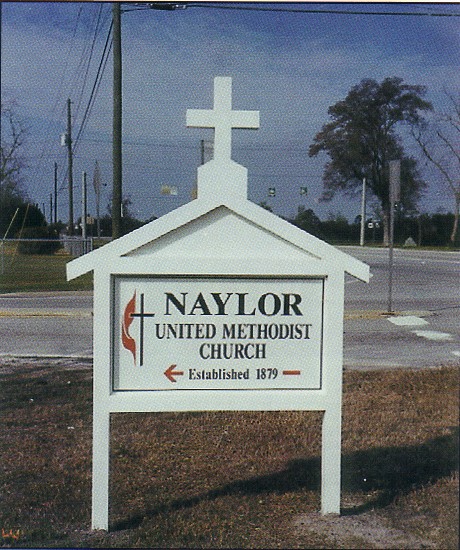
Church Sign for Naylor United Methodist Church

As I learn more about blogs and about this program, I will be able to start posting new items. Just yesterday I learned how to add a link to a post. Today I am attempting to learn how to add pictures to my posts.
For the record, the church sign at Naylor UMC was built by Mr. Robert Tomlinson, a faithful member of our congregation and a skilled woodworker.


******************************************************************
No Excuse Sunday
To make it possible for everyone to attend church next Sunday, we are going to have a special "No Excuse Sunday." Cots will be placed in the foyer for those who say, "Sunday is my only day to sleep in." There will be a special section with lounge chairs for those who feel that our pews are too hard. Eyedrops will be available for those with tired eyes from watching TV late Saturday night. We will have steel helmets for those who say, "The roof would cave in if I ever came to church." Blankets will be furnished for those who think the church is too cold and fans for those who say it is too hot. Scorecards will be available for those who wish to list the hypocrites present. Relatives and friends will be in attendance for those who can't go to church and cook dinner, too. We will distribute "Stamp Out Stewardship" buttons for those who feel that the church is always asking for money.
One section will be devoted to trees and grass for those who like to seek God in nature. Doctors and nurses will be in attendance for those who plan to be sick this Sunday. A big-screen TV will be set up in the fellowship hall for race fans who can't miss the opening flag of the Nascar Race. The Sanctuary will be decorated with Christmas poinsettas and Easter lilies for those who have never seen the church without them. We will provide hearing aids to those who can't hear the preacher and cotton for those who can.
Author Unknown (Printed in Chicken Soup for the Christian Soul)
No Excuse Sunday
To make it possible for everyone to attend church next Sunday, we are going to have a special "No Excuse Sunday." Cots will be placed in the foyer for those who say, "Sunday is my only day to sleep in." There will be a special section with lounge chairs for those who feel that our pews are too hard. Eyedrops will be available for those with tired eyes from watching TV late Saturday night. We will have steel helmets for those who say, "The roof would cave in if I ever came to church." Blankets will be furnished for those who think the church is too cold and fans for those who say it is too hot. Scorecards will be available for those who wish to list the hypocrites present. Relatives and friends will be in attendance for those who can't go to church and cook dinner, too. We will distribute "Stamp Out Stewardship" buttons for those who feel that the church is always asking for money.
One section will be devoted to trees and grass for those who like to seek God in nature. Doctors and nurses will be in attendance for those who plan to be sick this Sunday. A big-screen TV will be set up in the fellowship hall for race fans who can't miss the opening flag of the Nascar Race. The Sanctuary will be decorated with Christmas poinsettas and Easter lilies for those who have never seen the church without them. We will provide hearing aids to those who can't hear the preacher and cotton for those who can.
Author Unknown (Printed in Chicken Soup for the Christian Soul)
Thursday, May 13, 2004
Link to Rev. Dr. Bill Hinson's Talk
Try Clicking HERE to get to his address as mentioned in the earlier post.
Try Clicking HERE to get to his address as mentioned in the earlier post.
***********************************************************************
Splitting the Methodist Church
O.K. Time for me to weigh in on the big news from General Conference, which recently ended in Pittsburgh, PA. I have gotten some additional information from delegates to the event, and now know the true story in regards to the proposed split of the Methodist Church that was bandied about in the news media over the past week.
First, this was NOT an official call for a split and was not the result of a resolution offered on the floor. The mention of a split occurred at the annual breakfast of the Good News organization. Rev. Bill Hinson, the President of the Confessing Movement, suggested the possibility of a split in the future during his address at this breakfast. His comments were then reported on the media as an offical call for a split.
According to the information that I have been able to find, this comment by Rev. Hinson was based on the fact that liberals in the church are gaining more and more ground in pushing forth their homosexual agenda, primarily in two areas -- ordination of gay ministers and same-sex marriages. Rev. Hinson maintains, and I agree, that these views are not compatible with orthodox Christian doctrines or with the underlying doctrines of the United Methodist Church as outlined in our Book of Discipline. So, even though the delegates to General Conference soundly defeated attempts to push through homosexual resolutions this year, the threat is not going to go away.
Here is a direct quote from Rev. Hinson's address to the Good News breakfast attendees:
"We cannot fight both church and culture. Our culture alone confronts us with more challenges than we can humanly speaking confront and challenge. That struggle, combined with the continuous struggle in the church, is more than we can bear. And our people, who have been faithful and patient, should not have to continue to endure our endless conflict. I believe the time has come when we must begin to explore an amicable and just separation that will free us both from our cycle of pain and conflict. Such a just separation will protect the property rights of churches and the pension rights of clergy. It will also free us to reclaim our high calling and to fulfill our mission in the world. Therefore, let us like Paul and Barnabas, agree to go our separate ways."
Thoughts to think on. Jesus said that the world would know we were His through our love and our unity. However, unity cannot be based on false doctrine or incompatible teachings.
If you would like to read the entire address by Rev. Hinson, click on this link:
Splitting the Methodist Church
O.K. Time for me to weigh in on the big news from General Conference, which recently ended in Pittsburgh, PA. I have gotten some additional information from delegates to the event, and now know the true story in regards to the proposed split of the Methodist Church that was bandied about in the news media over the past week.
First, this was NOT an official call for a split and was not the result of a resolution offered on the floor. The mention of a split occurred at the annual breakfast of the Good News organization. Rev. Bill Hinson, the President of the Confessing Movement, suggested the possibility of a split in the future during his address at this breakfast. His comments were then reported on the media as an offical call for a split.
According to the information that I have been able to find, this comment by Rev. Hinson was based on the fact that liberals in the church are gaining more and more ground in pushing forth their homosexual agenda, primarily in two areas -- ordination of gay ministers and same-sex marriages. Rev. Hinson maintains, and I agree, that these views are not compatible with orthodox Christian doctrines or with the underlying doctrines of the United Methodist Church as outlined in our Book of Discipline. So, even though the delegates to General Conference soundly defeated attempts to push through homosexual resolutions this year, the threat is not going to go away.
Here is a direct quote from Rev. Hinson's address to the Good News breakfast attendees:
"We cannot fight both church and culture. Our culture alone confronts us with more challenges than we can humanly speaking confront and challenge. That struggle, combined with the continuous struggle in the church, is more than we can bear. And our people, who have been faithful and patient, should not have to continue to endure our endless conflict. I believe the time has come when we must begin to explore an amicable and just separation that will free us both from our cycle of pain and conflict. Such a just separation will protect the property rights of churches and the pension rights of clergy. It will also free us to reclaim our high calling and to fulfill our mission in the world. Therefore, let us like Paul and Barnabas, agree to go our separate ways."
Thoughts to think on. Jesus said that the world would know we were His through our love and our unity. However, unity cannot be based on false doctrine or incompatible teachings.
If you would like to read the entire address by Rev. Hinson, click on this link:
Monday, May 10, 2004
*****************************************************************
Methodist Church Affirms Its Unity
[From South Georgia Conference -- The Link]
On Friday, May 7, the General Conference overwhelmingly (95%)
approved a resolution expressing our intention to remain in Christian fellowship with one another even through difficult and painful decisions.
The full text of the resolution is below:
As United Methodists we remain in covenant with one another, even in the midst of disagreement, and reaffirm our commitment to work together for our common mission of making disciples of Jesus Christ throughout the world.
This action was in response to inaccurate and misleading news stories reporting a planned split within the United Methodist Church. While there were some informal and unofficial conversations earlier this week, neither the idea of separation nor a plan for separation had been presented on the floor of General Conference or considered in a legislative committee. We
remind you that only The General Conference can speak for the United Methodist Church.
For a detailed article, to download the Unity Resolution or to read the verbatim transcript of Unity Resolution, visit
http://www.sgaumc.com/General%20Conference/Day%2010article%205.htm. (Copy and paste into your browser)
Methodist Church Affirms Its Unity
[From South Georgia Conference -- The Link]
On Friday, May 7, the General Conference overwhelmingly (95%)
approved a resolution expressing our intention to remain in Christian fellowship with one another even through difficult and painful decisions.
The full text of the resolution is below:
As United Methodists we remain in covenant with one another, even in the midst of disagreement, and reaffirm our commitment to work together for our common mission of making disciples of Jesus Christ throughout the world.
This action was in response to inaccurate and misleading news stories reporting a planned split within the United Methodist Church. While there were some informal and unofficial conversations earlier this week, neither the idea of separation nor a plan for separation had been presented on the floor of General Conference or considered in a legislative committee. We
remind you that only The General Conference can speak for the United Methodist Church.
For a detailed article, to download the Unity Resolution or to read the verbatim transcript of Unity Resolution, visit
http://www.sgaumc.com/General%20Conference/Day%2010article%205.htm. (Copy and paste into your browser)
***********************************************************************
UNITY CONCERT!
The local contemporary singing group Unity will be in concert at Messiah Lutheran Church, 500 Baytree Avenue, Valdosta, on 22 May at 7:00 pm. This group performed at Naylor UMC this year and are a dynamic trio who have been gifted by God to bring forth His message through song. They have just released their first CD, and have been getting airplay on Benny Daniel's radio show. Everyone who has heard them expects great things from them.
Please keep this date in mind and share with all who might be interested.
UNITY CONCERT!
The local contemporary singing group Unity will be in concert at Messiah Lutheran Church, 500 Baytree Avenue, Valdosta, on 22 May at 7:00 pm. This group performed at Naylor UMC this year and are a dynamic trio who have been gifted by God to bring forth His message through song. They have just released their first CD, and have been getting airplay on Benny Daniel's radio show. Everyone who has heard them expects great things from them.
Please keep this date in mind and share with all who might be interested.
Sunday, May 09, 2004
**************************************************************
PROTESTANT PASTORS REVEAL BIBLE PREFERENCES
[From Pastors Weekly Briefing, Focus on the Family]
A survey of Protestant ministers finds the New International
Version translation of the Bible is the most popular among pastors
(31%). The poll, conducted by Ellison Research, found that other
personal favorites included the King James Version (23%), New Revised
Standard Version (14%), New King James Version (13%) and New American
Standard Version (10%).
According to the research, ministers tend to select their favorite
versions based on perceived accuracy (40%), readability (16%),
language style (14%) and solid reputation (13%).
Pastors of small churches, those over 60 years of age and those in
the South lean toward the King James Version. The New International
Version is strongest in the Midwest and West, while the New Revised
Standard Version scored best in the Northeast.
When asked which Bible versions they would be least likely to
recommend to their congregations, they listed the Living Bible (26%),
Today's New International Version (18%), The Message (15%) and the
King James Version (15%).
NOTE: I would concur with this list wholeheartedly. I prefer the NIV because I think it is accurate and is the easiest to read and understand. I also do not recommend paraphrases to the congregation such as the Living Bible or The Message for Bible study or Sunday morning worship. These paraphrases are good when used in concert with a good translation (such as the NIV), but offer too much bias and writer-interpretation to gain an accurate understanding of passages.
PROTESTANT PASTORS REVEAL BIBLE PREFERENCES
[From Pastors Weekly Briefing, Focus on the Family]
A survey of Protestant ministers finds the New International
Version translation of the Bible is the most popular among pastors
(31%). The poll, conducted by Ellison Research, found that other
personal favorites included the King James Version (23%), New Revised
Standard Version (14%), New King James Version (13%) and New American
Standard Version (10%).
According to the research, ministers tend to select their favorite
versions based on perceived accuracy (40%), readability (16%),
language style (14%) and solid reputation (13%).
Pastors of small churches, those over 60 years of age and those in
the South lean toward the King James Version. The New International
Version is strongest in the Midwest and West, while the New Revised
Standard Version scored best in the Northeast.
When asked which Bible versions they would be least likely to
recommend to their congregations, they listed the Living Bible (26%),
Today's New International Version (18%), The Message (15%) and the
King James Version (15%).
NOTE: I would concur with this list wholeheartedly. I prefer the NIV because I think it is accurate and is the easiest to read and understand. I also do not recommend paraphrases to the congregation such as the Living Bible or The Message for Bible study or Sunday morning worship. These paraphrases are good when used in concert with a good translation (such as the NIV), but offer too much bias and writer-interpretation to gain an accurate understanding of passages.
Sunday, May 02, 2004
****************************************************************
On Vacation!
Just a note to let anyone reading this know that we will be in Washington, D.C. for the following week. We will be back next Sunday, and will start reposting to the blog then.
If you have been visiting to keep up with the proceedings at General Conference, try contacting the MethoBlog at: http://www.methoblog.blogspot.com/
See you on May 10th!
On Vacation!
Just a note to let anyone reading this know that we will be in Washington, D.C. for the following week. We will be back next Sunday, and will start reposting to the blog then.
If you have been visiting to keep up with the proceedings at General Conference, try contacting the MethoBlog at: http://www.methoblog.blogspot.com/
See you on May 10th!
Subscribe to:
Posts (Atom)